


International biotech company Roche Pharmaceuticals and Medical Excellence Taiwan (MET) yesterday announced the launch of the Asia Pacific Hub for Rare Disease Innovation and Treatment, signing a letter of intent under the witness of the Ministry of Health and Welfare.
The hub would integrate Taiwan’s expertise to provide people with rare genetic diseases, such as spinal muscular atrophy and Duchenne muscular dystrophy, access to advanced technologies, clinical expertise and emerging treatments, including gene therapies.
The initiative also aligns with Taiwan’s updated New Southbound Policy, expanding the country’s medical and healthcare collaboration across Southeast Asia and positioning Taiwan as a regional center for pioneering clinical research and treatment.
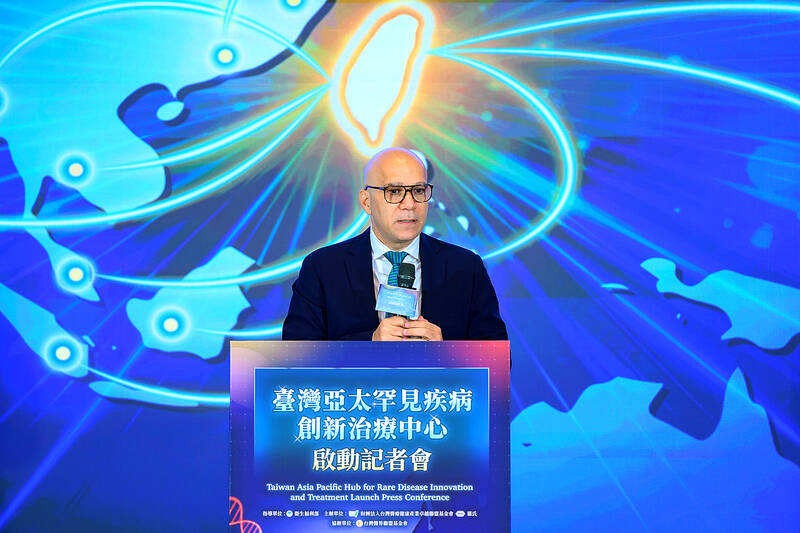
Photo courtesy of Medical Excellence Taiwan
Roche, one of the world’s largest biotech companies, has worked with local partners in Taiwan over the past three years to advance more than 60 clinical trials, publish more than 40 international scientific papers and provide care to more than 700 patients Roche Taiwan general manager Diana Liu (劉寒青) said.
The company has long maintained that “rare diseases are not rare,” with more than 7,000 conditions worldwide affecting approximately 400 million people, about half of whom are children, she added.
The agreement was signed at a news conference in Taipei attended by Minister of Health and Welfare Shih Chung-liang (石崇良), Democratic Progressive Party Legislator Wang Cheng-hsu (王正旭) and representatives from leading medical institutions, including National Taiwan University Hospital and Chang Gung Memorial Hospital.
Roche Pharmaceuticals Asia-Pacific area head Ahmed Elhusseiny also attended.
Taiwan was selected as the Asia-Pacific hub to be a “center of excellence” due to its strong track record in rare disease care and excellent reputation within the region, Elhusseiny said.
Roche often selects Taiwan for clinical trials due to its high level of clinical expertise and professionals who can provide the highest quality of scientific data, he added.
Taiwan also has a comprehensive legal framework, supported by more than two decades of experience in building a mature ecosystem for care of rare diseases.
Newborn screening is critical to the treatment of rare genetic conditions, enabling families to begin targeted therapies that alter the genetic makeup of their child as early as possible, to accompany the child’s natural development timeline and improve long-term outcomes, Elhusseiny said.
Taiwan provides newborn screening across the board, with a coverage rate of more than 99 percent, making it one of the most comprehensive programs in the world.
Thanks to the new Asia-Pacific hub, parents who discover through newborn screening that their child carries a rare genetic disease can access therapies, clinical expertise and the latest treatments and technologies, he said.
Patients with rare diseases often face challenges such as long diagnostic pathways and difficulties in accessing treatment resources.
Moreover, one of the main challenges in addressing such diseases is that they are, by definition, rare and some do not yet have targeted therapeutics as the science is not yet advanced enough to treat them, he added.
However, Elhusseiny said he remains optimistic that technological and scientific advances would continue to develop new treatments and provide more therapies for a wider range of conditions.
For Roche, success is measured by their “incredible patient stories,” he said, with case studies of babies who receive early intervention and treatment growing up to become “healthy adults and have wonderful lives.”
This latest collaboration aims to create the right conversations in Taiwan and around the world of what it means to be able to provide an exceptionally high level of care and access for patients of rare genetic diseases and their families, he said.
These medicines are adding incredible value to patients’ lives, he added.
Meanwhile, the Ministry of Health and Welfare said that it would continue to promote institutional alignment and deepen cooperation, transforming Taiwan’s medical strengths into an important force for advancing regional health equity.

NATIONAL SECURITY: Authorities are working to confirm the identities of the military personnel involved and investigating possible illegal conduct and regulatory violations Authorities are probing possible national security implications after Kinmen police and immigration officers on Sunday found a Chinese woman allegedly posing as a tourist while engaging in prostitution involving more than 10 military personnel. The woman, surnamed Chen (陳), has since been deported, authorities said, adding that investigators are still working to confirm the identities of those implicated, as the records only listed code names and aliases. The case stemmed from a report received by the Kinmen District Prosecutors’ Office on Friday last week from the Jinhu Precinct of the Kinmen County Police Bureau. On Sunday, police, along with the National Immigration

REASONS FOR TRAVEL: An assistant professor said that proposed amendments to penalize drivers if they used drugs overseas would not deter people from traveling People who operate a motor vehicle under the influence of marijuana would have their driver’s license revoked, even if they used the substance while overseas, the Ministry of Transportation and Communications said yesterday, citing proposed amendments to the Road Traffic Management and Penalty Act (道路交通管理處罰條例). The amendments would also authorize the government to revoke the licenses of people determined to have used Category 1 or Category 2 narcotics, even if they were not operating a vehicle while under the influence of drugs, as well as ban them from taking the license test for three years, the ministry said. People aged 18 or

GLOBALGIVING: ‘ Caving to external pressure is not acceptable for an organization that has cultivated justice reform and human rights for 30 years,’ one NGO said A slew of non-government organizations (NGOs) have withdrawn from the GlobalGiving fundraising platform after it announced it would use “Chinese Taipei” instead of “Taiwan” from next month. The Taiwan Good Rice Association wrote on Facebook on Friday that it was informed on April 28 via a teleconference call of the change, which was made because the platform wanted to operate in China. Taiwan Good Rice is to terminate all cooperative relationships with GlobalGiving in response to the platform’s “unilateral and non-negotiable” decision to remove references to Taiwan, the NGO said. “Taiwan is in the official name of Taiwan Good Rice Association and the

HEAVY WEATHER: Typhoon Jangmi is due to crash straight into the Ryukyus as airlines look to shift flights to larger aircraft or cancel flights to Okinawa entirely Taiwan’s international air carriers announced flight adjustments over the weekend as Typhoon Jangmi is forecast to hit the Ryukyu Islands today and tomorrow. The Central Weather Administration (CWA) upgraded Jangmi from a tropical storm to a typhoon at 8am yesterday, with the eye located 580km south of Naha city. It was moving north at 19kph. Today, China Airlines’ CI-120, CI-121, CI-122 and CI-123 flights between Taoyuan and Naha, Okinawa, have been canceled as well as CI-132 and CI-133 between Kaohsiung and Naha. EVA Air’s BR-112, BR-113, BR-186 and BR-185 flights between Taoyuan and Naha are also canceled. Low-cost carrier Tigerair Taiwan canceled IT-230,


 RSS
RSS