

A standoff between the Chinese Nationalist Party (KMT) and the Ministry of Culture yesterday escalated after Public Television Service (PTS) chairman Hu Yuan-hui (胡元輝) was asked to leave a legislative committee meeting.
Before the session of the Education and Culture Committee began, Hu left the room at the request of KMT Legislator Lo Chih-chiang (羅智強), who said that Hu, whose term ended in May last year, was no longer PTS chair.
Amendments to the Public Television Act (公共電視法), which abolish provisions allowing PTS board members to remain in office after their terms expire, had already cleared the legislature and were promulgated by President Willaim Lai (賴清德) on Feb. 4, Lo said.
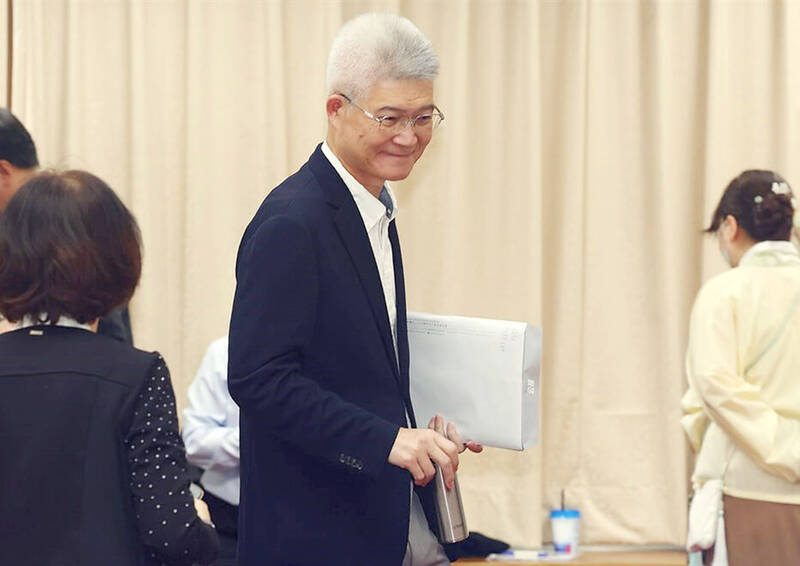
Photo: CNA
The move was not directed at Hu personally, but concerned legislative principle and respect for laws promulgated by the president, Lo said.
Outside the meeting room, Hu told reporters that because the act does not explicitly state what should happen when an outgoing board’s term expires, the Foundations Act (財團法人法) provided legal grounds for his continued tenure as chair of Taiwan’s only public broadcaster.
Article 40 of the Foundations Act states that directors shall continue performing their duties until newly appointed directors take office if replacements are not appointed “in a timely manner” after their terms expire.
Under the Public Television Act, the PTS board comprises 11 to 15 directors and three to five supervisors. All must be approved by a review committee made up of public figures nominated proportionally by legislative parties, with a two-thirds majority required for approval.
On Dec. 17 last year, the ministry announced 14 directors and five supervisor nominees, but only four director candidates were approved at the first review meeting on Dec. 31, which was insufficient to constitute the board.
On March 12, the ministry released a second list of nominees for the eighth board of directors. However, before another review meeting could be held, eight opposition-nominated members of the 15-member review committee withdrew on April 9, leaving the meeting without the quorum required to conduct the review.
They said that Minister of Culture Li Yuan (李遠) had ignored a long-standing convention followed by previous ministers of consulting all political parties on potential nominees.
Li yesterday protested Hu’s removal from the room, saying that requiring interparty negotiations to form the board would contravene the principle of keeping political parties, the government and the military out of public media.
The deadlock over the PTS board election had dragged on for too long, and all sides hoped the process could be completed as soon as possible, KMT Legislator Ko Chih-en (柯志恩) said.
She also urged Li not to become disconnected from public opinion.
“Political negotiation” can take many forms and viewing the issue in overly simplistic terms would not help resolve it, Ko said.


Minister of Health and Welfare Shih Chung-liang (石崇良) yesterday praised fans of South Korean boy band BTS for turning chance encounters with their idols into charitable donations, while urging them to check that the charities receiving their donations are legally registered. Shih described the fan-driven charity trend as “a wonderful thing that deserves encouragement.” With BTS returning to Taiwan for concerts in Kaohsiung this past weekend, local fans have taken to social media to encourage one another to practice so-called “sea turtle-style stanning” — treating the idols like protected sea turtles by admiring them from a respectful distance rather than

NEW IDEAS: The drills, which appeared to be part of this year’s ‘All-Military Strategic Exercise,’ used civilian resources to improvise landing infrastructure, a source said China is staging a weeks-long amphibious landing drill in the province facing Taiwan, testing a new method to land troops ashore by linking civilian vessels into a makeshift floating bridge, satellite images and a research report showed. The exercise, in Dacheng Bay in China’s southeastern province of Fujian, was first spotted on Nov. 1, satellite images and a report by geospatial data company ingeniSPACE showed. “The [Chinese] People’s Liberation Army [PLA] appeared to be rehearsing low-signature methods to provide logistical support to forces that could be involved in a First Island Chain invasion scenario,” said the company’s chief operating officer, Jason Wang.

Taiwanese actor Liu Kuan-ting (劉冠廷) won best leading actor at the Golden Horse Awards yesterday for his portrayal of a groom attempting to stage two weddings in Double Happiness (雙囍). Liu, 38, beat four other nominees to win his first Golden Horse leading actor award on his second nomination in the category. The 63rd edition of the awards was held at the Taipei Music Center. The other nominees were Leon Dai (戴立忍) for Kung Fu (功夫), Yeung Wai-lun (楊偉倫) for We Are Born Good (善男信女), Ethan Juan (阮經天) for Arrested Memory (狂忘警探) and Jack Tan (陳澤耀) for Dead Tide

Lithuania has threatened to revoke the legal status of Taiwan’s representative office in Vilnius as the Baltic country seeks to mend its fraught ties with China. The government has the authority to act unilaterally if Taipei refuses to change the office’s name, which currently refers to it as Taiwanese, President Gitanas Nauseda said yesterday. Prime Minister Mindaugas Sinkevicius said he is considering revoking the office’s status, though would prefer an agreement. The escalation in rhetoric is a sign of Lithuania’s growing frustration with Taiwan as the Baltic nation seeks to resolve the issue that has marred its diplomatic and economic relations with


 RSS