


More than 1,000 nurses yesterday protested outside the Ministry of Health and Welfare in Taipei, handing in a petition demanding that a proposed nurse-to-patient ratio system be codified into law after two years of promises.
The system would set minimum nurse-to-patient ratios for day, evening and night shifts at medical centers and hospitals, which would prevent nurses from being overworked, guarantee adequate staffing levels and protect patient safety, they said.
Department of Nursing and Healthcare Director-General Tsai Shu-feng (蔡淑鳳) accepted the petition and promised that the ministry would meet on Friday to discuss the legislative timeline and related measures.
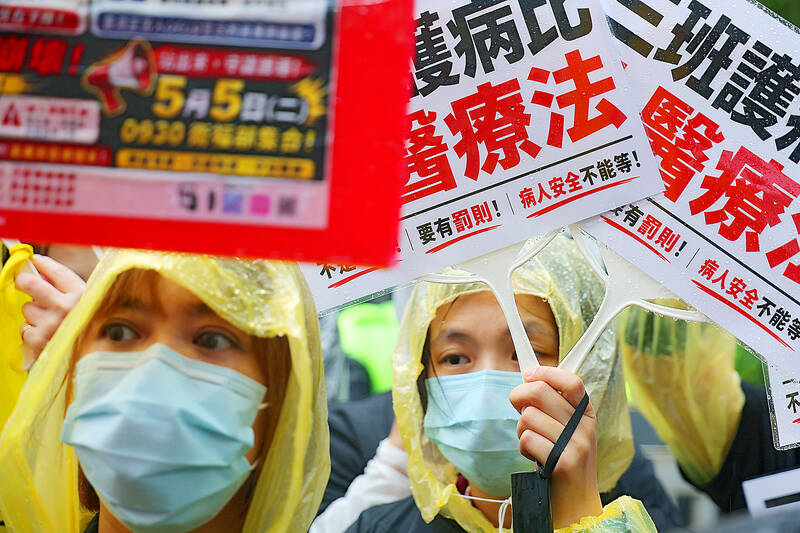
Photo: CNA
Minister of Health and Welfare Shih Chung-liang (石崇良) later held a closed-door meeting with representatives from the groups, during which he said that a draft amendment would be released as early as Tuesday next week, on International Nurses Day.
When he took office, President William Lai (賴清德) promised that a three-shift nurse-to-patient ratio system would be codified into law during his first two years.
In July 2024, the Executive Yuan approved a 12-point plan to address nursing shortages that included retention and night-shift incentives, an overhaul of the work environment and the implementation of standard three-shift nurse-to-patient ratios per shift.
The measures were expected to be codified into law within two years and would require four years to be fully implemented.
Nursing groups yesterday stood outside the ministry holding signs and chanting protest slogans, accusing the government of changing its proposals and standards.
The ministry has allocated NT$6 billion (US$189.84 million) annually to the program since 2024, showing that the government has adequate funding to move the proposal forward, Taiwan Union of Nurses Association president Chen Li-chin (陳麗琴) said.
The delay shows a disregard for patient safety and quality of care, she said.
While the nursing community can understand the need for a “buffer period,” it cannot accept policy stagnation, Chen said.
Only by legislating the standard promptly and incorporating penalties can it truly protect nurses and patients, she added.
The nursing groups proposed three demands.
First, the government should immediately revise the Establishment Standards for Medical Institutions (醫療機構設置標準) and implement the new ratio system by May 20, they said.
Second, the ministry should draft an amendment to be submitted to the Cabinet, revising Article 12 of the Medical Care Act (醫療法) to codify the three-shift nurse-to-patient ratio into law, they said.
Last, the government should amend Article 102 of the act to introduce reasonable penalties and establish an enforcement mechanism to act as a deterrent, they added.
According to a report last year by the Organisation for Economic Co-operation and Development (OECD), Taiwan has 7.29 hospital beds per 1,000 people, far above the OECD average of 4.3 and up to 2.5 times the level in Europe and the US, the groups said.
Taiwan does not lack beds, but struggles to retain nursing staff, they said.
Once the ministry finalizes the details, the legislation would enter a 60-day public notice period before official promulgation, although the ministry would try to expedite the process for formal publication by the end of July, Shih said.
Hospitals would then have a two-year buffer period before enforcement, he added.

NATIONAL SECURITY: Authorities are working to confirm the identities of the military personnel involved and investigating possible illegal conduct and regulatory violations Authorities are probing possible national security implications after Kinmen police and immigration officers on Sunday found a Chinese woman allegedly posing as a tourist while engaging in prostitution involving more than 10 military personnel. The woman, surnamed Chen (陳), has since been deported, authorities said, adding that investigators are still working to confirm the identities of those implicated, as the records only listed code names and aliases. The case stemmed from a report received by the Kinmen District Prosecutors’ Office on Friday last week from the Jinhu Precinct of the Kinmen County Police Bureau. On Sunday, police, along with the National Immigration

GLOBALGIVING: ‘ Caving to external pressure is not acceptable for an organization that has cultivated justice reform and human rights for 30 years,’ one NGO said A slew of non-government organizations (NGOs) have withdrawn from the GlobalGiving fundraising platform after it announced it would use “Chinese Taipei” instead of “Taiwan” from next month. The Taiwan Good Rice Association wrote on Facebook on Friday that it was informed on April 28 via a teleconference call of the change, which was made because the platform wanted to operate in China. Taiwan Good Rice is to terminate all cooperative relationships with GlobalGiving in response to the platform’s “unilateral and non-negotiable” decision to remove references to Taiwan, the NGO said. “Taiwan is in the official name of Taiwan Good Rice Association and the
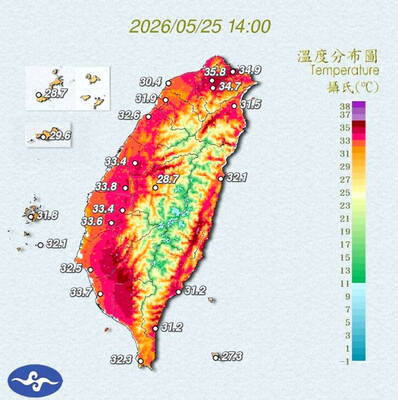
STAY COOL: The HPA recommended that people stay hydrated, use air-conditioning or fans while indoors, wear loose-fitting clothes and walk in the shade while outdoors Employers must implement measures such as installing cooling equipment, and providing drinking water and rest breaks for outdoor workers starting from Monday next week, the Taipei Department of Labor said on Sunday. Employers who fail to comply could face fines of NT$30,000 to NT$300,000 under the Occupational Safety and Health Act (職業安全衛生法), the department said. Businesses in Taipei employing fewer than 100 workers, as well as registered self-employed workers with labor insurance coverage, could receive on-site assessments and guidance from occupational safety consultants to help them apply for central government subsidies to implement or improve heat-protection measures, it said. Under the Ministry of

HEAVY WEATHER: Typhoon Jangmi is due to crash straight into the Ryukyus as airlines look to shift flights to larger aircraft or cancel flights to Okinawa entirely Taiwan’s international air carriers announced flight adjustments over the weekend as Typhoon Jangmi is forecast to hit the Ryukyu Islands today and tomorrow. The Central Weather Administration (CWA) upgraded Jangmi from a tropical storm to a typhoon at 8am yesterday, with the eye located 580km south of Naha city. It was moving north at 19kph. Today, China Airlines’ CI-120, CI-121, CI-122 and CI-123 flights between Taoyuan and Naha, Okinawa, have been canceled as well as CI-132 and CI-133 between Kaohsiung and Naha. EVA Air’s BR-112, BR-113, BR-186 and BR-185 flights between Taoyuan and Naha are also canceled. Low-cost carrier Tigerair Taiwan canceled IT-230,


 RSS
RSS