


China could use data collected by the Amap (高德地圖) app against Taiwan, a Institute for National Defense and Security Research expert warned yesterday.
The China-based application provides 3D street views and even shows traffic signal countdown timers in parts of Taiwan.
The Ministry of Digital Affairs has said that government agencies are banned from using Amap, as it poses a threat to cybersecurity, adding that it would conduct a cybersecurity assessment of the app.
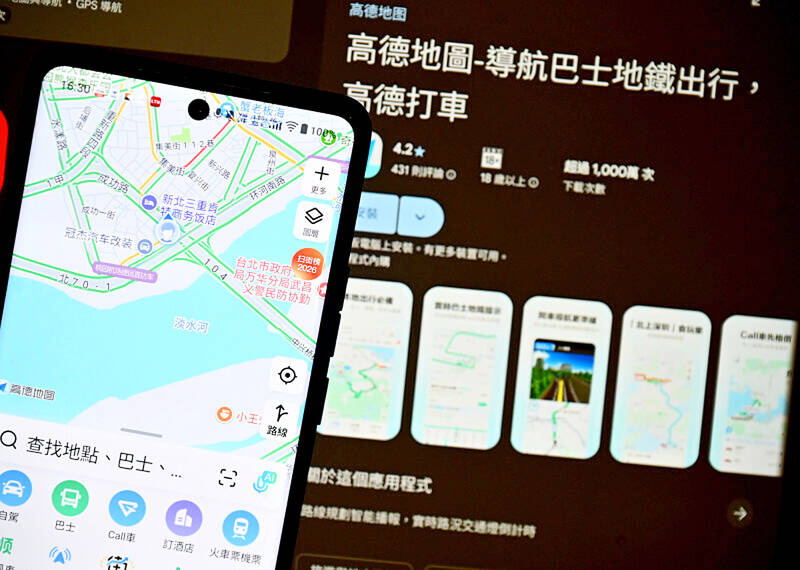
Photo: Wang Yi-sung, Taipei Times
In an article titled “Legal and National Security Risks of Data Collection by Amap” (高德地圖數據蒐集之法律與國安風險), Alice Yang (楊長蓉), an assistant research fellow at the institute, said that global positioning software no longer functions solely as a navigation tool.
Such software can be used as a comprehensive intelligence-gathering platform, that collects coordinates, real-time movement and traffic patterns, Yang said in the article, which was published on the institute’s Web site.
Even if Amap was not linked to any Chinese government databases, the data it collects could be turned into useful intelligence by analyzing operating modes of traffic signals and infrastructure, as well as collective activity patterns, she said.
For example, a French Navy officer inadvertently exposed the location of the Charles de Gaulle aircraft carrier by recording their running activity on the Strava app, Yang said.
The example demonstrates that software-based de-identification has limited effectiveness, as most items can be re-identified using only a few spatiotemporal data points, she said.
Gauging the cybersecurity risk of an app by solely looking at whether it was funded by Chinese investors is insufficient, Yang said, adding that the focus should be on whether app regulation should be the jurisdiction of national security and intelligence authorities.
China’s National Intelligence Law stipulates that all Chinese organizations and citizens are obligated to support, assist and cooperate with Beijing’s intelligence operations, she said, adding that the law applies to corporations founded and operating in China, as well as China-linked organizations and personnel in other countries.
The government might misjudge the risk to Taiwan’s security from an app if it focuses solely on where the money came from to develop it, she said.
Chinese law says that Beijing can access data collected by private companies without independent oversight, she said.
Taipei would not be able to effectively supervise or restrict the use of such data, nor require that it be deleted once transferred overseas, she added.
“In the long run, data that are seemingly risk-free could be turned into a strategic asset China uses against Taiwan,” Yang said.
Amap should be treated as a national security issue, not a personal data risk, she added.

The Ministry of Finance this afternoon announced the winning numbers for the March-April uniform invoice lottery. The winning number for the NT$10 million (US$318,060) special prize is 19531471, and the winning number for the NT$2 million grand prize is 85941329. Three numbers were drawn for the NT$200,000 first prize: 07225810, 20231230 and 83518781. Those with receipts matching the last seven digits of any of the first-prize numbers will win the NT$40,000 second prize, while those matching the last six digits will win the NT$10,000 third prize. Those whose receipts match the last five digits of the first-prize numbers can claim the NT$4,000 fourth prize,

SIX SUBSIDIES: The monthly allowance for older farmers is to increase to NT$10,000, and NT$5,000 is to be given to homemakers under the national pension system, Lai said The government is to implement major welfare policies for disadvantaged groups, including raising the monthly allowance for older farmers to NT$10,000 and providing homemakers with NT$5,000 per month, President William Lai (賴清德) said yesterday. Lai made the remarks during a visit to Wangling Temple in Chiayi County, saying that the planned increases were being introduced amid economic growth and an increase in tax revenue. Touting a policy, in which the government plans to provide a monthly allowance of NT$5,000 for every child under the age of 18 in a bid to address Taiwan’s low birthrate, Lai said that if received for the
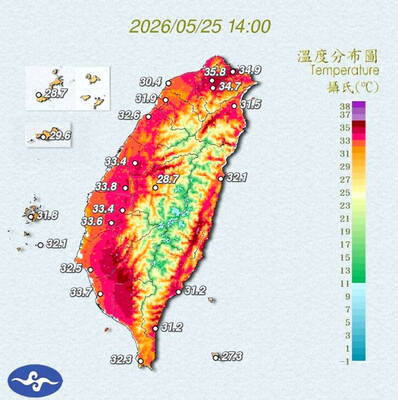
STAY COOL: The HPA recommended that people stay hydrated, use air-conditioning or fans while indoors, wear loose-fitting clothes and walk in the shade while outdoors Employers must implement measures such as installing cooling equipment, and providing drinking water and rest breaks for outdoor workers starting from Monday next week, the Taipei Department of Labor said on Sunday. Employers who fail to comply could face fines of NT$30,000 to NT$300,000 under the Occupational Safety and Health Act (職業安全衛生法), the department said. Businesses in Taipei employing fewer than 100 workers, as well as registered self-employed workers with labor insurance coverage, could receive on-site assessments and guidance from occupational safety consultants to help them apply for central government subsidies to implement or improve heat-protection measures, it said. Under the Ministry of

NATIONAL SECURITY: Authorities are working to confirm the identities of the military personnel involved and investigating possible illegal conduct and regulatory violations Authorities are probing possible national security implications after Kinmen police and immigration officers on Sunday found a Chinese woman allegedly posing as a tourist while engaging in prostitution involving more than 10 military personnel. The woman, surnamed Chen (陳), has since been deported, authorities said, adding that investigators are still working to confirm the identities of those implicated, as the records only listed code names and aliases. The case stemmed from a report received by the Kinmen District Prosecutors’ Office on Friday last week from the Jinhu Precinct of the Kinmen County Police Bureau. On Sunday, police, along with the National Immigration


 RSS
RSS