


Taiwan Taoyuan International Airport has strong potential to become a major transfer hub between Southeast Asia and North America, but still faces constraints in route diversity, airline density and terminal capacity, experts said.
Taoyuan handled 22.1 percent of the 9.82 million passengers traveling from Southeast Asia to nine destinations in North America directly connected to the airport, the Institute of Transportation under the Ministry of Transportation and Communications said in a report released in March.
The figure was second only to Incheon International Airport’s 23.6 percent and ahead of rivals including Tokyo’s Haneda and Narita airports and Hong Kong International Airport, the report said.
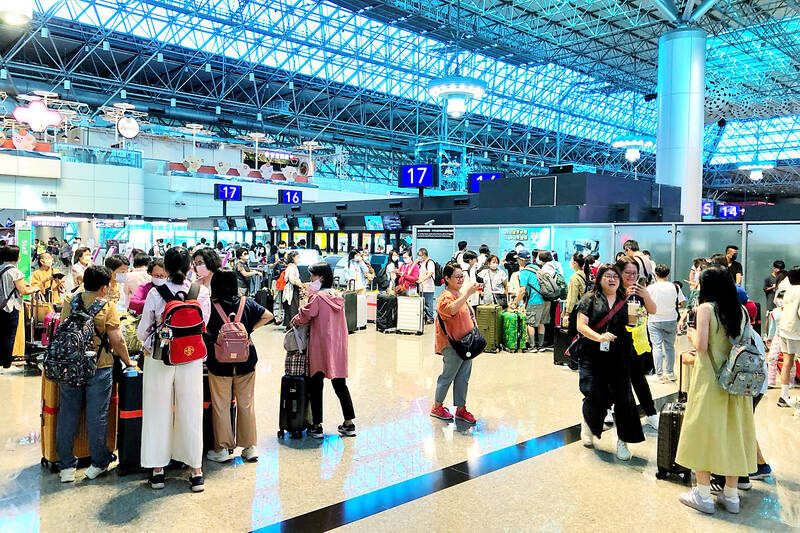
Photo: CNA
However, Hwang Tay-lin (黃泰林), a professor of aviation management at Chang Jung Christian University, said that transfer passengers account for only about 15 percent of total traffic at Taoyuan Airport.
Compared with established hubs such as Singapore Changi, Incheon and Hong Kong, Taoyuan still lags in route diversity, airline density and terminal capacity, he said.
Nevertheless, he said airlines are more likely to expand their destination networks once passenger volumes reach a larger scale.
Providence University tourism professor Huang Cheng-tsung (黃正聰) said Taoyuan remains attractive to transfer passengers, particularly compared with more congested hubs such as Hong Kong and Singapore Changi.
The expected completion of Terminal 3 and a third runway would increase capacity by about 50 percent, improving service quality and competitiveness, Huang said.
From an airline perspective, EVA Air sees Taiwan’s geographic position as a key advantage.
Chung Kai-cheng (鍾凱成), executive vice president of EVA Air’s corporate planning division, said that Taiwan sits at the heart of East Asia and serves as a natural hub linking North America with the region.
Flights between Taiwan and North America typically take 11 to 16 hours, while flights to major Southeast Asian cities are generally under four hours, he said.
That allows for transfer times of about two to four hours, giving passengers enough time to rest before continuing long-haul journeys, he said.
Chung added that Taiwan’s advanced semiconductor industry is also driving business travel demand between Taiwan and the US, with spillover effects extending to Southeast Asia.
Airlines are already moving to capitalize on that potential by expanding their networks.
EVA Air is set to launch direct flights to Washington in July, while Starlux Airlines is to begin direct service to Prague in August, its first European destination.
Starlux chief strategy officer Simon Liu (劉允富) said that Prague was chosen for its central location in Europe, offering connections to Germany, Austria and Poland, while also growing in popularity among Taiwanese travelers.
Liu said demand for business travel is expected to grow as Taiwan strengthens economic and technological ties with the Czech Republic.
He said that Taiwan Semiconductor Manufacturing Co’s first European fab, now under construction in Dresden, Germany, along with other technology firms expanding into the region, is expected to help create a semiconductor cluster in Central Europe.
Liu added that Prague currently has direct air links to only four Asian cities: Beijing, Seoul, Tokyo and Taipei.
Through flight scheduling, Starlux expects to attract connecting passengers from Southeast Asia, Japan, South Korea, Hong Kong and Macau via Taipei, with transfer travelers projected to account for about 20 percent of traffic on the Prague route, he said.
Government officials also see strong growth ahead.
Chen Chao-yu (陳昭諭), a division chief at the Civil Aviation Administration, said Taiwan’s international passenger traffic is projected to reach a record 62 million this year, driven by fleet expansion, increased transfer traffic between North America and Southeast Asia and additional routes by foreign carriers.
Tourism Administration Deputy Director Huang Ho-ting (黃荷婷) said increasing flight volume is crucial for Taiwan’s tourism sector, adding that more than 94 percent of visitors arrive by air.
To further attract transit passengers, the agency plans to introduce half-day transit incentives aimed at encouraging stopovers and stimulating airport-area businesses, she said.

The Ministry of Finance this afternoon announced the winning numbers for the March-April uniform invoice lottery. The winning number for the NT$10 million (US$318,060) special prize is 19531471, and the winning number for the NT$2 million grand prize is 85941329. Three numbers were drawn for the NT$200,000 first prize: 07225810, 20231230 and 83518781. Those with receipts matching the last seven digits of any of the first-prize numbers will win the NT$40,000 second prize, while those matching the last six digits will win the NT$10,000 third prize. Those whose receipts match the last five digits of the first-prize numbers can claim the NT$4,000 fourth prize,

SIX SUBSIDIES: The monthly allowance for older farmers is to increase to NT$10,000, and NT$5,000 is to be given to homemakers under the national pension system, Lai said The government is to implement major welfare policies for disadvantaged groups, including raising the monthly allowance for older farmers to NT$10,000 and providing homemakers with NT$5,000 per month, President William Lai (賴清德) said yesterday. Lai made the remarks during a visit to Wangling Temple in Chiayi County, saying that the planned increases were being introduced amid economic growth and an increase in tax revenue. Touting a policy, in which the government plans to provide a monthly allowance of NT$5,000 for every child under the age of 18 in a bid to address Taiwan’s low birthrate, Lai said that if received for the
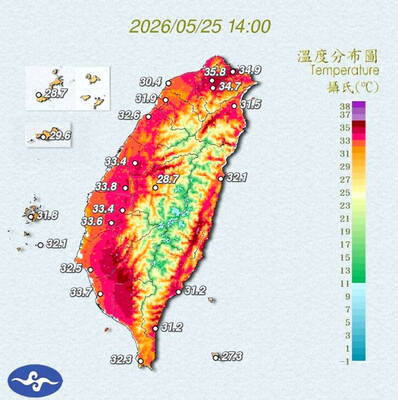
STAY COOL: The HPA recommended that people stay hydrated, use air-conditioning or fans while indoors, wear loose-fitting clothes and walk in the shade while outdoors Employers must implement measures such as installing cooling equipment, and providing drinking water and rest breaks for outdoor workers starting from Monday next week, the Taipei Department of Labor said on Sunday. Employers who fail to comply could face fines of NT$30,000 to NT$300,000 under the Occupational Safety and Health Act (職業安全衛生法), the department said. Businesses in Taipei employing fewer than 100 workers, as well as registered self-employed workers with labor insurance coverage, could receive on-site assessments and guidance from occupational safety consultants to help them apply for central government subsidies to implement or improve heat-protection measures, it said. Under the Ministry of

NATIONAL SECURITY: Authorities are working to confirm the identities of the military personnel involved and investigating possible illegal conduct and regulatory violations Authorities are probing possible national security implications after Kinmen police and immigration officers on Sunday found a Chinese woman allegedly posing as a tourist while engaging in prostitution involving more than 10 military personnel. The woman, surnamed Chen (陳), has since been deported, authorities said, adding that investigators are still working to confirm the identities of those implicated, as the records only listed code names and aliases. The case stemmed from a report received by the Kinmen District Prosecutors’ Office on Friday last week from the Jinhu Precinct of the Kinmen County Police Bureau. On Sunday, police, along with the National Immigration


 RSS
RSS