


Democratic Progressive Party (DPP) lawmakers have proposed amendments to the National Intelligence Services Act (國家情報工作法) to define “cognitive warfare” and empower countermeasures against foreign influence.
“Doubts about the US” and “doubts about the military” are recurring manufactured narratives used by the Chinese Communist Party, the National Security Bureau said earlier this year.
DPP lawmakers such as Lin I-chin (林宜瑾), Hsu Chih-chieh (許智傑) and Chen Pei-yu (陳培瑜) jointly proposed draft amendments to articles 3, 5 and 13-1 of the act that would define “cognitive warfare” as “the act of foreign or hostile forces using artificial intelligence [AI], information technology, or other means to spread false or misleading information, with the intent to disrupt government functions, social stability or the constitutional order of freedom and democracy.”

Photo: Bloomberg
Intelligence work might include preventing the use of AI in cognitive warfare, generating false information or manipulating public opinion, the amendment for Article 5 said.
Intelligence agencies might also have to use AI to analyze threats, provided that the data is anonymous, it added.
The use of AI would be regulated to ensure that it does not infringe on people’s rights, the draft said, adding that the guidelines would be established by competent authorities in consultation with intelligence agencies.
The intelligence authority should regularly organize AI and digital security training to enhance the capability of intelligence personnel in countering cognitive warfare, the draft said.
Critical information is largely controlled by Internet service providers, so without their cooperation, intelligence agencies would have difficulty in quickly identifying abnormal information flows and recognizing cognitive warfare activities, making it challenging to effectively identify and respond to threats, it said.
Therefore, “businesses providing Internet services should cooperate by offering necessary assistance within the scope required to safeguard national security interests when intelligence agencies are carrying out intelligence work,” it said, adding that the details and procedures for such cooperation would be established by the competent authorities.
If a service provider becomes aware that foreign hostile forces are using its platform to carry out cognitive warfare, they should, upon notification from intelligence agencies, provide related data and algorithm parameters, and undertake countermeasures such as restricting access or removing content to block the activity, the draft said.
Foreign hostile forces are employing “hybrid warfare,” using AI to generate vast amounts of realistic misinformation, and engaging in “data pollution” and “cognitive manipulation” to target nations, it said.
The impact of these tactics is as significant as traditional military attacks, it said, adding that to effectively counter digital cognitive warfare, intelligence agencies must be equipped with a solid legal foundation.

NATIONAL SECURITY: Authorities are working to confirm the identities of the military personnel involved and investigating possible illegal conduct and regulatory violations Authorities are probing possible national security implications after Kinmen police and immigration officers on Sunday found a Chinese woman allegedly posing as a tourist while engaging in prostitution involving more than 10 military personnel. The woman, surnamed Chen (陳), has since been deported, authorities said, adding that investigators are still working to confirm the identities of those implicated, as the records only listed code names and aliases. The case stemmed from a report received by the Kinmen District Prosecutors’ Office on Friday last week from the Jinhu Precinct of the Kinmen County Police Bureau. On Sunday, police, along with the National Immigration
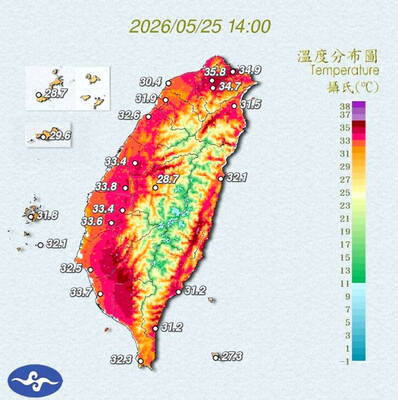
STAY COOL: The HPA recommended that people stay hydrated, use air-conditioning or fans while indoors, wear loose-fitting clothes and walk in the shade while outdoors Employers must implement measures such as installing cooling equipment, and providing drinking water and rest breaks for outdoor workers starting from Monday next week, the Taipei Department of Labor said on Sunday. Employers who fail to comply could face fines of NT$30,000 to NT$300,000 under the Occupational Safety and Health Act (職業安全衛生法), the department said. Businesses in Taipei employing fewer than 100 workers, as well as registered self-employed workers with labor insurance coverage, could receive on-site assessments and guidance from occupational safety consultants to help them apply for central government subsidies to implement or improve heat-protection measures, it said. Under the Ministry of

GLOBALGIVING: ‘ Caving to external pressure is not acceptable for an organization that has cultivated justice reform and human rights for 30 years,’ one NGO said A slew of non-government organizations (NGOs) have withdrawn from the GlobalGiving fundraising platform after it announced it would use “Chinese Taipei” instead of “Taiwan” from next month. The Taiwan Good Rice Association wrote on Facebook on Friday that it was informed on April 28 via a teleconference call of the change, which was made because the platform wanted to operate in China. Taiwan Good Rice is to terminate all cooperative relationships with GlobalGiving in response to the platform’s “unilateral and non-negotiable” decision to remove references to Taiwan, the NGO said. “Taiwan is in the official name of Taiwan Good Rice Association and the

Chinese Nationalist Party (KMT) Chairwoman Cheng Li-wun (鄭麗文) yesterday briefed her party’s Central Standing Committee regarding her scheduled visit to the US between Monday next week and June 16, saying that her purpose would be to persuade the US that the Republic of China (ROC) Constitution was a “one China” constitution that would foster stable and peaceful cross-strait relations. The ROC Constitution is the most important defense for all Taiwanese citizens, as it upholds our democracy and has contributed to our robust economy, which aligns with international and US interests, she said. “We would not be troublemakers and drag the US under,”


 RSS
RSS