


The Highway Bureau today announced further details of new regulations for mandatory driver's license renewals that would take effect this month, including the addition of a physician’s assessment and a self-declaration, with the latter likely applicable to those aged 75 or older.
The bureau said it is considering adding a physician’s assessment and self-declaration to the medical exam form in addition to existing checks on vision, hearing, limb function and mobility.
The self-declaration would list possible physical and mental symptoms for drivers aged 75 or older to assess whether they have recently experienced them, the bureau said.
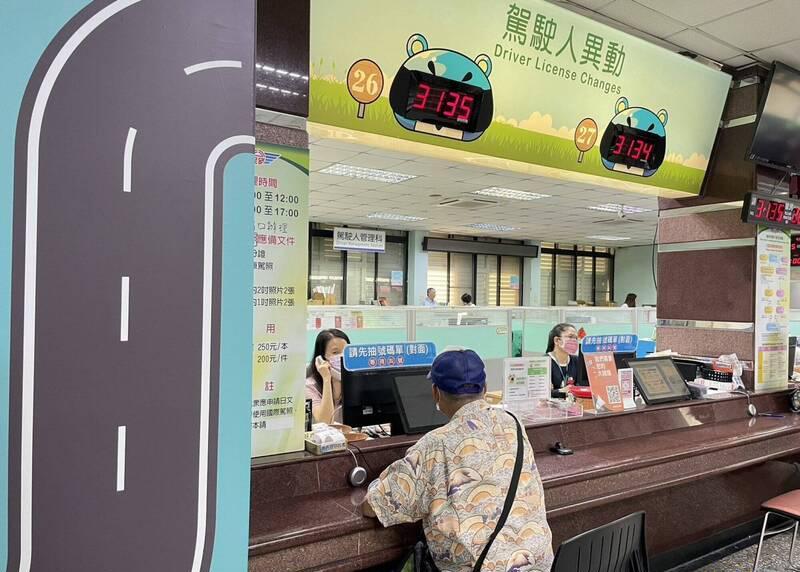
Photo: Taipei Times file photo
The revised medical form would be implemented after it is reviewed and confirmed by the Ministry of Transportation and Communications’ driver medical advisory committee, it added.
The minimum age for mandatory driver's license renewals would be lowered from 75 to 70 starting May 31, the ministry announced last month.
Under the new regulations, drivers aged 70 or older would have to undergo a physical examination and complete a two-hour traffic safety course to renew their licenses, which would remain valid until age 75.
There would be a grace period of two years that would run until the end of May 2028 to provide a full transition period for drivers aged 70 to 74, the bureau said.
However, those who have already used the two-year grace period would not be eligible for an additional three-year grace period upon turning 75, it added.
For drivers who turn 70 after the new system takes effect, the two-year grace period would begin on their 70th birthday, it said.
Drivers aged 75 or older would still need to renew their licenses every three years, and would be required to pass a cognitive function test to obtain a license, in addition to a physical examination and a traffic safety course, it said.
The decision not to include cognitive testing for drivers aged 70 to 74 was based on data from a 2023 epidemiological survey by the Taiwanese Society of Geriatric Psychiatry provided to the Ministry of Health and Welfare, as well as a study on the National Health Insurance database published last year, said Huang Ming-sheng (黃明聲), deputy head of the bureau’s Licensing Division.
The prevalence of dementia among people aged 75 to 79 is nearly twice that of those aged 70 to 74, with the trend becoming more pronounced in older age groups, the study showed.
For drivers aged 75 or older, the cognitive test would include three components: orientation to time and place, short-term memory, and judgement and coordination, he said.
Those who fail the cognitive test could undergo further evaluation at a hospital and obtain certification from a physician confirming they do not have moderate or severe dementia, he said.
The new system would affect about 1.288 million drivers, including 1.1 million people aged 70 to 74 and 188,000 aged 75 or older, the bureau’s data showed.
Renewal notices are to be sent starting next month, with an average of about 100,000 notices issued per month, the bureau said, adding that older drivers should renew their licenses upon receiving notification.
In January, the Ministry of Transportation and Communications introduced an incentive program offering people aged 70 or older who surrender their driver's licenses a 50 percent subsidy on public transport using a digital TPass card, capped at NT$1,500 per month, for up to two years.
As of March 31, more than 5,300 people had surrendered their licenses and qualified for the program, data showed.
The Ministry of Transportation and Communications has also proposed amendments to traffic safety regulations that, from Dec. 31, would require drivers aged 75 or older who have caused accidents due to traffic contraventions to complete training at an accredited driving institution before renewing their licenses.
Under the Road Traffic Management and Penalty Act (道路交通管理處罰條例), driving with an expired license is punishable by a fine of NT$1,800 to NT$3,600, along with license suspension.

NATIONAL SECURITY: Authorities are working to confirm the identities of the military personnel involved and investigating possible illegal conduct and regulatory violations Authorities are probing possible national security implications after Kinmen police and immigration officers on Sunday found a Chinese woman allegedly posing as a tourist while engaging in prostitution involving more than 10 military personnel. The woman, surnamed Chen (陳), has since been deported, authorities said, adding that investigators are still working to confirm the identities of those implicated, as the records only listed code names and aliases. The case stemmed from a report received by the Kinmen District Prosecutors’ Office on Friday last week from the Jinhu Precinct of the Kinmen County Police Bureau. On Sunday, police, along with the National Immigration
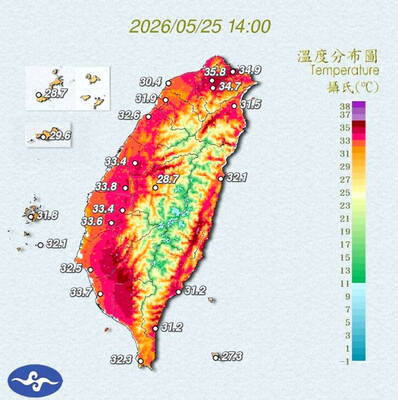
STAY COOL: The HPA recommended that people stay hydrated, use air-conditioning or fans while indoors, wear loose-fitting clothes and walk in the shade while outdoors Employers must implement measures such as installing cooling equipment, and providing drinking water and rest breaks for outdoor workers starting from Monday next week, the Taipei Department of Labor said on Sunday. Employers who fail to comply could face fines of NT$30,000 to NT$300,000 under the Occupational Safety and Health Act (職業安全衛生法), the department said. Businesses in Taipei employing fewer than 100 workers, as well as registered self-employed workers with labor insurance coverage, could receive on-site assessments and guidance from occupational safety consultants to help them apply for central government subsidies to implement or improve heat-protection measures, it said. Under the Ministry of

GLOBALGIVING: ‘ Caving to external pressure is not acceptable for an organization that has cultivated justice reform and human rights for 30 years,’ one NGO said A slew of non-government organizations (NGOs) have withdrawn from the GlobalGiving fundraising platform after it announced it would use “Chinese Taipei” instead of “Taiwan” from next month. The Taiwan Good Rice Association wrote on Facebook on Friday that it was informed on April 28 via a teleconference call of the change, which was made because the platform wanted to operate in China. Taiwan Good Rice is to terminate all cooperative relationships with GlobalGiving in response to the platform’s “unilateral and non-negotiable” decision to remove references to Taiwan, the NGO said. “Taiwan is in the official name of Taiwan Good Rice Association and the

Chinese Nationalist Party (KMT) Chairwoman Cheng Li-wun (鄭麗文) yesterday briefed her party’s Central Standing Committee regarding her scheduled visit to the US between Monday next week and June 16, saying that her purpose would be to persuade the US that the Republic of China (ROC) Constitution was a “one China” constitution that would foster stable and peaceful cross-strait relations. The ROC Constitution is the most important defense for all Taiwanese citizens, as it upholds our democracy and has contributed to our robust economy, which aligns with international and US interests, she said. “We would not be troublemakers and drag the US under,”


 RSS
RSS