


Children’s advocacy groups yesterday called on the government to ensure childcare surveillance footage is securely protected, after a provision in the Childcare Services Act (兒童托育服務法) requiring footage to be uploaded to a regulatory cloud system sparked privacy concerns.
Childcare centers in Taiwan are required by law to install surveillance cameras, but concerns over missing or damaged footage have persisted.
The new act passed on April 14 mandates the 30-day retention of recordings for children aged two years old and younger, which must be uploaded and stored on a centralized government system.
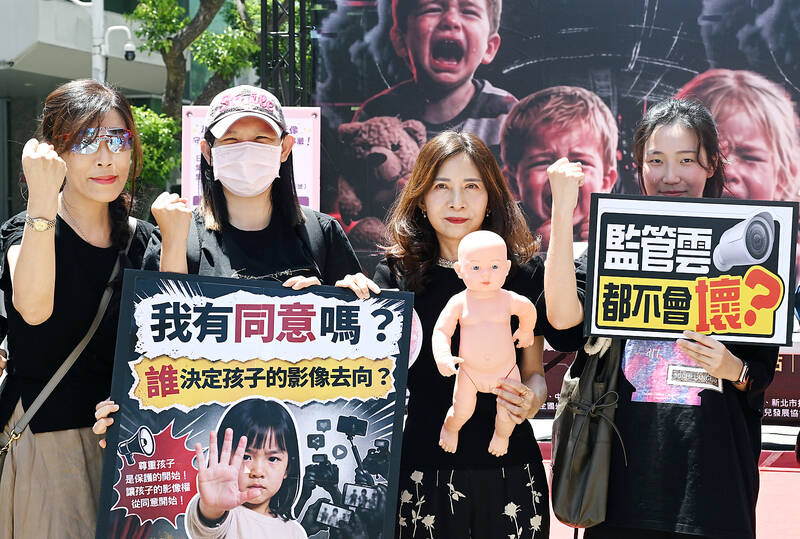
Photo: Liao Chen-huei, Taipei Times
Twenty childhood education groups yesterday gathered outside the Legislative Yuan, saying that uploading surveillance footage to the cloud contravenes the UN Convention on the Rights of the Child and threatens children’s privacy.
The groups said they oppose cloud storage of footage rather than cameras themselves, calling for protection of childcare professionalism and workers’ dignity.
Footage of highly private moments would be stored and could be leaked if there are cybersecurity breaches, they said.
They called for the subsidiary regulations to incorporate three key principles: Avoid comprehensive real-time surveillance to prevent undue intrusion into children’s lives; ensure video uploads and access require written parental consent; and establish clear limits and a regulatory framework for accessing the footage.
Childcare centers have been using surveillance cameras since 2020 and institutions should be allowed to upgrade their own systems rather than rely on a centralized cloud, Child Education and Nursing Association president Chiang Shu-jung (蔣叔融) said.
Childcare centers depend on trustworthy staff and a loving environment, Chiang said, adding that installing excessive surveillance does not equate to genuine protection.
The government should engage in further dialogue with educators and parents instead of penalizing nearly 2,000 childcare providers based on a single case, Chiang added, referring to the high-profile death of a one-year-old nicknamed Kai Kai (剴剴), which occurred at home rather than a childcare center.
Uploading surveillance footage to the cloud raises concerns over children’s privacy and data protection, as childcare centers use full-coverage surveillance, meaning even private moments such as changing of diapers or undressing are recorded, Taiwan Early Childhood Education Association president Yeh Jo-chiao (葉若蕎) said.
Centralizing all footage in the cloud poses hacking risks, Yeh said, urging the government to give the policy more careful consideration to find what is truly best for children.
She stressed the importance of fostering a positive childcare environment, supporting professional development for staff and improving teacher-parent communication.
The regulatory cloud system is dangerous as the videos reveal children in vulnerable situations and it is unclear where they would even be stored, said a mother of three.
Those speaking out do not oppose the government, but seek dialogue, Chinese Early Childhood Education Association chairman Su Chuan-chen (蘇傳臣) said, adding that public views and concerns should be taken into account in the drafting of the subsidiary regulations.
Data in the regulatory cloud system could only be accessed according to legal procedures and would not be available for arbitrary or real-time viewing, Minister of Health and Welfare Shih Chung-liang (石崇良) said yesterday, emphasizing that there would be no privacy leaks.
The government would draft detailed subsidiary regulations for the regulatory cloud system and the exact implementation would be discussed with relevant parties, Shih said.
Additional reporting by CNA

The Ministry of Finance this afternoon announced the winning numbers for the March-April uniform invoice lottery. The winning number for the NT$10 million (US$318,060) special prize is 19531471, and the winning number for the NT$2 million grand prize is 85941329. Three numbers were drawn for the NT$200,000 first prize: 07225810, 20231230 and 83518781. Those with receipts matching the last seven digits of any of the first-prize numbers will win the NT$40,000 second prize, while those matching the last six digits will win the NT$10,000 third prize. Those whose receipts match the last five digits of the first-prize numbers can claim the NT$4,000 fourth prize,

SIX SUBSIDIES: The monthly allowance for older farmers is to increase to NT$10,000, and NT$5,000 is to be given to homemakers under the national pension system, Lai said The government is to implement major welfare policies for disadvantaged groups, including raising the monthly allowance for older farmers to NT$10,000 and providing homemakers with NT$5,000 per month, President William Lai (賴清德) said yesterday. Lai made the remarks during a visit to Wangling Temple in Chiayi County, saying that the planned increases were being introduced amid economic growth and an increase in tax revenue. Touting a policy, in which the government plans to provide a monthly allowance of NT$5,000 for every child under the age of 18 in a bid to address Taiwan’s low birthrate, Lai said that if received for the
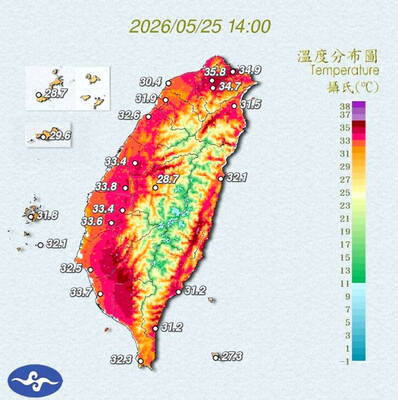
STAY COOL: The HPA recommended that people stay hydrated, use air-conditioning or fans while indoors, wear loose-fitting clothes and walk in the shade while outdoors Employers must implement measures such as installing cooling equipment, and providing drinking water and rest breaks for outdoor workers starting from Monday next week, the Taipei Department of Labor said on Sunday. Employers who fail to comply could face fines of NT$30,000 to NT$300,000 under the Occupational Safety and Health Act (職業安全衛生法), the department said. Businesses in Taipei employing fewer than 100 workers, as well as registered self-employed workers with labor insurance coverage, could receive on-site assessments and guidance from occupational safety consultants to help them apply for central government subsidies to implement or improve heat-protection measures, it said. Under the Ministry of

NATIONAL SECURITY: Authorities are working to confirm the identities of the military personnel involved and investigating possible illegal conduct and regulatory violations Authorities are probing possible national security implications after Kinmen police and immigration officers on Sunday found a Chinese woman allegedly posing as a tourist while engaging in prostitution involving more than 10 military personnel. The woman, surnamed Chen (陳), has since been deported, authorities said, adding that investigators are still working to confirm the identities of those implicated, as the records only listed code names and aliases. The case stemmed from a report received by the Kinmen District Prosecutors’ Office on Friday last week from the Jinhu Precinct of the Kinmen County Police Bureau. On Sunday, police, along with the National Immigration


 RSS
RSS