


Quarantine standards for imported potatoes have not been not lowered, and potatoes can be inspected individually at processing plants, Deputy Minister of Agriculture Hu Jong-i (胡忠一) said yesterday.
Hu’s remarks came after the Ministry of Agriculture revised imported plant product quarantine regulations, including quarantine protocol for processing potatoes imported from the US.
The change has raised concerns that imported potatoes with solanine — a toxin that could cause vomiting, diarrhea or death in humans — might enter the domestic market.
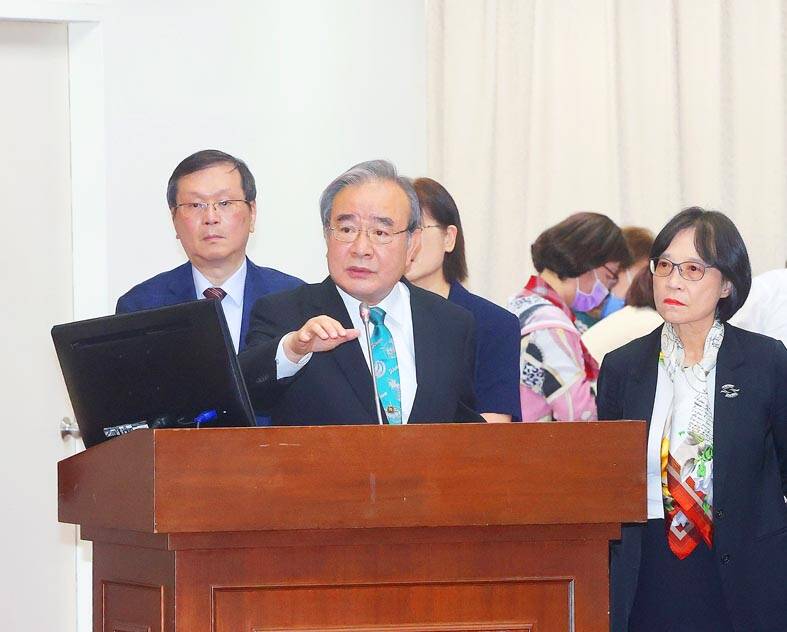
Photo: CNA
Processing potatoes imported from the US would not be allowed into the domestic supply chain if they are sprouted, moldy or rotten, even if their solanine levels are within the safe amount of 200 parts per million (ppm), he told a meeting of the legislature’s Finance Committee.
US processing potatoes cannot be exported to Taiwan if soil, sprout, or any of the eight banned pests or diseases are spotted before they arrive in Taiwan, he said.
Importers must apply for quarantine inspection upon arrival of processing potatoes for soil, sprouts and the eight banned pests or diseases, as well as declare that the potato shipment is for processing only, Hu said.
That is the same quarantine approach for potato imports as before, he said.
Quarantine personnel would inform the Food and Drug Administration about sprouted potatoes, which would need further solanine testing, Hu said, adding that the potatoes would be banned from entering the food processing supply chain if they have excessive solanine.
Even processing potatoes with safe solanine levels would be returned or destroyed along with the other potatoes in the same shipping containers, he said.
The whole shipment could also be sealed and moved to a quarantine zone, with the ministry’s Animal and Plant Health Inspection Agency supervising a container by container inspection, he added.
Chinese Nationalist Party (KMT) Legislator Lin Te-fu (林德福) said shipments with sprouted potatoes should be returned altogether, as solanine in a potato could contaminate the others in the same batch.
In response, Hu said that sprouted potatoes do not necessarily contain solanine and sprouts within 5cm are acceptable by international standards.
Deputy Minister of Health and Welfare Chuang Jen-hsiang (莊人祥) said if a potato is found to have more than 200ppm of solanine, the whole shipment would be returned.
Responding to KMT Legislator Lee Yen-hsiu’s (李彥秀) concerns about the effectiveness of secondary quarantine inspection at processing plants, Hu said that imported potatoes are inspected at customs at a sampling rate of 60 percent, higher than the 5 percent to 10 percent in most other countries.
Quarantine personnel who fail to conduct inspection in accordance with regulations would be fined up to NT$150,000, in line with the Plant Protection and Quarantine Act (植物防疫檢疫法), he added.
Asked by KMT Legislator Lai Shyh-bao (賴士葆) about whether it is feasible to inspect imported potatoes one by one, Hu said it is possible at processing plants.
Potato imports are about 27,000 tonnes a year, equivalent to nearly 100 million potatoes, he said.
Meanwhile, National Taiwan Ocean University food science professor Chen Tai-yuan (陳泰源) in a statement issued by Science Media Center Taiwan said the newly implemented protocol focuses on enhancing food safety via multiple inspections.
It replaced one-dimensional appearance inspection standards, such as sprout length, with a multi-layered preventive framework that integrates source treatment, documentation verification, export quarantine, border inspection and elimination at processing plants, he said.
Such an approach aligns with international risk-oriented management practices and could ensure food product safety in a more systemic way, he added.
Additional reporting by CNA
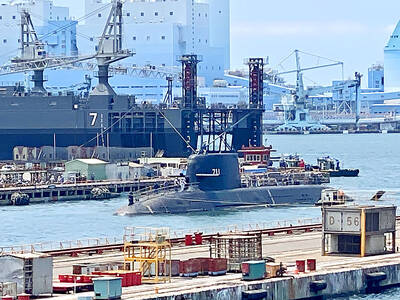
AGING: While Japan has 22 submarines, Taiwan only operates four, two of which were commissioned by the US in 1945 and 1946, and transferred to Taiwan in 1973 Taiwan would need at least 12 submarines to reach modern fleet capabilities, CSBC Corp, Taiwan chairman Chen Cheng-hung (陳政宏) said in an interview broadcast on Friday, citing a US assessment. CSBC is testing the nation’s first indigenous defense submarine, the Hai Kun (海鯤, Narwhal), which is scheduled to be delivered to the navy next month or in July. The Hai Kun has completed torpedo-firing tests and is scheduled to undergo overnight sea trials, Chen said on an SET TV military affairs program. Taiwan would require at least 12 submarines to establish a modern submarine force after assessing the nation’s operational environment and defense
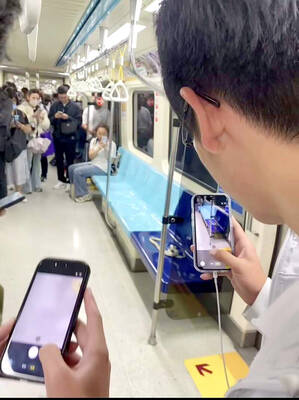
A white king snake that frightened passengers and caused a stir on a Taipei MRT train on Friday evening has been claimed by its owner, who would be fined, Taipei Rapid Transit Corp (TRTC) said yesterday. A person on Threads posted that he thought he was lucky to find an empty row of seats on Friday after boarding a train on the Bannan (Blue) Line, only to spot a white snake with black stripes after sitting down. Startled, he jumped up, he wrote, describing the encounter as “terrifying.” “Taipei’s rat control plan: Release snakes on the metro,” one person wrote in reply, referring
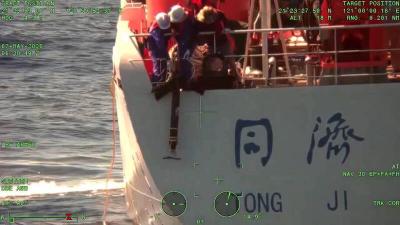
The coast guard today said that it had disrupted "illegal" operations by a Chinese research ship in waters close to the nation and driven it away, part of what Taipei sees a provocative pattern of China's stepped up maritime activities. The coast guard said that it on Thursday last week detected the Chinese ship Tongji (同濟號), which was commissioned only last year, 29 nautical miles (54km) southeast of the southern tip of Taiwan, although just outside restricted waters. The ship was observed lowering ropes into the water, suspected to be the deployment of scientific instruments for "illegal" survey operations, and the coast
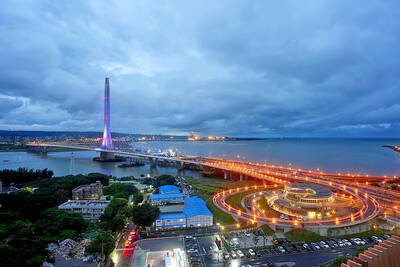
An inauguration ceremony was held yesterday for the Danjiang Bridge, the world’s longest single-mast asymmetric cable-stayed bridge, ahead of its official opening to traffic on Tuesday, marking a major milestone after nearly three decades of planning and construction. At the ceremony in New Taipei City attended by President William Lai (賴清德), Premier Cho Jung-tai (卓榮泰), Minister of Transportation and Communications Chen Shih-kai (陳世凱) and New Taipei City Mayor Hou Yu-ih (侯友宜), the bridge was hailed as both an engineering landmark and a long-awaited regional transport link connecting Tamsui (淡水) and Bali (八里)


 RSS
RSS