


An initial review of amendments to allow candidates with a deferred sentence to participate in elections passed the Legislative Yuan’s Internal Administration Committee, but would require cross-caucus discussions before the issue could be discussed during the legislative session.
Democratic Progressive Party (DPP) Legislator Lin Shu-fen (林淑芬) said Article 26 of the Civil Servants Election and Recall Act (公職人員選舉罷免法) prevents such people from registering as candidates, but does not make a distinction about the severity of the offense or whether they need to serve prison time.
Article 26 states that people found guilty of sedition or offenses under the Anti-Corruption Act (貪污治罪條例), the Organized Crime Prevention Act (組織犯罪防制條例), the National Security Act (國家安全法) or the Narcotics Hazard Prevention Act (毒品危害防制條例) cannot register as a candidate for elections.
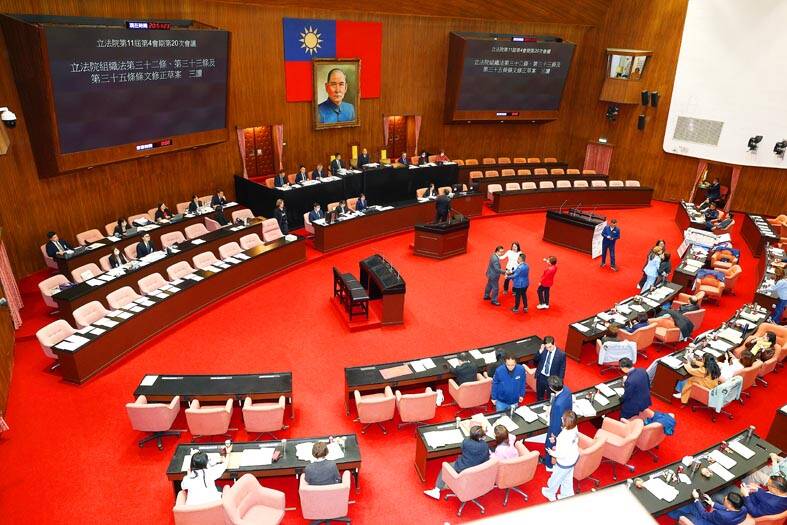
Photo: CNA
Those found guilty, but whose sentences were deferred, are also barred from registering.
The lack of distinctions means that people whose crimes were not related to gun smuggling, narcotics use or sales, economic crimes and organized crimes, and who have had their sentences deferred, would experience “greater” restrictions than those who were found guilty of breaking the law and fined, Lin said.
A proposal by Chinese Nationalist Party (KMT) Legislator Chen Yu-jen (陳玉珍) states that the law does not discriminate between minor or severe offenses and runs contrary to the judiciary’s intent of encouraging rehabilitation, and risked contravening the principle of proportionality under the Constitution.
The Taiwan People’s Party (TPP) said that fines, communal service and deferred sentences were alternative punishments for those with minor offenses, and people who have not yet served their sentence or those whose obligation to serve has already been obviated should not have their right to participate in elections removed.
KMT and DPP legislators in the committee agreed to add a clause that states: “Those who have had their sentences deferred are not included,” while TPP Legislator Hsu Chung-hsin (許忠信) said the clause should read: “Those whose sentences have been deferred, or whose sentences have been commuted, should not be included.”
Committee convener and KMT Legislator Liao Hsien-hsiang (廖先翔) said that the phrasing should be left as is until cross-caucus discussions yield a result.
The committee also passed an amendment to Article 26 of the President and Vice President Election and Recall Act (總統副總統選舉罷免法) that states that those convicted of contravening the Fraud Crime Hazard Prevention Act (詐欺犯罪危害防制條例) cannot register as an election candidate.
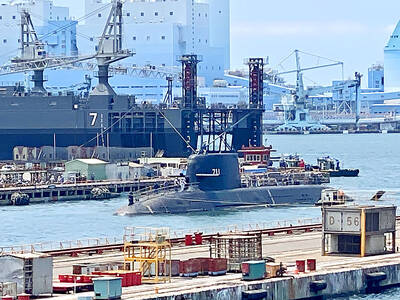
AGING: While Japan has 22 submarines, Taiwan only operates four, two of which were commissioned by the US in 1945 and 1946, and transferred to Taiwan in 1973 Taiwan would need at least 12 submarines to reach modern fleet capabilities, CSBC Corp, Taiwan chairman Chen Cheng-hung (陳政宏) said in an interview broadcast on Friday, citing a US assessment. CSBC is testing the nation’s first indigenous defense submarine, the Hai Kun (海鯤, Narwhal), which is scheduled to be delivered to the navy next month or in July. The Hai Kun has completed torpedo-firing tests and is scheduled to undergo overnight sea trials, Chen said on an SET TV military affairs program. Taiwan would require at least 12 submarines to establish a modern submarine force after assessing the nation’s operational environment and defense
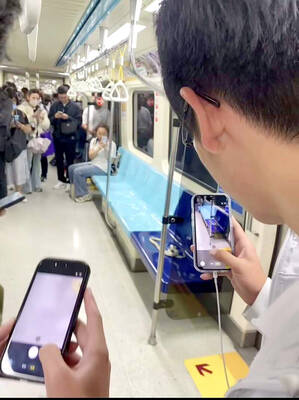
A white king snake that frightened passengers and caused a stir on a Taipei MRT train on Friday evening has been claimed by its owner, who would be fined, Taipei Rapid Transit Corp (TRTC) said yesterday. A person on Threads posted that he thought he was lucky to find an empty row of seats on Friday after boarding a train on the Bannan (Blue) Line, only to spot a white snake with black stripes after sitting down. Startled, he jumped up, he wrote, describing the encounter as “terrifying.” “Taipei’s rat control plan: Release snakes on the metro,” one person wrote in reply, referring
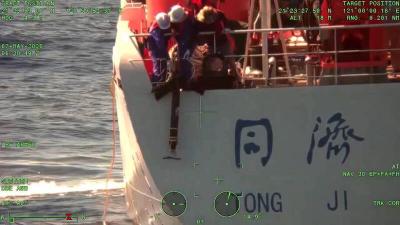
The coast guard today said that it had disrupted "illegal" operations by a Chinese research ship in waters close to the nation and driven it away, part of what Taipei sees a provocative pattern of China's stepped up maritime activities. The coast guard said that it on Thursday last week detected the Chinese ship Tongji (同濟號), which was commissioned only last year, 29 nautical miles (54km) southeast of the southern tip of Taiwan, although just outside restricted waters. The ship was observed lowering ropes into the water, suspected to be the deployment of scientific instruments for "illegal" survey operations, and the coast
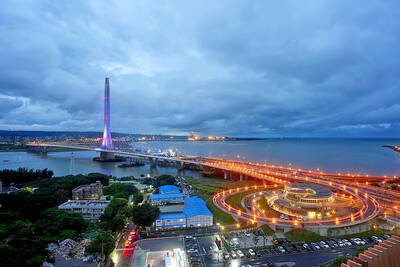
An inauguration ceremony was held yesterday for the Danjiang Bridge, the world’s longest single-mast asymmetric cable-stayed bridge, ahead of its official opening to traffic on Tuesday, marking a major milestone after nearly three decades of planning and construction. At the ceremony in New Taipei City attended by President William Lai (賴清德), Premier Cho Jung-tai (卓榮泰), Minister of Transportation and Communications Chen Shih-kai (陳世凱) and New Taipei City Mayor Hou Yu-ih (侯友宜), the bridge was hailed as both an engineering landmark and a long-awaited regional transport link connecting Tamsui (淡水) and Bali (八里)


 RSS
RSS