


China’s navigation app Amap (高德地圖) is classified as a product that endangers national information security and is banned from use by government agencies, the Ministry of Digital Affairs said today.
The app raised concerns after it was found to display countdown timers for some traffic lights in Taiwan, prompting fears of potential cybersecurity risks.
It has been confirmed that some user data from Amap could be transmitted back to servers in China, Minister of Digital Affairs Lin Yi-jin (林宜敬) told the Legislative Yuan yesterday.
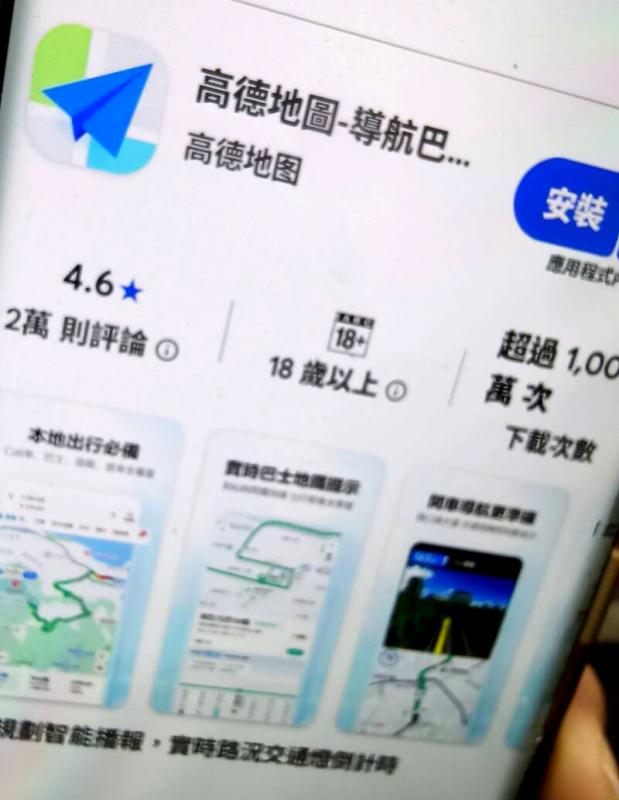
Photo: Wang Yi-sung, Taipei Times
The situation is being jointly reviewed with the Mainland Affairs Council and national security agencies, she said.
The app’s traffic light countdown feature is not connected to Taiwan’s traffic signal systems, but is instead based on estimations by the app’s developer, the ministry said, adding that it would release the results of a cybersecurity risk assessment of the app next month.
Guidelines restricting the use of products deemed harmful to national information security have been in place since 2019, Executive Yuan spokeswoman Michelle Lee (李慧芝) told a news conference following a Cabinet meeting today.
Software widely considered to pose cybersecurity risks is prohibited in government agencies, she said.
The public is advised to remain vigilant and avoid downloading Chinese-made apps that could pose security risks, she added.
The National Institute of Cyber Security would carry out cybersecurity testing on Amap, Administration for Cybersecurity Director-General Tsai Fu-lung (蔡福隆) told the news conference.
Under the Information and Communication Security Management Act (資通安全管理法), which was amended last year, Amap is classified as a product that endangers national information security and is banned from use by government agencies, he said.
The app’s map data is obtained through cooperation with a Dutch firm, rather than being collected independently in Taiwan, he said.
The traffic light countdown feature is not linked to Taiwan’s traffic signal systems, but is instead calculated using aggregated user behavior, such as when users stop and start at intersections, he said.
Under Chinese regulations, the Chinese government has the authority to access corporate data, and citizens are obligated to cooperate, he said.
Data collected by Amap, including location and movement trajectories, could be transmitted back to servers in China and accessed by Chinese authorities, he said.
The app is mainly used by Taiwanese businesspeople traveling between Taiwan and China, as well as people visiting China, he said.
However, given the potential for sensitive personal location and digital footprint data to be leaked, people should avoid using the app, he said.
Minister of National Defense Wellington Koo (顧立雄) told reporters that the military would follow ministry’s lead in banning the use of Amap app across all branches of the armed forces.
Asked whether privately owned mobile phones would also be subject to regulation, he said that the ministry would adhere to the ministry’s ban and ensure that all service members comply with restrictions on the use of applications with potential cybersecurity risks.
Asked about the app’s ability to identify military installations — even those that have been stripped of identifying information or blurred — by using nearby landmarks such as convenience stores, Koo said that Chinese satellites pass over Taiwan on a daily basis.
In the event of a conflict, fixed positions would never be entirely secure, he said, adding that the military would identify suitable concealed operational positions in terms of tactical planning.
Meanwhile, the Kaohsiung City government’s Transportation Bureau said in a statement that an internal review found no data leaks and that no traffic data had been provided to the app’s developer.
It made the comments after Kaohsiung City Councilor Kuo Chien-meng (郭建盟) tested the app and found it could display traffic light countdowns at intersections in the city.
The city’s traffic signal control system is physically isolated and inaccessible from external networks, the bureau said, adding that monitoring and regular security checks would continue to ensure safe operations.
The New Taipei City Government’s Transportation Department also said that real-time traffic signal timing data and related plans are not publicly available.
Amap’s developer, AutoNavi, is headquartered in Beijing and has been wholly owned by Alibaba Group Holding Ltd since 2014, people familiar with the matter said.
In China, digital mapping is considered a highly sensitive sector requiring a government-issued surveying and mapping license, as such data involves national security, including military, transportation and geographic information, they said.
Amap operates under strict government oversight, they added.
Using Amap in Taiwan carries risks, as map data can include sensitive locations such as military facilities, government offices and critical infrastructure, people informed with cross-strait matters said.
Map apps can collect large amounts of sensitive information, including a person’s GPS location, search history and behavioral patterns, providing real-time and historical tracking, while device information, such as phone models and IP addresses, can also be collected, they said.
Once transmitted to servers in China, such data could be accessed under Chinese law, enabling authorities to analyze users’ behavior, commuting routes and frequently visited locations, they said.
Such apps can collect long-term data on users’ movements, which can be used to analyze traffic nodes, population flows and activity patterns in specific areas, Tunghai University Center for Mainland China and Regional Development Research deputy director Hung Pu-chao (洪浦釗) said.
If such data is transmitted to China, Taiwan would have no control over who accesses it or how it is used, and it could potentially be leveraged for further analysis, he said.
The issue extends beyond commercial concerns to the risk of data outflows, which could allow China to better understand Taiwan’s transportation systems and regional activity, he said.
He urged the government to clarify usage guidelines as soon as possible, particularly for agencies, including the administrative sector, military and police, which are involved in sensitive operations such as transportation control, energy and communications.
The government should exercise caution and avoid apps that might transmit data abroad, while the public also needs clearer disclosures to understand where their data goes and what risks are involved, enabling them to make informed choices, he said.
The issue should be handled through a cross-agency risk assessment and management mechanism involving the Ministry of Digital Affairs, the Ministry of the Interior, the Ministry of Transportation and Communications, national security agencies and competent authorities to establish consistent standards and define clear boundaries between convenience and security, he said.
Additional reporting by Huang Tzu-yang and Fang Wei-li
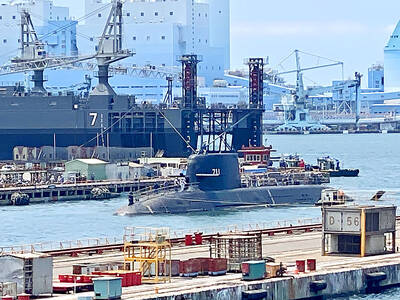
AGING: While Japan has 22 submarines, Taiwan only operates four, two of which were commissioned by the US in 1945 and 1946, and transferred to Taiwan in 1973 Taiwan would need at least 12 submarines to reach modern fleet capabilities, CSBC Corp, Taiwan chairman Chen Cheng-hung (陳政宏) said in an interview broadcast on Friday, citing a US assessment. CSBC is testing the nation’s first indigenous defense submarine, the Hai Kun (海鯤, Narwhal), which is scheduled to be delivered to the navy next month or in July. The Hai Kun has completed torpedo-firing tests and is scheduled to undergo overnight sea trials, Chen said on an SET TV military affairs program. Taiwan would require at least 12 submarines to establish a modern submarine force after assessing the nation’s operational environment and defense

A white king snake that frightened passengers and caused a stir on a Taipei MRT train on Friday evening has been claimed by its owner, who would be fined, Taipei Rapid Transit Corp (TRTC) said yesterday. A person on Threads posted that he thought he was lucky to find an empty row of seats on Friday after boarding a train on the Bannan (Blue) Line, only to spot a white snake with black stripes after sitting down. Startled, he jumped up, he wrote, describing the encounter as “terrifying.” “Taipei’s rat control plan: Release snakes on the metro,” one person wrote in reply, referring
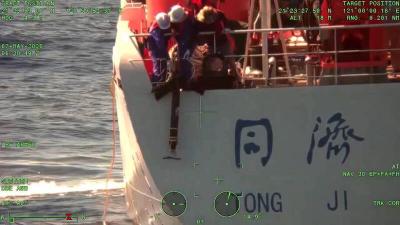
The coast guard today said that it had disrupted "illegal" operations by a Chinese research ship in waters close to the nation and driven it away, part of what Taipei sees a provocative pattern of China's stepped up maritime activities. The coast guard said that it on Thursday last week detected the Chinese ship Tongji (同濟號), which was commissioned only last year, 29 nautical miles (54km) southeast of the southern tip of Taiwan, although just outside restricted waters. The ship was observed lowering ropes into the water, suspected to be the deployment of scientific instruments for "illegal" survey operations, and the coast

Taiwan’s two cases of hantavirus so far this year are on par with previous years’ case numbers, and the government is coordinating rat extermination work, so there should not be any outbreaks, Centers for Disease Control (CDC) Director-General Philip Lo (羅一鈞) said today in an interview with the Liberty Times (the Taipei Times’ sister newspaper). An increase in rat sightings in Taipei and New Taipei City has raised concerns about the spread of hantavirus, as rats can carry the disease. In January, a man in his 70s who lived in Taipei’s Daan District (大安) tested positive posthumously for hantavirus, Taiwan’s


 RSS
RSS