


The US Department of Defense is preparing security assistance options for Taiwan, US Assistant Secretary of Defense for Indo-Pacific Security Affairs John Noh said yesterday, urging Taiwanese political parties to work together to pass a NT1.25 trillion (US$39.68 billion) special defense budget.
Noh and US Indo-Pacific Commander Admiral Samuel Paparo attended a US House of Representatives Committee on Armed Services hearing which discussed US military deployment in the Indo-Pacific region and national security challenges.
The US calls “upon wealthy and capable allies and partners to share the burden of restoring and sustaining deterrence deterrence by increasing defense spending, meeting the new global standard of spending 3.5 percent of Gross Domestic Product (GDP) on core defense, and taking greater responsibility for their conventional defense,” Noh said in a statement.
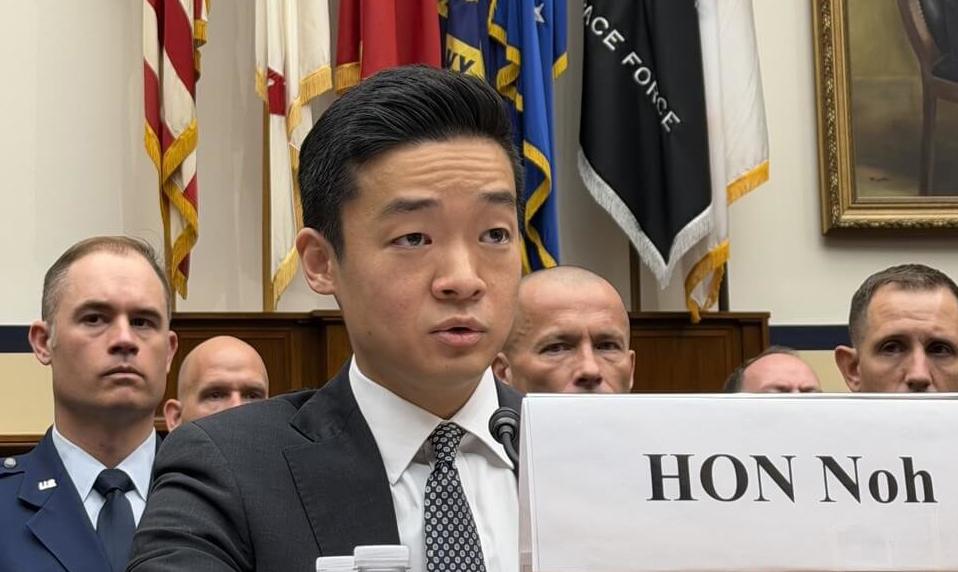
Photo: CNA
“This is particularly critical for Taiwan,” he said.
President William Lai (賴清德) has committed to reach 5 percent of GDP in core defense spending by 2030, including a special defense budget that “addresses many of Taiwan’s most critical defense gaps,” Noh said.
The US Department of Defense worked closely with the Ministry of National Defense in the development of Taiwan’s “historic” special defense budget, he said, calling on the nation’s political parties to “work together to fund these requirements.”
“Taiwan must do more, and faster, to build on this positive momentum and ensure it has the self defense capability to meet the scale of the threat it faces,” he said.
Lai proposed the eight-year NT$1.25 trillion special defense budget late last year, but the plan has faced resistance from opposition parties, which have proposed lower funding ranging from NT$380 billion to NT$400 billion.
Asked about US security aid for Taiwan, Noh said that the department offers options including arms sales, as well as support through the Presidential Drawdown Authority and Taiwan Security Cooperation Initiative.
The department is studying several options, he said, adding that it would report them to senior leaders, including US Secretary of Defense Pete Hegseth and US President Donald Trump.
Addressing concerns raised by US Representative Salud Carbajal over delays in the delivery of US-made F-16 fighter jets to Taiwan, Paparo emphasized the importance of integrated air and missile defense across domains and theaters.
Each foreign military sale must not only be delivered on time, but as early as possible, he said, adding that US agencies are working to resolve related issues.
Asked about what “non-kinetic” measures China could employ to assert control over Taiwan, he said they could include “united front” work, cognitive warfare and legal warfare, such as establishing new customs entities backed by the China Coast Guard and other law enforcement forces.
Other potential tactics include seizing Taiwan’s outlying islands or imposing a quarantine or blockade, he said, adding that they would be Beijing’s preferred options.
Beijing has not ruled out the use of force against Taiwan, he said in the statement.
In Taipei, Legislative Speaker Han Kuo-yu (韓國瑜) yesterday said that he would work to build cross-party consensus on the special defense budget.
Lawmakers are this afternoon again scheduled to hold cross-party negotiations after they failed to reach a consensus on Wednesday last week.
Meanwhile, Han yesterday met with a delegation from the Washington-based Center for Strategic and International Studies (CSIS), the Legislative Yuan said in a statement.
He was accompanied by lawmakers, including Chen Yeong-kang (陳永康) of the Chinese Nationalist Party (KMT), Wang Ting-yu (王定宇) of the Democratic Progressive Party and Wang An-hsiang (王安祥) of the Taiwan People’s Party, the statement said.
National security is an important issue valued by lawmakers across party lines, Han said, pledging to promote deliberation on the special defense budget to fulfill the legislature’s duty and respond to the public’s concerns about whether the budget would be used appropriately.
Despite having different stances, every party supports the defense budget, Chen said.
Facing increasing threats from China, Taiwan should shoulder responsibility for its own security and the legislature should support the defense budget, Wang Ting-yu said, adding that he hoped the CSIS delegation would continue to support Taiwan’s security after returning to the US.
Wang An-hsiang said he hoped that under Han’s leadership, a second round of cross-party negotiations on the special arms procurement bill would progress and deepen Taiwan-US cooperation in the military and supply chain sectors.
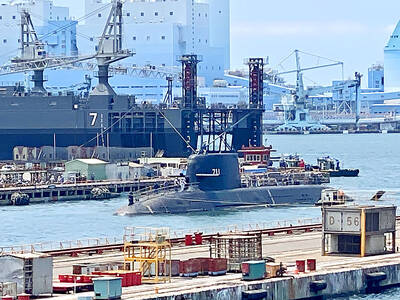
AGING: While Japan has 22 submarines, Taiwan only operates four, two of which were commissioned by the US in 1945 and 1946, and transferred to Taiwan in 1973 Taiwan would need at least 12 submarines to reach modern fleet capabilities, CSBC Corp, Taiwan chairman Chen Cheng-hung (陳政宏) said in an interview broadcast on Friday, citing a US assessment. CSBC is testing the nation’s first indigenous defense submarine, the Hai Kun (海鯤, Narwhal), which is scheduled to be delivered to the navy next month or in July. The Hai Kun has completed torpedo-firing tests and is scheduled to undergo overnight sea trials, Chen said on an SET TV military affairs program. Taiwan would require at least 12 submarines to establish a modern submarine force after assessing the nation’s operational environment and defense
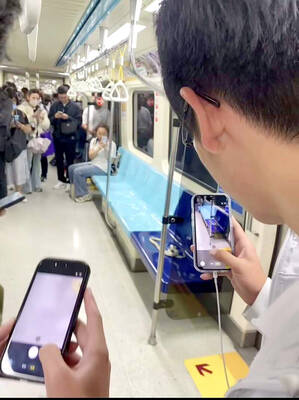
A white king snake that frightened passengers and caused a stir on a Taipei MRT train on Friday evening has been claimed by its owner, who would be fined, Taipei Rapid Transit Corp (TRTC) said yesterday. A person on Threads posted that he thought he was lucky to find an empty row of seats on Friday after boarding a train on the Bannan (Blue) Line, only to spot a white snake with black stripes after sitting down. Startled, he jumped up, he wrote, describing the encounter as “terrifying.” “Taipei’s rat control plan: Release snakes on the metro,” one person wrote in reply, referring
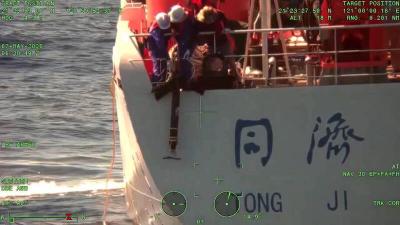
The coast guard today said that it had disrupted "illegal" operations by a Chinese research ship in waters close to the nation and driven it away, part of what Taipei sees a provocative pattern of China's stepped up maritime activities. The coast guard said that it on Thursday last week detected the Chinese ship Tongji (同濟號), which was commissioned only last year, 29 nautical miles (54km) southeast of the southern tip of Taiwan, although just outside restricted waters. The ship was observed lowering ropes into the water, suspected to be the deployment of scientific instruments for "illegal" survey operations, and the coast
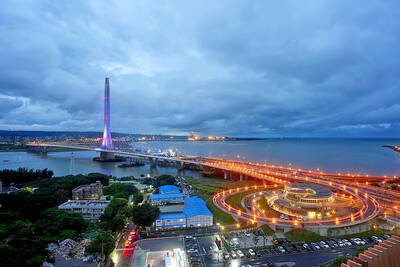
An inauguration ceremony was held yesterday for the Danjiang Bridge, the world’s longest single-mast asymmetric cable-stayed bridge, ahead of its official opening to traffic on Tuesday, marking a major milestone after nearly three decades of planning and construction. At the ceremony in New Taipei City attended by President William Lai (賴清德), Premier Cho Jung-tai (卓榮泰), Minister of Transportation and Communications Chen Shih-kai (陳世凱) and New Taipei City Mayor Hou Yu-ih (侯友宜), the bridge was hailed as both an engineering landmark and a long-awaited regional transport link connecting Tamsui (淡水) and Bali (八里)


 RSS
RSS