


The legislature’s Foreign Affairs and National Defense Committee yesterday passed a resolution to “strongly condemn” Beijing, a day after China coerced nations on the route of President William Lai’s (賴清德) trip to Eswatini to close their airspace to the president.
Separately, the Chinese Nationalist Party (KMT) and Chairwoman Cheng Li-wun (鄭麗文) issued contradictory responses, with the party criticizing Beijing and Cheng blaming the Lai administration for angering China.
Democratic Progressive Party (DPP) lawmakers on the committee sponsored the resolution, which passed by a unanimous vote.
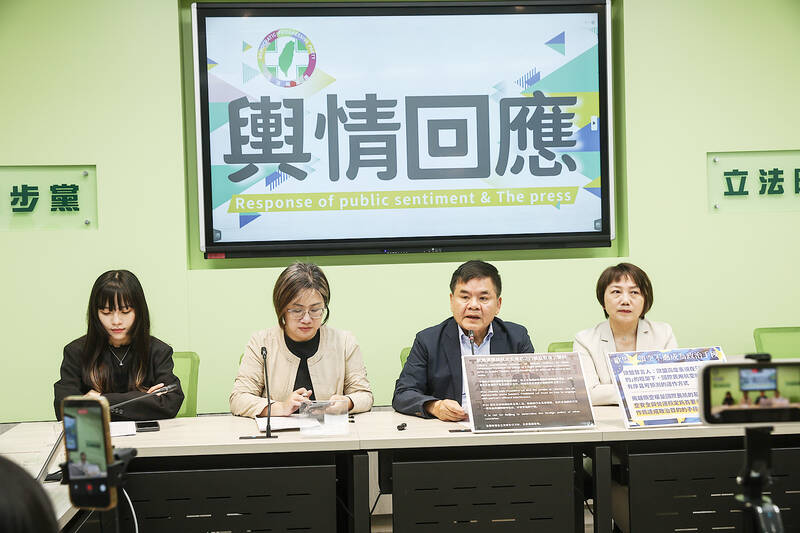
Photo: CNA
China’s use of diplomatic and economic coercion to revoke the flight permits from countries en route Lai’s state visit to Eswatini was an infringement on Taiwan’s diplomatic freedom, international norms and the “status quo,” the resolution said.
Beijing’s actions contravened international laws and conventions protecting a nation’s right to conduct diplomatic policy, manage internal affairs without interference and the freedom of civil aviation, it said.
The resolution cited the UN Charter, UN General Assembly Resolution 2625, the Chicago Convention and the Vienna Convention on Diplomatic Relations.
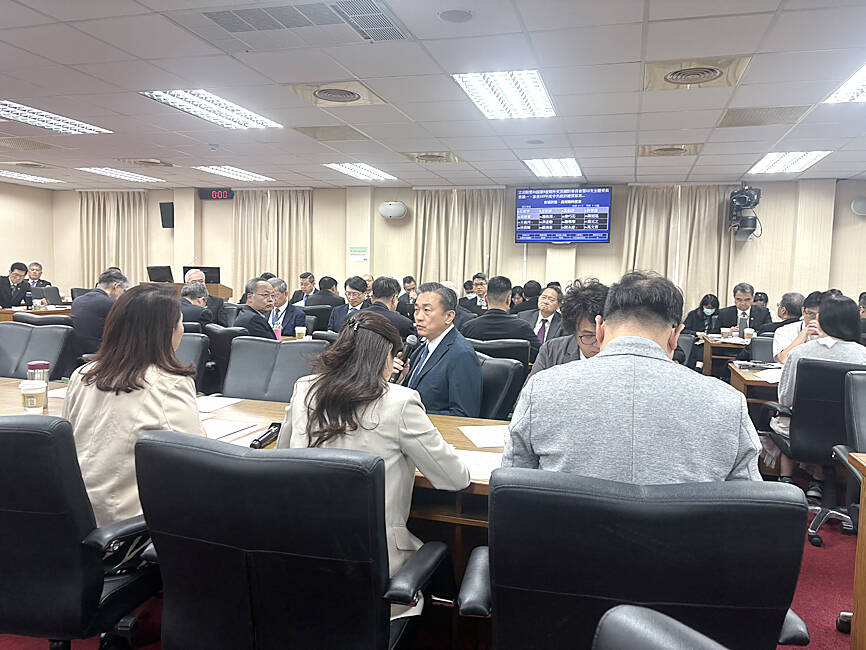
Photo: CNA
The Ministry of Foreign Affairs should protest China’s meddling via its missions to foreign nations and multilateral frameworks, including the International Civil Aviation Organization, to safeguard Taiwan’s sovereignty and diplomatic space, it said.
Democratic Progressive Party (DPP) Legislator Wang Ting-yu (王定宇) said the three African nations neighboring landlocked Eswatini had approved Lai’s flight path weeks before the scheduled visit.
Beijing waited until 12 hours before Lai’s takeoff to threaten these nations, leveraging debts they owed to China, he said.
KMT Legislator Hsu Chiao-hsin (徐巧芯) said that she fully supports the president’s right to visit the nation’s diplomatic allies.
However, Cheng, who had earlier this month returned from a closed-door meeting with Chinese President Xi Jinping (習近平), blamed Lai for what she called a “diplomatic defeat.”
“Sometimes we should look at ourselves before looking at others,” she said.
Former president Ma Ying-jeou (馬英九) had an excellent relationship with China, she said.
“I ask the DPP government: Doesn’t the Constitution support the ‘one China’ principle? Doesn’t every country in the world oppose Taiwanese independence and uphold the ‘1992 consensus?’” Cheng said.
“As an opposition party, the KMT is opposed to Taiwanese independence like all other foreign governments, and the party is brave enough to take the first steps toward peace when the threat of war rises in the Taiwan Strait,” Cheng said.
The so-called “1992 consensus,” a term former Mainland Affairs Council chairman Su Chi (蘇起) in 2006 admitted making up in 2000, refers to a tacit understanding between the KMT and the Chinese government that both sides of the Strait acknowledge there is “one China,” with each side having its own interpretation of what “China” means.
In contrast with Cheng’s statements, the KMT said the cancellation of Lai’s trip was “deeply regrettable.” It also urged Beijing to exercise restraint and reduce its “suppression” of Taiwan’s diplomatic space.
The Taiwan People’s Party (TPP) said it “strongly protests and condemns” China’s actions, which “seriously trampled on our sovereignty and interfered in our internal affairs.”
DPP spokesman Justin Wu (吳崢) slammed Cheng in a news conference, saying that the KMT leader’s “haste in turning her guns on her own country is deeply regrettable.”
Cheng’s remarks about “one China” echoed the official statement China’s Taiwan Affairs Office had issued hours earlier, Wu said.
“Cheng had only China in her eyes, not Taiwan’s numerous democratic allies who voiced support for the nation in the wake of Beijing’s barbaric behavior,” he said. “Her comments deviated from the national interest and were wildly out of touch with mainstream public opinion.”
Additional reporting by Liu Wan-lin

NATIONAL SECURITY: Authorities are working to confirm the identities of the military personnel involved and investigating possible illegal conduct and regulatory violations Authorities are probing possible national security implications after Kinmen police and immigration officers on Sunday found a Chinese woman allegedly posing as a tourist while engaging in prostitution involving more than 10 military personnel. The woman, surnamed Chen (陳), has since been deported, authorities said, adding that investigators are still working to confirm the identities of those implicated, as the records only listed code names and aliases. The case stemmed from a report received by the Kinmen District Prosecutors’ Office on Friday last week from the Jinhu Precinct of the Kinmen County Police Bureau. On Sunday, police, along with the National Immigration

GLOBALGIVING: ‘ Caving to external pressure is not acceptable for an organization that has cultivated justice reform and human rights for 30 years,’ one NGO said A slew of non-government organizations (NGOs) have withdrawn from the GlobalGiving fundraising platform after it announced it would use “Chinese Taipei” instead of “Taiwan” from next month. The Taiwan Good Rice Association wrote on Facebook on Friday that it was informed on April 28 via a teleconference call of the change, which was made because the platform wanted to operate in China. Taiwan Good Rice is to terminate all cooperative relationships with GlobalGiving in response to the platform’s “unilateral and non-negotiable” decision to remove references to Taiwan, the NGO said. “Taiwan is in the official name of Taiwan Good Rice Association and the

HEAVY WEATHER: Typhoon Jangmi is due to crash straight into the Ryukyus as airlines look to shift flights to larger aircraft or cancel flights to Okinawa entirely Taiwan’s international air carriers announced flight adjustments over the weekend as Typhoon Jangmi is forecast to hit the Ryukyu Islands today and tomorrow. The Central Weather Administration (CWA) upgraded Jangmi from a tropical storm to a typhoon at 8am yesterday, with the eye located 580km south of Naha city. It was moving north at 19kph. Today, China Airlines’ CI-120, CI-121, CI-122 and CI-123 flights between Taoyuan and Naha, Okinawa, have been canceled as well as CI-132 and CI-133 between Kaohsiung and Naha. EVA Air’s BR-112, BR-113, BR-186 and BR-185 flights between Taoyuan and Naha are also canceled. Low-cost carrier Tigerair Taiwan canceled IT-230,
MULTIPRONGED APPROACH: China has sought to pressure Palau across a number of fronts, but the island nation has staunchly resisted overtures to ditch Taiwan Palau has been firm in backing Taiwan despite Chinese pressure that uses tourism economics, cyberattacks and criminal infiltration as tools to threaten the Pacific ally into renouncing its recognition of Taiwan as a sovereign state. The Presidential Office yesterday announced that Vice President Hsiao Bi-khim (蕭美琴) would visit Palau from Saturday to Wednesday next week at the invitation of Palauan President Surangel Whipps Jr. Whipps in April said in an interview that China had outspokenly asked Palau to “denounce Taiwan.” “And we have said: ‘We have no enemies, but nobody tells us who our friends are,’” he said. Whipps has told reporters multiple times


 RSS
RSS