


The passage of the special defense budget would signal to the US how committed Taiwan is to its own defense, US Indo-Pacific Commander Admiral Samuel Paparo told a US Senate hearing yesterday.
“We can’t want Taiwan’s defense more than they want it itself,” he added.
The US Senate Committee on Armed Services yesterday held a full committee hearing on the US’ posture in the Indo-Pacific Command and Korea in review of the defense authorization request for the next fiscal year and future programs.
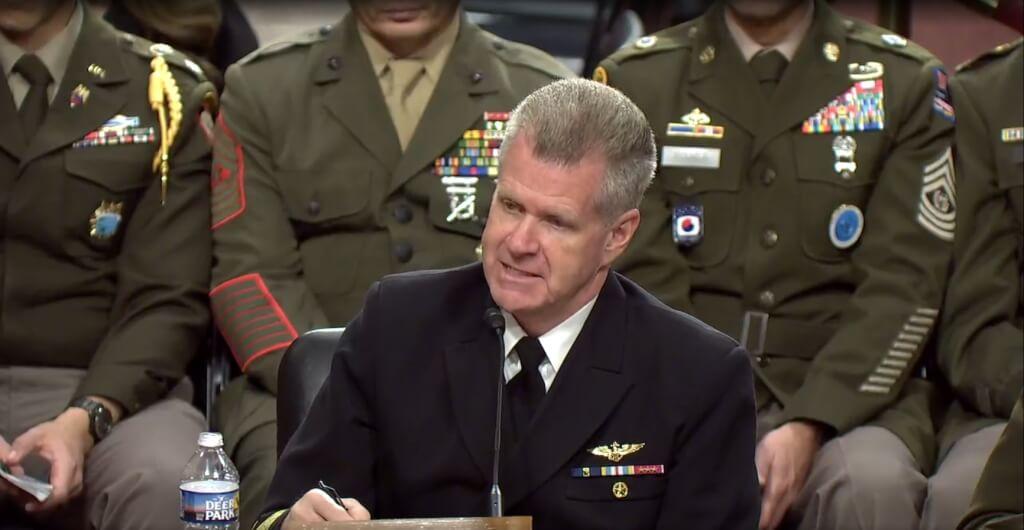
Photo from the Senate Committee on Armed Services Web site
The legislature has repeatedly blocked the passage of President William Lai’s (賴清德) proposed NT$1.25 trillion (US$39.7 billion) special defense budget, prompting concern from Washington.
“The Indo-Pacific is the defining strategic theater of the 21st century,” Paparo said.
The US’ stance on Taiwan has not changed, from foreign military sales under the Taiwan Relations Act to the Three Communiques and the “six assurances,” Paparo said.
However, it is “very important” that Taiwan funds its own defense, he said, adding: “It’s not a chicken and the egg, because you’re not going to get chicken or eggs if you starve the chicken.”
“I have a great deal of faith in Taiwan’s military-age population’s willingness, capability and will to defend themselves,” he added.
He cited polling numbers of willingness to fight between Ukraine and Taiwan, adding that Taiwan’s polling is “orders of magnitude” higher than that of pre-conflict Ukraine.
“They’re building the kind of operational concepts that would lead them to be successful in thwarting an invasion,” he added.
In his witness testimony, Paparo outlined three "meta trends" driving the shift in modern conflict.
The first is that information, influence, cognitive and cyber operations are achieving increasing strategic effects by shaping perceptions and disrupting decision-making, he said.
Second, the commoditization of cheap, massed, uncrewed and often autonomous systems has lowered barriers to advanced capabilities, increasing the cost of assault operations and compressing decision timelines, he said.
The third meta trend is that the commoditization of long-range, precision, penetrating and — frequently — cheap strike has enabled greater leverage to coercion and cost imposition, he said.
The three meta trends “converge into a mega-trend,” he said: achieving information and decision superiority via space proliferation, data, compute, application including artificial intelligence (AI) and human adoption.
Democratic US Senator Richard Blumenthal asked Paparo how Taiwan, a smaller country with fewer troops yet highly capable in cyber and uncrewed, asymmetric forces, is viewed by China.
Paprao said the Chinese are “deeply worried,” and are trying to reckon with the three meta-trends, the mega-trend and the changing character of warfare.
China wants to build a drone force that would be “a vanguard of an assaulting force, “ he said.
However, the mass deployment and employment of cheap expendable munitions would favor the defensive, he said.
Taiwan and the US must therefore pursue asymmetric, uncrewed warfare capabilities with mass, numbers, sustainability and AI tools that would enable them to outmatch potential adversaries, he said.
US Senate Armed Services Committee Chairman Jack Reed said that comparisons could be drawn between Ukraine and Taiwan in that Taiwan would largely use asymmetric strategies to counter China, asking what lessons the US has drawn from Ukraine in this regard.
Paparo said that the US would continue to prioritize the “hellscape strategy” and has learned that low-cost munitions and drone warfare make assault much more costly.
The “hellscape” strategy involves saturating the air and waters around Taiwan with thousands of drones and other platforms capable of striking invading forces from multiple domains at once.
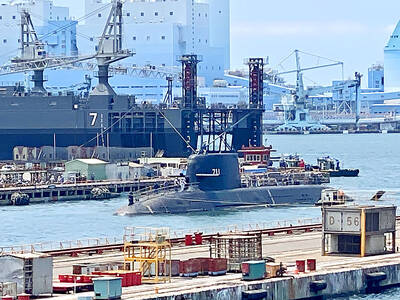
AGING: While Japan has 22 submarines, Taiwan only operates four, two of which were commissioned by the US in 1945 and 1946, and transferred to Taiwan in 1973 Taiwan would need at least 12 submarines to reach modern fleet capabilities, CSBC Corp, Taiwan chairman Chen Cheng-hung (陳政宏) said in an interview broadcast on Friday, citing a US assessment. CSBC is testing the nation’s first indigenous defense submarine, the Hai Kun (海鯤, Narwhal), which is scheduled to be delivered to the navy next month or in July. The Hai Kun has completed torpedo-firing tests and is scheduled to undergo overnight sea trials, Chen said on an SET TV military affairs program. Taiwan would require at least 12 submarines to establish a modern submarine force after assessing the nation’s operational environment and defense
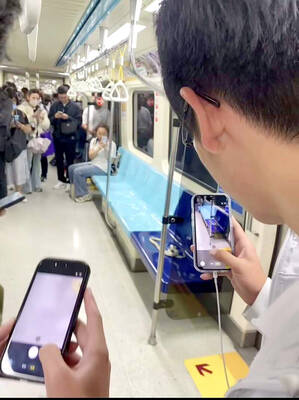
A white king snake that frightened passengers and caused a stir on a Taipei MRT train on Friday evening has been claimed by its owner, who would be fined, Taipei Rapid Transit Corp (TRTC) said yesterday. A person on Threads posted that he thought he was lucky to find an empty row of seats on Friday after boarding a train on the Bannan (Blue) Line, only to spot a white snake with black stripes after sitting down. Startled, he jumped up, he wrote, describing the encounter as “terrifying.” “Taipei’s rat control plan: Release snakes on the metro,” one person wrote in reply, referring
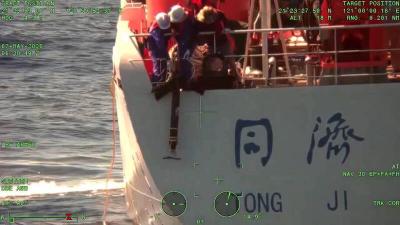
The coast guard today said that it had disrupted "illegal" operations by a Chinese research ship in waters close to the nation and driven it away, part of what Taipei sees a provocative pattern of China's stepped up maritime activities. The coast guard said that it on Thursday last week detected the Chinese ship Tongji (同濟號), which was commissioned only last year, 29 nautical miles (54km) southeast of the southern tip of Taiwan, although just outside restricted waters. The ship was observed lowering ropes into the water, suspected to be the deployment of scientific instruments for "illegal" survey operations, and the coast
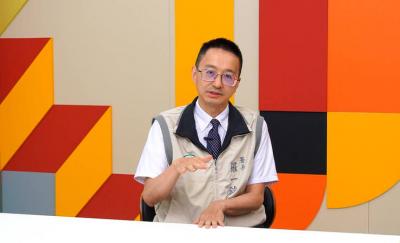
Taiwan’s two cases of hantavirus so far this year are on par with previous years’ case numbers, and the government is coordinating rat extermination work, so there should not be any outbreaks, Centers for Disease Control (CDC) Director-General Philip Lo (羅一鈞) said today in an interview with the Liberty Times (the Taipei Times’ sister newspaper). An increase in rat sightings in Taipei and New Taipei City has raised concerns about the spread of hantavirus, as rats can carry the disease. In January, a man in his 70s who lived in Taipei’s Daan District (大安) tested positive posthumously for hantavirus, Taiwan’s


 RSS
RSS