


Center for Strategic and International Studies (CSIS) president John Hamre yesterday praised Taiwan’s significant strides in self-defense, saying that the nation’s growing preparedness serves as a powerful deterrent against authoritarian threats.
Speaking during a meeting with President William Lai (賴清德) at the Presidential Office in Taipei, Hamre talked about his previous visit to Taiwan, three years ago, during Lai’s presidential campaign.
At every meeting during that visit, the Taiwanese side would always ask: “Will the US help defend Taiwan?” while the US side would ask: “Will Taiwan be prepared to defend itself?” he said.
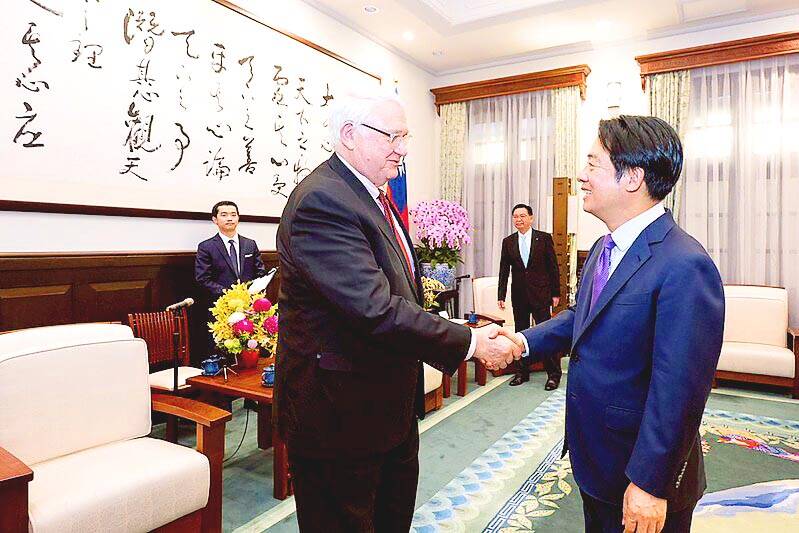
Photo courtesy of the Presidential Office
Hamre said he was pleased today to witness the remarkable progress Taiwan has made under Lai’s leadership, especially the nation’s commitment to its own defense.
The efforts extend beyond merely acquiring essential military equipment, to strengthening the civil defense resilience of the entire population, he added.
Hamre said that US Indo-Pacific Commander Admiral Samuel Paparo recognizes Taiwan as a vital partner and is advancing bilateral cooperation in numerous critical domains.
While acknowledging that there is still work to be done — specifically passing the special defense budget awaiting approval in the Legislative Yuan — Hamre remained optimistic.
He expressed confidence that the budget would eventually pass, saying that Taiwanese understand the importance of self-defense.
The more prepared you are, the greater the deterrent power, Hamre added.
Making his final international trip as CSIS president before handing leadership to former US chairman of the joint chiefs of staff, retired Marine general Joseph Dunford, Hamre reaffirmed his deep personal connection to Taiwan.
Describing Taiwan as his “second home,” he said that seeing the nation’s flag reminds him that it stands as a “symbol of freedom in Asia,” and reaffirms his commitment to Taiwan’s long-term security and prosperity.
Lai thanked the outgoing think tank leader for his steadfast support over the years.
Lai described CSIS as a “powerful searchlight” that illuminates the crucial importance of cross-strait peace and stability for global prosperity, ensuring that Taiwan is not isolated while making authoritarian regimes hesitate before acting.
Taiwanese firmly believe “strength is the moat of peace,” Lai said.
He reiterated his administration’s commitment to boosting the nation’s defense capabilities, saying that Taiwan’s defense budget, calculated by NATO standards, has already surpassed 3 percent of GDP, with a target of 5 percent by 2030 to further secure the Indo-Pacific region.
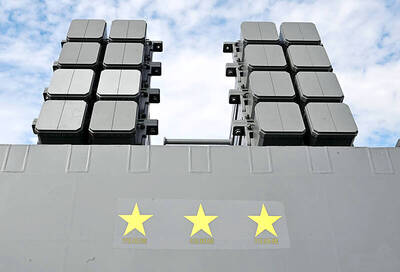
UPGRADE: The Kang Ding-class frigate is replacing its Chaparall missiles with Tien Chien II and Hua Yang VLS, which would provide it with long-range, 360° air defense Taiwan plans to produce 1,200 to 1,376 Hai Chien II missiles (海劍二, Sea Sword II) — also known as TC-2N — to serve as the standard air defense system of the navy’s surface combatant fleet, a source said yesterday. Last week, the Hai Chien II, the naval version of the Tien Kung II missile (天劍二, Sky Sword II), completed a live-fire test in waters off the National Chungshan Institute of Science and Technology’s Jiupeng facility (九鵬) in Pingtung County’s Manjhou Township (滿州). The MIM72 Chaparral and other dated air defense missiles that currently arm Taiwanese ships have inadequate range to combat Chinese

REASONS FOR TRAVEL: An assistant professor said that proposed amendments to penalize drivers if they used drugs overseas would not deter people from traveling People who operate a motor vehicle under the influence of marijuana would have their driver’s license revoked, even if they used the substance while overseas, the Ministry of Transportation and Communications said yesterday, citing proposed amendments to the Road Traffic Management and Penalty Act (道路交通管理處罰條例). The amendments would also authorize the government to revoke the licenses of people determined to have used Category 1 or Category 2 narcotics, even if they were not operating a vehicle while under the influence of drugs, as well as ban them from taking the license test for three years, the ministry said. People aged 18 or
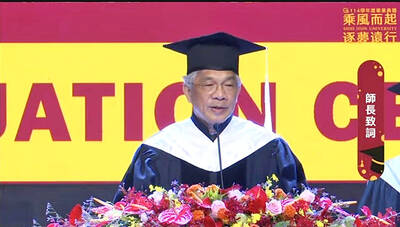
Shih Hsin University President Chen Ching-he (陳清河) yesterday issued a public apology for comments made in his commencement speech last week, stating that he has asked the school to suspend his duties and halt his wages for two months as a show of contrition. At the commencement ceremony on May 30, Chen said, “If you don’t manage your time well, or your own emotions, or your health, then I am telling every one of you — put a quick end to ‘you,’ because the world has no need for ‘you.’” The comments have sparked significant controversy online, and Chen through an open
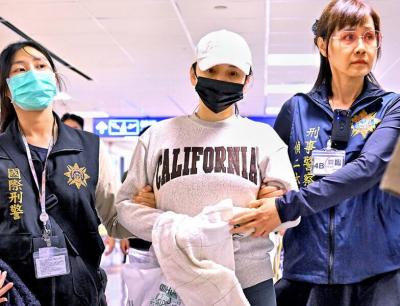
Johanne Liou (劉喬安), a Taiwanese woman who shot to unwanted fame during the Sunflower movement protests in 2014, returned to Taiwan last night after being deported from the US. She is to stand trial in Taiwan for charges involving embezzlement, fraud and drug crimes. The Criminal Investigation Bureau (CIB) said it took her into custody at Taiwan Taoyuan International Airport and would first question her before transferring her to the New Taipei District Prosecutors’ Office. She was arrested upon disembarking a flight from San Francisco that landed shortly before 7pm. Liou absconded to the US in 2019 after jumping bail


 RSS
RSS