


China’s 10 new “incentives” are “sugar-coated poison,” an official said yesterday, adding that Taiwanese businesses see them clearly for what they are, but that Beijing would inevitably find some local collaborators to try to drums up support.
The official, speaking on condition of anonymity, made the remark ahead of a news conference the General Chamber of Commerce is to hold today.
The event, titled “Industry Perspectives on China’s Recent Pro-Taiwan Policies,” is expected to include representatives from industry associations — such as those in travel, hotels, food and agriculture — to request the government cooperate with China’s new measures, people familiar with the matter said.
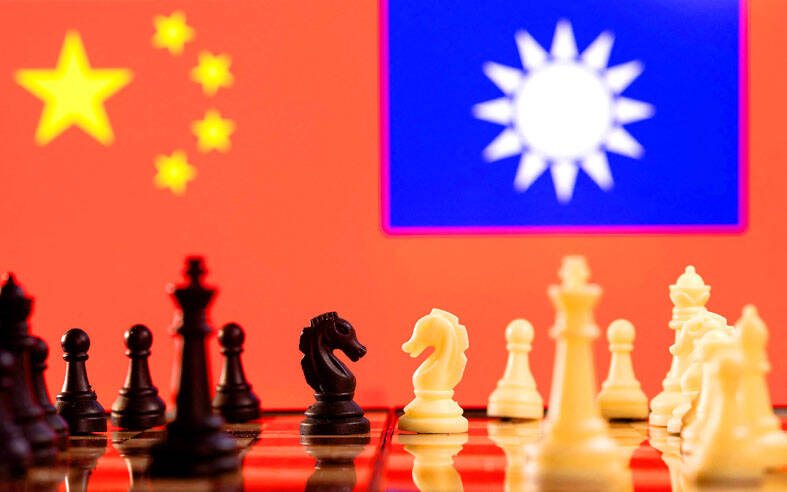
Photo: Reuters
The Chinese Communist Party (CCP) is looking for local collaborators to voice support for the “incentives,” even though businesses and farmers in Taiwan are aware that the “pro-Taiwan” measures are “sugar-coated poison,” the official said.
“This same old trick has been going on for 20 years,” they said.
The state-controlled Hong Kong-based China Review News Agency published an article saying that the chamber and seven associations back the measures.
The “incentive measures” were announced on April 12, the last day of Chinese Nationalist Party (KMT) Chairwoman Cheng Li-wun’s (鄭麗文) visit to China, where she met with Chinese President Xi Jinping (習近平) and echoed the CCP’s narrative, the official said.
The KMT ignored historical lessons and the painful experience of Tibetans and Hong Kongers, as well as the tragedy of past KMT-CCP cooperation, they said.
China has announced “preferential” measures in the past, which often turned out to be empty promises, they said.
Apart from seeking support from industry associations, the KMT might advocate for CCP cooperation in the Legislative Yuan, which Taiwanese would oppose, the official said, urging people to safeguard the nation’s freedom and democracy, and prevent Taiwan from being dragged into a unification framework.
Economic Democracy Union convener Lai Chung-chiang (賴中強) similarly compared the measures to poison, adding that Beijing was weaponizing tourism and trade.
Industry associations should not amplify the CCP’s political agenda, he said.
Even if China resumes “individual travel” for residents of China’s Fujian Province and Shanghai, as promised in the “incentives,” it would still have to go through designated travel agencies in China, making genuine free travel unlikely, Lai said.
Itineraries for Chinese tourists are heavily influenced by Chinese tour operators, which determine destinations, accommodation and dining arrangements under a “one-stop” system, meaning the market is manipulated by Chinese travel agencies, he said.
“Resuming individual travel for Chinese tourists would not benefit Taiwan’s tourism industry,” he said, adding that a key issue is breaking the monopoly of Chinese tour operators.
China uses tourism and trade as tools of coercion, imposing or lifting bans at will, a tactic that Taiwan, Japan, Canada and New Zealand have experienced, he said.
If Taiwan’s hospitality businesses invest in facilities for short-term gains, they risk significant losses should Beijing reverse course, he said.
As for agricultural and fishery exports to China, unless Beijing abandons its politicization of trade inspections, Taiwanese products would face high political risks, Lai said.
He urged Taiwan’s agricultural and fishery sectors to learn from the past and avoid repeating mistakes, otherwise they would again fall victim to China’s “trick and trap” playbook that allows the CCP to enhance its economic coercion.
Industry associations should not play along with China’s political maneuvers, he said, calling on them to support a diversified and resilient market environment in Taiwan.
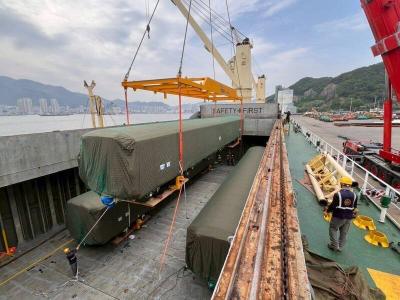
The first of 10 new high-capacity trains purchased from South Korea’s Hyundai Rotem arrived at the Port of Taipei yesterday to meet the demands of an expanding metro network, Taipei Rapid Transit Corp (TRTC) said yesterday. The train completed a three-day, 1,200km voyage from the Port of Masan in South Korea, the company said. Costing NT$590 million (US$18.79 million) each, the new six-carriage trains feature a redesigned interior based on "human-centric" transportation concepts, TRTC said. The design utilizes continuous longitudinal seating to widen the aisles and optimize passenger flow, while also upgrading passenger information displays and driving control systems for a more comfortable
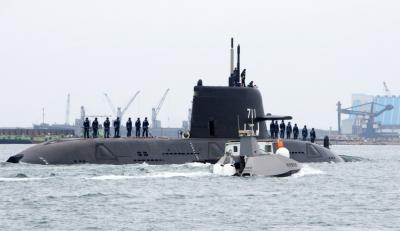
Taiwan's first indigenous defense submarine, the SS-711 Hai Kun (海鯤, or Narwhal), departed for its 13th sea trial at 7am today, marking its seventh submerged test, with delivery to the navy scheduled for July. The outing also marked its first sea deployment since President William Lai (賴清德) boarded the submarine for an inspection on March 19, drawing a crowd of military enthusiasts who gathered to show support. The submarine this morning departed port accompanied by CSBC Corp’s Endeavor Manta (奮進魔鬼魚號) uncrewed surface vessel and a navy M109 assault boat. Amid public interest in key milestones such as torpedo-launching operations and overnight submerged trials,
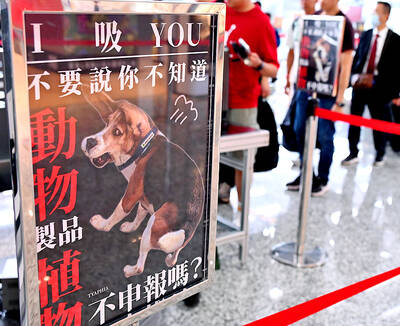
Quarantine awareness posters at Taiwan Taoyuan International Airport have gone viral for their use of wordplay. Issued by the airport branch of the Animal and Plant Health Inspection Agency, the posters feature sniffer dogs making a range of facial expressions, paired with advisory messages built around homophones. “We update the messages for holidays and campaign needs, periodically refreshing materials to attract people’s attention,” quarantine officials said. “The aim is to use the dogs’ appeal to draw focus to quarantine regulations.” A Japanese traveler visiting Taiwan has posted a photo on X of a poster showing a quarantine dog with a
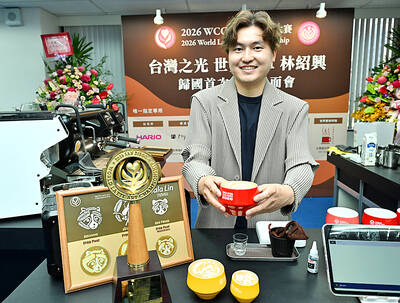
Taiwan’s coffee community has launched a “one-person-one-e-mail” campaign, calling for people to send a protest-e-mail to the World Coffee Championships (WCC) urging it to redesignate Taiwanese competitors as from “Taiwan,” rather than “Chinese Taipei.” The call followed sudden action last week after the WCC changed all references to Taiwanese competitors from “Taiwan” to “Chinese Taipei,” including recent World Latte Art champion Bala (林紹興), who won the World Latte Art Championship in San Diego earlier this month. When Bala received the trophy, he was referred to as representing Taiwan, as well as in the announcement on the WCC’s Web site, until it


 RSS
RSS