


China’s population is rapidly aging and moving toward a low-fertility society, with the demographic dividend that fueled three decades of rapid economic growth now turning into a demographic burden, according to a Taiwanese researcher.
In an article titled “Observations on China’s Population Structure Issues” published on the Mainland Affairs Council’s latest Briefing on Mainland China and Cross-Strait Situation, Institute for National Defense and Security Research associate researcher Wang Chan-hsi (王占璽) noted that since 2016, China’s birthrate has declined sharply. Last year, the number of newborns fell to 7.92 million, only 44 percent of the 2016 level.
It not only dropped below the projected thresholds of 9 million and 8 million, but was also the lowest level since the founding of the People’s Republic of China in 1949, he said, adding China’s total population has fallen to 1.40489 billion, recording four consecutive years of negative growth.

Photo: Wang Zhao, AFP
China’s birthrate is rapidly declining, and it could soon match the levels of Taiwan, Japan and South Korea within the next three to five years, Wang said.
As the number of newborns drops, 20,000 kindergartens closed in 2024, resulting in the loss of over 240,000 preschool teaching jobs, he said.
Primary schools are also facing an annual loss of more than 2 million students since 2023, he said, adding that many provinces and cities in China are seeing a rapid contraction of teaching positions, with increasing pressure on educators to switch roles, further escalating unemployment issues tied to its declining birthrate.
The gender distribution of the population shows a surplus of men in rural areas and a surplus of women in cities, resulting in a two-way imbalance, he said.
He cited data from China’s 2021 Seventh National Census as showing the gender ratio in urban areas is 106 (106 males for every 100 females), while in rural areas it reaches 120.
Nearly 30 million unmarried young men live in rural China, while unmarried young women in first- and second-tier cities might number more than 20 million, he said, adding this gender imbalance further exacerbates China’s already low marriage and birthrates.
China’s aging population, coupled with the challenge of “growing old before getting rich” and weak consumer spending, is expected to trigger significant economic and social consequences, he said.
While China’s aging rate is rapidly approaching that of other East Asian countries, its overall wealth remains relatively insufficient, he said.
Moreover, the wealth distribution among older people is highly uneven, he added, stating that of the more than 320 million retirees, 180 million rural pensioners receive less than 200 RMB per month, while only about 17 million urban retirees receive over 5,000 RMB a month, accounting for just 5.3 percent of the total retired population.
Over the medium to long term, the trends of declining birthrates and rapid aging are expected to become major obstacles to sustainable growth, with the potential to disrupt economic and social structures more severely than anticipated, he said.

UPGRADE: The Kang Ding-class frigate is replacing its Chaparall missiles with Tien Chien II and Hua Yang VLS, which would provide it with long-range, 360° air defense Taiwan plans to produce 1,200 to 1,376 Hai Chien II missiles (海劍二, Sea Sword II) — also known as TC-2N — to serve as the standard air defense system of the navy’s surface combatant fleet, a source said yesterday. Last week, the Hai Chien II, the naval version of the Tien Kung II missile (天劍二, Sky Sword II), completed a live-fire test in waters off the National Chungshan Institute of Science and Technology’s Jiupeng facility (九鵬) in Pingtung County’s Manjhou Township (滿州). The MIM72 Chaparral and other dated air defense missiles that currently arm Taiwanese ships have inadequate range to combat Chinese

REASONS FOR TRAVEL: An assistant professor said that proposed amendments to penalize drivers if they used drugs overseas would not deter people from traveling People who operate a motor vehicle under the influence of marijuana would have their driver’s license revoked, even if they used the substance while overseas, the Ministry of Transportation and Communications said yesterday, citing proposed amendments to the Road Traffic Management and Penalty Act (道路交通管理處罰條例). The amendments would also authorize the government to revoke the licenses of people determined to have used Category 1 or Category 2 narcotics, even if they were not operating a vehicle while under the influence of drugs, as well as ban them from taking the license test for three years, the ministry said. People aged 18 or

HEAVY WEATHER: Typhoon Jangmi is due to crash straight into the Ryukyus as airlines look to shift flights to larger aircraft or cancel flights to Okinawa entirely Taiwan’s international air carriers announced flight adjustments over the weekend as Typhoon Jangmi is forecast to hit the Ryukyu Islands today and tomorrow. The Central Weather Administration (CWA) upgraded Jangmi from a tropical storm to a typhoon at 8am yesterday, with the eye located 580km south of Naha city. It was moving north at 19kph. Today, China Airlines’ CI-120, CI-121, CI-122 and CI-123 flights between Taoyuan and Naha, Okinawa, have been canceled as well as CI-132 and CI-133 between Kaohsiung and Naha. EVA Air’s BR-112, BR-113, BR-186 and BR-185 flights between Taoyuan and Naha are also canceled. Low-cost carrier Tigerair Taiwan canceled IT-230,
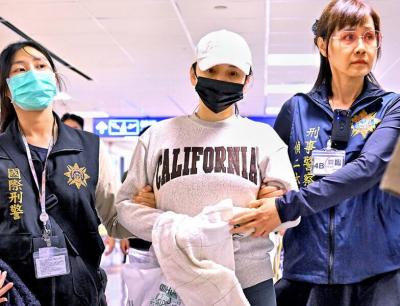
Johanne Liou (劉喬安), a Taiwanese woman who shot to unwanted fame during the Sunflower movement protests in 2014, returned to Taiwan last night after being deported from the US. She is to stand trial in Taiwan for charges involving embezzlement, fraud and drug crimes. The Criminal Investigation Bureau (CIB) said it took her into custody at Taiwan Taoyuan International Airport and would first question her before transferring her to the New Taipei District Prosecutors’ Office. She was arrested upon disembarking a flight from San Francisco that landed shortly before 7pm. Liou absconded to the US in 2019 after jumping bail


 RSS
RSS