


Looking to end an impasse of more than six months, lawmakers across party lines have agreed to begin reviewing the general budget for this fiscal year as long as Premier Cho Jung-tai (卓榮泰) agrees to present the budget at the legislature.
The Chinese Nationalist Party (KMT), Taiwan People’s Party (TPP) and the ruling Democratic Progressive Party (DPP) agreed on Wednesday to send the Cabinet’s budget proposal to committee review after Cho briefs lawmakers on the plan and responds to lawmakers’ questions.
However, as of yesterday afternoon, Cho had not confirmed he would make the appearance, which has been tentatively scheduled for Tuesday.
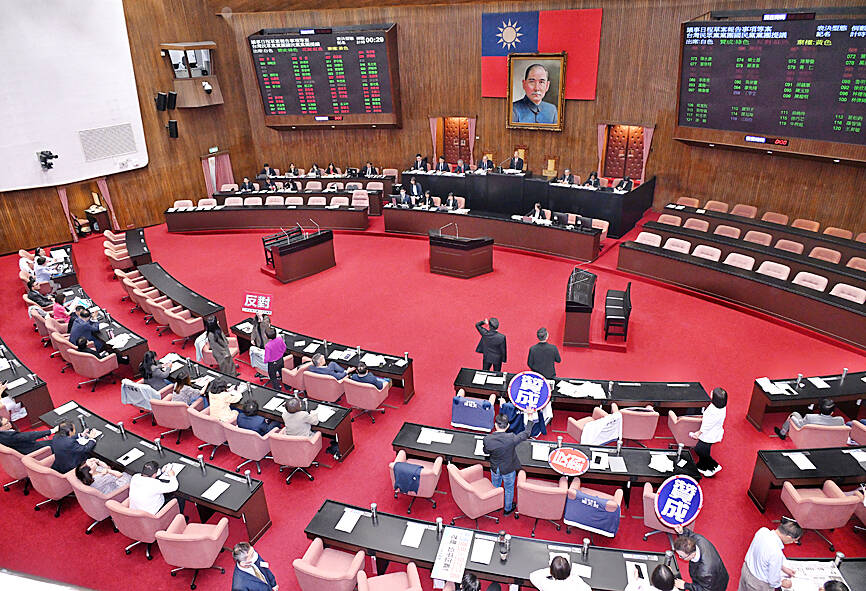
Photo: Fang Pin-chao, Taipei Times
The agreement also requires the Cabinet to promptly implement a NT$71.8 billion (US$2.28 billion) portion of the NT$3.3 trillion budget approved by the opposition-controlled legislature to fund new initiatives before the general budget proposal clears the legislative floor.
Another part of the agreement requires the Cabinet to submit bills within six months of the start of the review that provide a pay raise for active-duty military personnel and increase the income replacement ratio for retired police officers and firefighters.
However, this condition was not tied to the review or passage of this year’s general budget bill, and there is no mechanism that would force the Cabinet to present bills providing for these salary and pension increases.
Opposition lawmakers passed legislation last year directing the Cabinet to budget a pay raise for military personnel and to increase pensions for retired police officers and firefighters, but Cho has declined to earmark funding, citing constitutional concerns.
The Cabinet’s refusal to implement the legislation has led opposition parties to block the budget review.
Instead, the Cabinet has requested a constitutional interpretation and an injunction in both cases.
The Constitutional Court remains in limbo because of the government’s inability to fill seven of the court’s 15 seats, which have been vacant since November 2024, as well as legal wrangling over how many judges the court needs to meet a quorum.
The Cabinet’s earlier position — that the raises would be issued retroactively if the court rules the bills constitutional — was also rejected by opposition lawmakers.
Responding to the agreement, Cabinet spokesperson Michelle Lee (李慧芝) quoted Cho on Thursday as saying that the Ministry of National Defense should conduct a more comprehensive review of military pay, allowances and welfare measures, identify shortcomings and submit proposals to the Cabinet for review.
As for the police personnel system, Cho said relevant agencies have been instructed to continue communicating and negotiating with the Legislature to seek a reasonable and feasible solution.
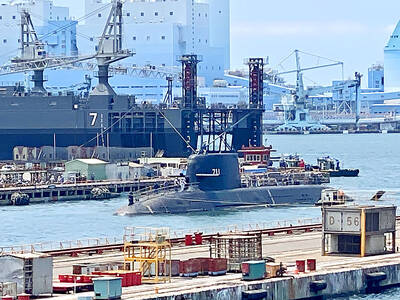
AGING: While Japan has 22 submarines, Taiwan only operates four, two of which were commissioned by the US in 1945 and 1946, and transferred to Taiwan in 1973 Taiwan would need at least 12 submarines to reach modern fleet capabilities, CSBC Corp, Taiwan chairman Chen Cheng-hung (陳政宏) said in an interview broadcast on Friday, citing a US assessment. CSBC is testing the nation’s first indigenous defense submarine, the Hai Kun (海鯤, Narwhal), which is scheduled to be delivered to the navy next month or in July. The Hai Kun has completed torpedo-firing tests and is scheduled to undergo overnight sea trials, Chen said on an SET TV military affairs program. Taiwan would require at least 12 submarines to establish a modern submarine force after assessing the nation’s operational environment and defense

A white king snake that frightened passengers and caused a stir on a Taipei MRT train on Friday evening has been claimed by its owner, who would be fined, Taipei Rapid Transit Corp (TRTC) said yesterday. A person on Threads posted that he thought he was lucky to find an empty row of seats on Friday after boarding a train on the Bannan (Blue) Line, only to spot a white snake with black stripes after sitting down. Startled, he jumped up, he wrote, describing the encounter as “terrifying.” “Taipei’s rat control plan: Release snakes on the metro,” one person wrote in reply, referring
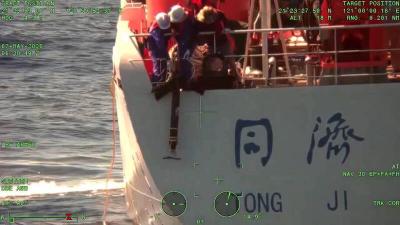
The coast guard today said that it had disrupted "illegal" operations by a Chinese research ship in waters close to the nation and driven it away, part of what Taipei sees a provocative pattern of China's stepped up maritime activities. The coast guard said that it on Thursday last week detected the Chinese ship Tongji (同濟號), which was commissioned only last year, 29 nautical miles (54km) southeast of the southern tip of Taiwan, although just outside restricted waters. The ship was observed lowering ropes into the water, suspected to be the deployment of scientific instruments for "illegal" survey operations, and the coast

Taiwan’s two cases of hantavirus so far this year are on par with previous years’ case numbers, and the government is coordinating rat extermination work, so there should not be any outbreaks, Centers for Disease Control (CDC) Director-General Philip Lo (羅一鈞) said today in an interview with the Liberty Times (the Taipei Times’ sister newspaper). An increase in rat sightings in Taipei and New Taipei City has raised concerns about the spread of hantavirus, as rats can carry the disease. In January, a man in his 70s who lived in Taipei’s Daan District (大安) tested positive posthumously for hantavirus, Taiwan’s


 RSS
RSS