


As Chinese warships and fighter jets staged massive drills around Taiwan in December last year, a parallel action was unfolding on smartphone screens.
On Douyin, China’s version of TikTok, a news outlet run by the Chinese Communist Party (CCP) posted a 51-second video of Chinese Nationalist Party (KMT) Chairwoman Cheng Li-wun (鄭麗文) accusing President William Lai (賴清德) of inviting Chinese aggression.
Lai was “dragging all 23 million of us” in Taiwan into a “dead end, a road to death” by pursuing independence, Cheng said.
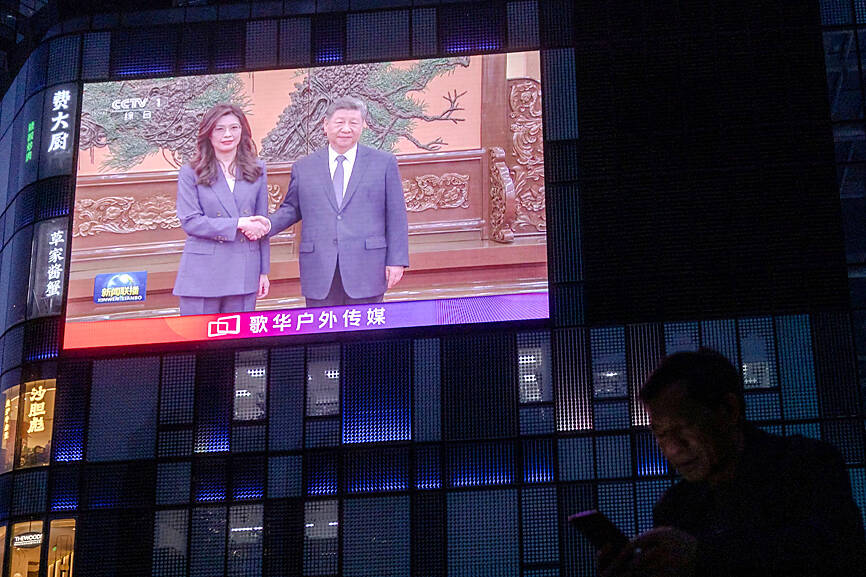
Photo: Reuters
The clip quickly surfaced on Facebook, YouTube and other platforms popular in Taiwan.
Chinese state media outlets are increasingly amplifying Taiwanese critics of the ruling Democratic Progressive Party (DPP), including influencers and politicians linked to the KMT, according to five Taiwanese security officials and data from Taipei-based research group Taiwan Information Environment Research Center (IORG).
China imports the public statements of leading KMT and other opposition figures that are critical of the government and pumps them out in a torrent of anti-DPP messaging in Chinese state media and on social media platforms in China. Those clips are then shared and often repackaged for consumption on platforms popular in Taiwan, including Facebook, TikTok and YouTube, as well as on Douyin, sometimes embellished or presented in ways that obscure China’s hand.
While China has previously employed Taiwanese in its propaganda, it has turbocharged this information-warfare tactic, the security officials said.
Familiar voices and accents can sound more credible. The goal is to discredit a government Beijing accuses of seeking independence, the officials said.
With the DPP seeking US$40 billion in extra defense outlays, the campaign also appears aimed at convincing Taiwanese that China’s military power is so overwhelming that it is futile for Taiwan to spend heavily on more US weapons, IORG and three of the security officials said.
China’s Taiwan Affairs Office and the Chinese Ministry of National Defense did not respond to requests for comment about Beijing’s information warfare.
In Taipei, the Ministry of National Defense said that it is countering a massive increase in Chinese “cognitive warfare” by strengthening the armed forces’ media-literacy skills and psychological resilience.
The Presidential Office added that cross-strait peace must be “built on strength, not on concessions to authoritarian pressure.”
Facebook, TikTok and YouTube, which are blocked in China, did not respond to questions about Chinese information warfare. Douyin also did not respond to a request for comment.
While Chinese preparations for military action against Taiwan continue, the information warfare is part of Beijing’s strategy of wearing down Taiwan without resorting to force. In this regard, the KMT provides a valuable opening for China: The party has moved to seek closer ties with Beijing in a bid to head off what it says is a crisis made worse by the DPP government’s provocation of China.
Cheng met with Chinese President Xi Jinping (習近平) earlier this month in Beijing, where Xi told her the KMT and the CCP must “consolidate political mutual trust” and “join hands to create a bright future of the motherland’s reunification.”
Cheng’s visit to Beijing fulfilled a campaign pledge and continued a long-established tradition of top-level meetings between the KMT and the CCP, the KMT said in a statement.
The two parties have many differences, but both believe disagreements should be resolved through dialogue, it added.
Data provided by IORG showed the mechanics of the Chinese campaign. The nonpartisan group of social scientists and data analysts is funded in part by the US and European governments, and Taiwanese academic institutions.
About 560,000 videos were posted on Douyin by 1,076 accounts run by official CCP media outlets in the fourth quarter of last year. About 18,000 videos discussed Taiwan.
IORG used facial recognition technology to identify 57 Taiwanese figures in 2,730 clips, with results verified by IORG researchers.
The number of videos featuring Taiwanese voices more than doubled from a year earlier during October and November last year, and monthly airtime jumped 164 percent to 369 minutes.
Strikingly, of the top 25 Taiwanese figures in the Chinese videos, 13 are affiliated with the KMT, from current lawmakers and party representatives to former officials under past KMT-led governments. Two others are senior officials in a small party that supports unification with China, while 10 are influencers known for criticizing the governing DPP.
Cheng was the top-ranked Taiwanese figure in the Chinese clips, featuring in 460 videos across 68 Douyin accounts and generating more than 5 million interactions, including likes, comments and shares.
The videos amplified her calls for “peace” with China, her criticism of Lai as a “pawn” of external forces, and her characterization of the DPP’s stance on Taiwan independence as destructive. Once aired on Chinese state media and social media platforms, some of the clips were repackaged and posted on platforms popular in Taiwan.
In its statement, the KMT said that Cheng’s comments reflected the mainstream aspirations of Taiwanese for peace.
“Even if mainland state media tend to incorporate more Taiwanese voices, this is based on the diversity of public opinion that already exists in Taiwan,” it added.
Various influencers were also heavily cited by the Chinese outlets. Among them were Holger Chen (陳之漢), a bodybuilder popular among younger audiences, and five retired senior military officials known for criticizing the DPP and Taiwan’s defenses.
The Mainland Affairs Council said that the government hoped the retired military officers “will be mindful of public perception” and should not echo Beijing’s rhetoric.
They “must not forget the oath they once swore to be loyal” to Taiwan, it added.
Support in Taiwan for maintaining the “status quo” indefinitely has risen 8 points to 33.5 percent since 2020, while support for maintaining the “status quo,” but moving toward independence has declined almost 4 points to 21.9 percent, according to a long-running annual survey series released in January by National Chengchi University’s Election Study Center.
The combined proportion who want unification with China as soon as possible or wish to maintain the “status quo,” but move toward unification has been relatively stable at about 7 percent.
It is unclear whether the intensification of China’s information warfare is having an impact. There has been no discernible shift in Taiwanese attitudes toward independence or unification since 2024, according to the survey data.
This timeframe roughly coincides with the period of intensified information warfare examined by IORG.
Taiwan’s intelligence officials recorded more than 45,000 sets of inauthentic social media accounts and 2.3 million pieces of disinformation on China-Taiwan issues last year, a January report by the National Security Bureau said.
It described the goals of Beijing’s information warfare: To exacerbate divisions within Taiwan, weaken the Taiwanese will to resist and win support for China’s stance.
“They want you to doubt the military and doubt Taiwan, to make you feel that no one will come to help you if war breaks out,” one Taiwanese security official said of China’s state media.
A civil defense handbook that the government issued to households last year went so far as to state pre-emptively that amid heightened tensions with China, any claims of Taiwan’s surrender must be considered false — a recognition that the information battle is intensifying, even if no shots have been fired.

NATIONAL SECURITY: Authorities are working to confirm the identities of the military personnel involved and investigating possible illegal conduct and regulatory violations Authorities are probing possible national security implications after Kinmen police and immigration officers on Sunday found a Chinese woman allegedly posing as a tourist while engaging in prostitution involving more than 10 military personnel. The woman, surnamed Chen (陳), has since been deported, authorities said, adding that investigators are still working to confirm the identities of those implicated, as the records only listed code names and aliases. The case stemmed from a report received by the Kinmen District Prosecutors’ Office on Friday last week from the Jinhu Precinct of the Kinmen County Police Bureau. On Sunday, police, along with the National Immigration

GLOBALGIVING: ‘ Caving to external pressure is not acceptable for an organization that has cultivated justice reform and human rights for 30 years,’ one NGO said A slew of non-government organizations (NGOs) have withdrawn from the GlobalGiving fundraising platform after it announced it would use “Chinese Taipei” instead of “Taiwan” from next month. The Taiwan Good Rice Association wrote on Facebook on Friday that it was informed on April 28 via a teleconference call of the change, which was made because the platform wanted to operate in China. Taiwan Good Rice is to terminate all cooperative relationships with GlobalGiving in response to the platform’s “unilateral and non-negotiable” decision to remove references to Taiwan, the NGO said. “Taiwan is in the official name of Taiwan Good Rice Association and the

HEAVY WEATHER: Typhoon Jangmi is due to crash straight into the Ryukyus as airlines look to shift flights to larger aircraft or cancel flights to Okinawa entirely Taiwan’s international air carriers announced flight adjustments over the weekend as Typhoon Jangmi is forecast to hit the Ryukyu Islands today and tomorrow. The Central Weather Administration (CWA) upgraded Jangmi from a tropical storm to a typhoon at 8am yesterday, with the eye located 580km south of Naha city. It was moving north at 19kph. Today, China Airlines’ CI-120, CI-121, CI-122 and CI-123 flights between Taoyuan and Naha, Okinawa, have been canceled as well as CI-132 and CI-133 between Kaohsiung and Naha. EVA Air’s BR-112, BR-113, BR-186 and BR-185 flights between Taoyuan and Naha are also canceled. Low-cost carrier Tigerair Taiwan canceled IT-230,

MULTIPRONGED APPROACH: China has sought to pressure Palau across a number of fronts, but the island nation has staunchly resisted overtures to ditch Taiwan Palau has been firm in backing Taiwan despite Chinese pressure that uses tourism economics, cyberattacks and criminal infiltration as tools to threaten the Pacific ally into renouncing its recognition of Taiwan as a sovereign state. The Presidential Office yesterday announced that Vice President Hsiao Bi-khim (蕭美琴) would visit Palau from Saturday to Wednesday next week at the invitation of Palauan President Surangel Whipps Jr. Whipps in April said in an interview that China had outspokenly asked Palau to “denounce Taiwan.” “And we have said: ‘We have no enemies, but nobody tells us who our friends are,’” he said. Whipps has told reporters multiple times


 RSS
RSS