


The High Court yesterday handed down prison sentences to six retired and active military personnel for leaking military secrets to China, and gave them prison sentences of up to eight years and six months.
Wang Wen-hao (王文豪), Tan Chun-ming (譚俊明), Lu Fang-chi (呂芳契), Chiu Han-lin (邱翰林) and Yang Chien-hui (楊千慧) were found guilty of developing an organization for China, in contravention of the National Security Act (國家安全法).
The other defendant, Yang Po-chih (楊博智), was convicted for disclosing information of a secret nature concerning national defense, in contravention of the Criminal Code of the Armed Forces (陸海空軍刑法).
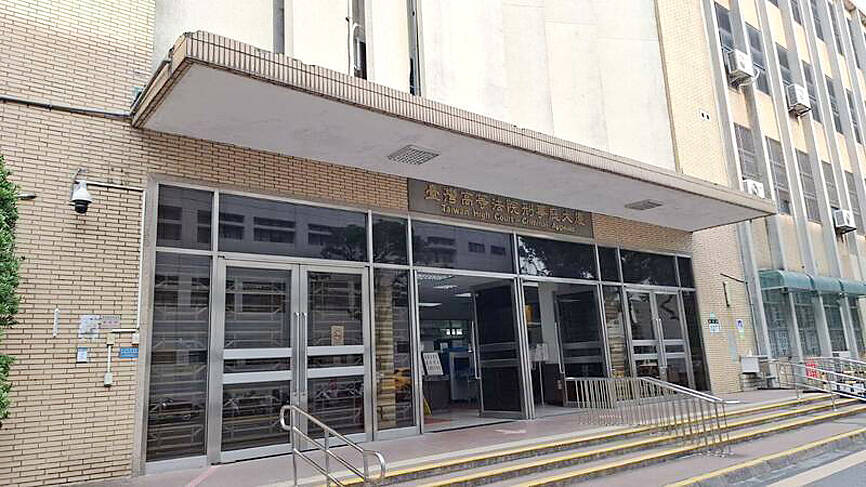
Photo: Weng Ching-yu, Taipei Times
They were given sentences ranging from four years and six months to eight years and six months.
The ruling can be appealed.
Ding Xiaohu (丁小琥), or Ting Siu Fu in Cantonese, a Chinese man with a Hong Kong passport, was also indicted in the case, but died in February and had his case dismissed.
The High Prosecutors’ Office indicted the seven people in November last year, after the Investigation Bureau’s Taipei Investigation Branch in 2024 began investigations into possible espionage activities involving Ding.
The bureau said that Ding recruited retired officers Wang, Tan and two others surnamed Chang (張) and Ho (何), who have since died, as members of a network that developed contacts and gathered classified information.
The four recruited active and retired personnel through their connections in the military, including Lu, Chiu, Yang Chien-hui and Yang Po-chih, prosecutors said.
The operation also involved persuading active military personnel to take a passive and non-resistant attitude in potential cross-Taiwan Strait military conflicts, they said.
More than NT$11.12 million (US$351,343) was transferred to Taiwan to support the espionage operations by an associate named Chen Chun-an (陳俊安), according to information provided by prosecutors, the bureau and the Ministry of National Defense.
The Taipei District Prosecutors’ Office also indicted Ding, Wang and Chen in November last year on charges of money laundering and contraventions of the Banking Act (銀行法).
The charges against Ding were dropped following his death, while proceedings against Wang and Chen are ongoing, the Taipei District Court said.
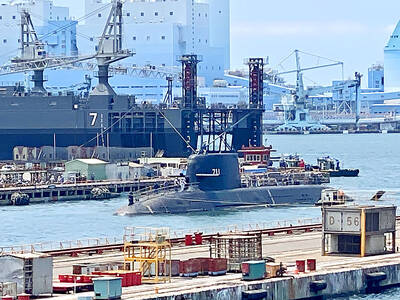
AGING: While Japan has 22 submarines, Taiwan only operates four, two of which were commissioned by the US in 1945 and 1946, and transferred to Taiwan in 1973 Taiwan would need at least 12 submarines to reach modern fleet capabilities, CSBC Corp, Taiwan chairman Chen Cheng-hung (陳政宏) said in an interview broadcast on Friday, citing a US assessment. CSBC is testing the nation’s first indigenous defense submarine, the Hai Kun (海鯤, Narwhal), which is scheduled to be delivered to the navy next month or in July. The Hai Kun has completed torpedo-firing tests and is scheduled to undergo overnight sea trials, Chen said on an SET TV military affairs program. Taiwan would require at least 12 submarines to establish a modern submarine force after assessing the nation’s operational environment and defense

A white king snake that frightened passengers and caused a stir on a Taipei MRT train on Friday evening has been claimed by its owner, who would be fined, Taipei Rapid Transit Corp (TRTC) said yesterday. A person on Threads posted that he thought he was lucky to find an empty row of seats on Friday after boarding a train on the Bannan (Blue) Line, only to spot a white snake with black stripes after sitting down. Startled, he jumped up, he wrote, describing the encounter as “terrifying.” “Taipei’s rat control plan: Release snakes on the metro,” one person wrote in reply, referring
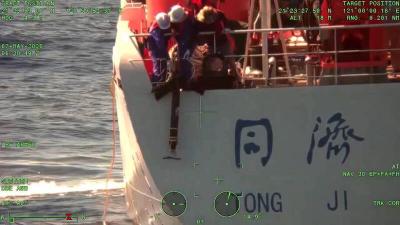
The coast guard today said that it had disrupted "illegal" operations by a Chinese research ship in waters close to the nation and driven it away, part of what Taipei sees a provocative pattern of China's stepped up maritime activities. The coast guard said that it on Thursday last week detected the Chinese ship Tongji (同濟號), which was commissioned only last year, 29 nautical miles (54km) southeast of the southern tip of Taiwan, although just outside restricted waters. The ship was observed lowering ropes into the water, suspected to be the deployment of scientific instruments for "illegal" survey operations, and the coast

Taiwan’s two cases of hantavirus so far this year are on par with previous years’ case numbers, and the government is coordinating rat extermination work, so there should not be any outbreaks, Centers for Disease Control (CDC) Director-General Philip Lo (羅一鈞) said today in an interview with the Liberty Times (the Taipei Times’ sister newspaper). An increase in rat sightings in Taipei and New Taipei City has raised concerns about the spread of hantavirus, as rats can carry the disease. In January, a man in his 70s who lived in Taipei’s Daan District (大安) tested positive posthumously for hantavirus, Taiwan’s


 RSS
RSS