


The Ministry of Labor yesterday reminded Alien Permanent Resident Certificate (APRC) holders covered by changes introduced at the turn of the year to make sure their employer has enrolled them in employment insurance.
“Before the change, only Taiwanese citizens and foreign spouses married to Taiwanese nationals were covered by employment insurance. Other foreign nationals could not enroll,” Department of Labor Insurance Director Chen Mei-nu (陳美女) told a news conference in Taipei.
Following a change in the law on Jan. 1, three categories of foreign professionals in Taiwan with permanent residency are now required to enroll in employment insurance, which would entitle them to certain benefits.

Photo: Screen grab from the Web site of the Administration for the Digital Industries
The three groups are “foreign professionals,” meaning those employed in white-collar jobs; “foreign specialist professionals,” referring to people with expertise specially needed in Taiwan, many of whom qualify for the Employment Gold Card; and “foreign senior professionals,” those recognized for outstanding achievements in a field of “excellence.”
Chen said the change was part of Taiwan’s efforts to “recruit the professional talent needed for national economic development,” adding that employment insurance benefits include unemployment benefits and parental leave allowances.
She said that such benefits help protect workers’ basic livelihood for a certain period when they are “involuntarily unemployed” or on unpaid parental leave.
However, if people in those three categories later have their permanent residency permits revoked or nullified, they would lose their right to receive benefits from the insurance, Chen said.
With the rule having taken effect, Chen reminded employers to enroll such workers in employment insurance either upon hiring or once they obtain permanent residency.
The Bureau of Labor Insurance is currently prioritizing guidance over enforcement, and no penalties are being imposed at this stage for failing to do so, she added.
By the end of February, 1,633 foreign professionals had been automatically enrolled in employment insurance, Chen said.
Department section chief Huang Ci-fang (黃琦鈁) said that the automatic enrollment was carried out by cross-checking data from government agencies, including the National Immigration Agency and the Workforce Development Agency.
She added that the Bureau of Labor Insurance had received several reports that certain eligible foreign professionals had not been included in the process.
Huang said the automatic enrollment was a one-time measure and would not be carried out again, advising anyone unsure of their enrollment status to contact the bureau for confirmation.
Currently, eligible employed workers aged 15 and above, but under 65 are covered by employment insurance.
Premiums are calculated based on an insured worker’s monthly salary, using a 1 percent premium rate, with workers paying 20 percent, employers 70 percent and the government covering 10 percent.
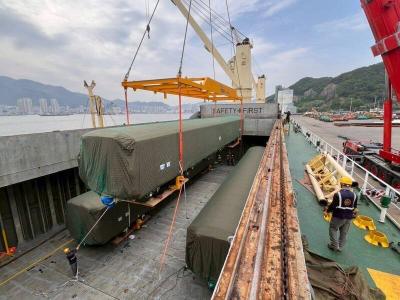
The first of 10 new high-capacity trains purchased from South Korea’s Hyundai Rotem arrived at the Port of Taipei yesterday to meet the demands of an expanding metro network, Taipei Rapid Transit Corp (TRTC) said yesterday. The train completed a three-day, 1,200km voyage from the Port of Masan in South Korea, the company said. Costing NT$590 million (US$18.79 million) each, the new six-carriage trains feature a redesigned interior based on "human-centric" transportation concepts, TRTC said. The design utilizes continuous longitudinal seating to widen the aisles and optimize passenger flow, while also upgrading passenger information displays and driving control systems for a more comfortable
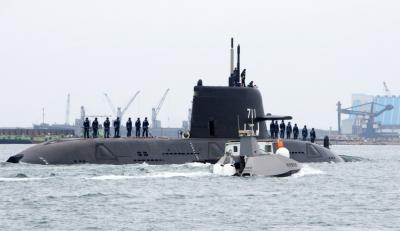
Taiwan's first indigenous defense submarine, the SS-711 Hai Kun (海鯤, or Narwhal), departed for its 13th sea trial at 7am today, marking its seventh submerged test, with delivery to the navy scheduled for July. The outing also marked its first sea deployment since President William Lai (賴清德) boarded the submarine for an inspection on March 19, drawing a crowd of military enthusiasts who gathered to show support. The submarine this morning departed port accompanied by CSBC Corp’s Endeavor Manta (奮進魔鬼魚號) uncrewed surface vessel and a navy M109 assault boat. Amid public interest in key milestones such as torpedo-launching operations and overnight submerged trials,
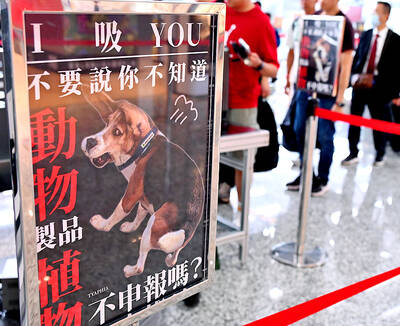
Quarantine awareness posters at Taiwan Taoyuan International Airport have gone viral for their use of wordplay. Issued by the airport branch of the Animal and Plant Health Inspection Agency, the posters feature sniffer dogs making a range of facial expressions, paired with advisory messages built around homophones. “We update the messages for holidays and campaign needs, periodically refreshing materials to attract people’s attention,” quarantine officials said. “The aim is to use the dogs’ appeal to draw focus to quarantine regulations.” A Japanese traveler visiting Taiwan has posted a photo on X of a poster showing a quarantine dog with a

Taiwan’s coffee community has launched a “one-person-one-e-mail” campaign, calling for people to send a protest-e-mail to the World Coffee Championships (WCC) urging it to redesignate Taiwanese competitors as from “Taiwan,” rather than “Chinese Taipei.” The call followed sudden action last week after the WCC changed all references to Taiwanese competitors from “Taiwan” to “Chinese Taipei,” including recent World Latte Art champion Bala (林紹興), who won the World Latte Art Championship in San Diego earlier this month. When Bala received the trophy, he was referred to as representing Taiwan, as well as in the announcement on the WCC’s Web site, until it


 RSS
RSS