


China’s so-called “incentives” for Taiwan might be an attempt to blur the lines between politics and business, a trade academic said yesterday, adding that there is still the risk of sudden trade bans.
Feng Chia University international business professor Yang Ming-hsien (楊明憲) made the comment after China announced 10 “incentive measures” for Taiwan, including facilitating the sales of Taiwanese agricultural and fishery products and investments in China, and the promotion of the resumption of travel to Taiwan.
The measures came after Chinese Nationalist Party (KMT) Chairwoman Cheng Li-wun (鄭麗文) met with Chinese President Xi Jinping (習近平) in Beijing on Friday.
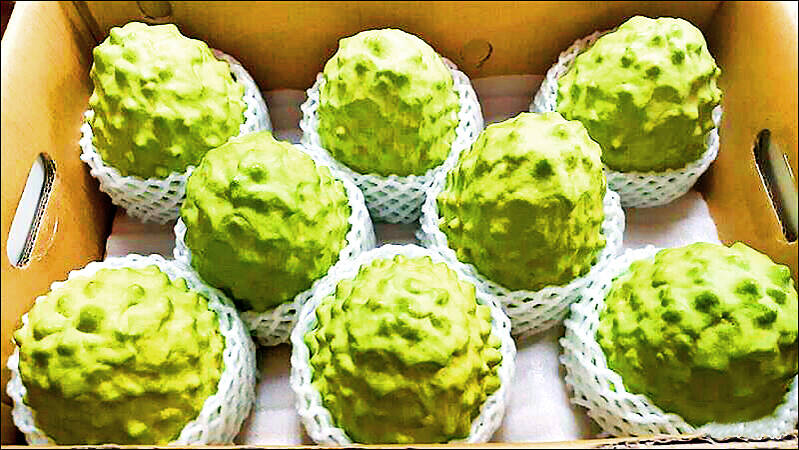
Photo: Yang Yuan-ting, Taipei Times
International trade mechanisms typically allows the import of agricultural products as long as local quarantine standards are met, but China is also imposing political demands, such as adhering to the so-called “1992 consensus” and opposing “Taiwanese independence,” Yang said.
The “1992 consensus,” a term former Mainland Affairs Council chairman Su Chi (蘇起) in 2006 admitted making up in 2000, refers to a tacit understanding between the KMT and the Chinese government that both sides of the Strait acknowledge there is “one China,” with each side having its own interpretation of what “China” means.
The political prerequisites imply that Taiwanese agricultural products were rejected by China solely due to political reasons, he said, adding that there could be a persistent risk of such arbitrary rejections.
Beijing might also require Taiwanese enterprises to register in China, which would mean that businesses would have to invest or establish local production facilities in China, Yang said.
However, as there is no investment protection agreement between Taiwan and China, issues such as labor recruitment, profit distribution and stakeholder interests in liquidation remain unaddressed, he added.
While the Chinese market is undeniably important, Taiwan’s agricultural trade should continue to diversify across different markets in light of these risks, he said.
Tunghai University Cross-Strait Research Center deputy executive director Hung Pu-chao (洪浦釗) said that when cross-strait interactions come with political prerequisites, exchanges cease to be neutral and instead operate strictly within that framework.
Such frameworks are not designed to facilitate acceptance, but rather to pressure the Taiwanese government through rejections, he said.
The true objective of China’s new policy is to sow division in Taiwan by creating a narrative that the government is “obstructing exchanges and hindering development,” Hung said.
China is attempting to establish a channel for dialogue that bypasses Taiwan’s democratically-elected government, with the goal of cultivating a specific perception: Any political party willing to accept China’s political framework can serve as a vehicle for cross-strait interaction, he said.
If this perception is accepted by other countries, it would impact the government’s representation and leadership in cross-strait affairs, and would become a national security concern, he added.
China’s political prerequisites show that exchanges, and its trade and economic measures are not simple interactions, he said.
Hung warned that constructing bridges from China to Kinmen and Lienchiang (Matsu) counties, and sharing airports and flight arrangements would result in a much deeper form of connectivity, and could impact Taiwan’s governance and national security.

NATIONAL SECURITY: Authorities are working to confirm the identities of the military personnel involved and investigating possible illegal conduct and regulatory violations Authorities are probing possible national security implications after Kinmen police and immigration officers on Sunday found a Chinese woman allegedly posing as a tourist while engaging in prostitution involving more than 10 military personnel. The woman, surnamed Chen (陳), has since been deported, authorities said, adding that investigators are still working to confirm the identities of those implicated, as the records only listed code names and aliases. The case stemmed from a report received by the Kinmen District Prosecutors’ Office on Friday last week from the Jinhu Precinct of the Kinmen County Police Bureau. On Sunday, police, along with the National Immigration

GLOBALGIVING: ‘ Caving to external pressure is not acceptable for an organization that has cultivated justice reform and human rights for 30 years,’ one NGO said A slew of non-government organizations (NGOs) have withdrawn from the GlobalGiving fundraising platform after it announced it would use “Chinese Taipei” instead of “Taiwan” from next month. The Taiwan Good Rice Association wrote on Facebook on Friday that it was informed on April 28 via a teleconference call of the change, which was made because the platform wanted to operate in China. Taiwan Good Rice is to terminate all cooperative relationships with GlobalGiving in response to the platform’s “unilateral and non-negotiable” decision to remove references to Taiwan, the NGO said. “Taiwan is in the official name of Taiwan Good Rice Association and the
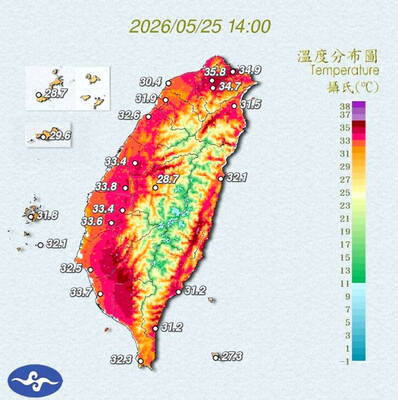
STAY COOL: The HPA recommended that people stay hydrated, use air-conditioning or fans while indoors, wear loose-fitting clothes and walk in the shade while outdoors Employers must implement measures such as installing cooling equipment, and providing drinking water and rest breaks for outdoor workers starting from Monday next week, the Taipei Department of Labor said on Sunday. Employers who fail to comply could face fines of NT$30,000 to NT$300,000 under the Occupational Safety and Health Act (職業安全衛生法), the department said. Businesses in Taipei employing fewer than 100 workers, as well as registered self-employed workers with labor insurance coverage, could receive on-site assessments and guidance from occupational safety consultants to help them apply for central government subsidies to implement or improve heat-protection measures, it said. Under the Ministry of

HEAVY WEATHER: Typhoon Jangmi is due to crash straight into the Ryukyus as airlines look to shift flights to larger aircraft or cancel flights to Okinawa entirely Taiwan’s international air carriers announced flight adjustments over the weekend as Typhoon Jangmi is forecast to hit the Ryukyu Islands today and tomorrow. The Central Weather Administration (CWA) upgraded Jangmi from a tropical storm to a typhoon at 8am yesterday, with the eye located 580km south of Naha city. It was moving north at 19kph. Today, China Airlines’ CI-120, CI-121, CI-122 and CI-123 flights between Taoyuan and Naha, Okinawa, have been canceled as well as CI-132 and CI-133 between Kaohsiung and Naha. EVA Air’s BR-112, BR-113, BR-186 and BR-185 flights between Taoyuan and Naha are also canceled. Low-cost carrier Tigerair Taiwan canceled IT-230,


 RSS
RSS