

Beijing’s identity approach has shifted from soft outreach to legislative pressure, Taiwanese academics said yesterday as they compared Friday’s meeting between Chinese Nationalist Party (KMT) Chairwoman Cheng Li-wun (鄭麗文) and Chinese President Xi Jinping (習近平) with a meeting 20 years ago between then-Chinese president Hu Jintao (胡錦濤) and then-KMT chairman Lien Chan (連戰).
Xi’s use of legal coercion to impose Chinese identity contrasted sharply with the sentimentality of the 2005 Lien-Hu meeting, said Dong Li-wen (董立文), executive officer of the Foundation on Asia-Pacific Peace Studies, at a seminar in Taipei hosted by the Asia-Pacific Elite Interchange Association.
“China’s passage last year of the Law on Promoting Ethnic Unity and Progress, which allowed the prosecution of those who defy its diktats, showed that accepting Xi’s framework would be tantamount to shackling the people of Taiwan,” Dong said.
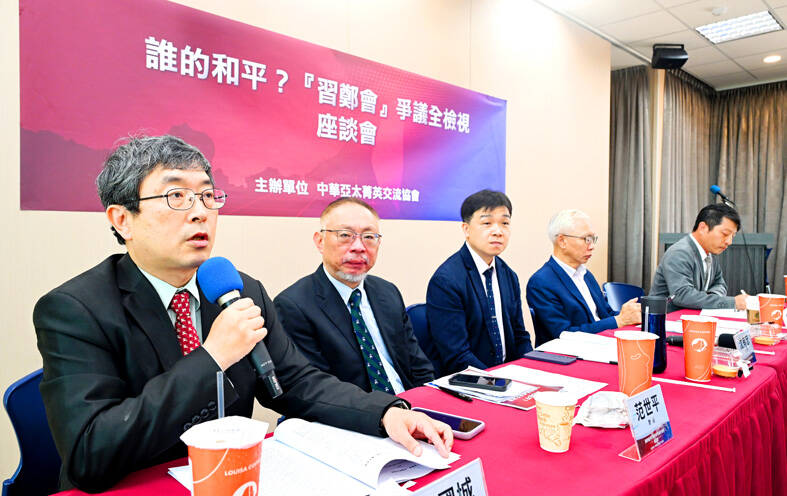
Photo: Liao Chen-huei, Taipei Times
While Hu spoke of Taiwanese independence in the language of politics, Xi spoke of it in terms of judicial criminalization embodied in Beijing’s “Opinions on Punishing ‘Taiwan Independence’ Diehard Elements for Splitting the State and Inciting to Split the State According to Law,” Dong said.
Cheng acknowledged to reporters at a post-meeting news conference that she supports the incremental enactment of “peaceful unification,” but Xi’s vision is for Taiwan to be unified against its will, Dong said, urging Cheng to stop before she “falls into the abyss of complicity in Xi’s schemes.”
Fan Shih-ping (范世平), a professor of East Asia studies at National Taiwan Normal University, told the seminar that many businesspeople were among those in Lien’s delegation to Beijing 20 years ago.
However, only one entrepreneur is in Cheng’s 14-member delegation to China, showing the seismic change that has occurred in Taiwan’s economic structure and the decline of China’s economic fortunes, Fan said.
The lure of profits promised by China’s economy for Taiwanese businesspeople is gone, as is the promise of a better life for young Taiwanese workers, he said.
“The absence of those two attractions means that Beijing’s talk of the great Chinese national renaissance, the greater Chinese family across the Taiwan Strait and expanding cross-strait exchanges remain pale and feeble slogans,” he said.
Taiwan Thinktank researcher Wu Se-chih (吳瑟致) said that the unilateral narrative of the CCP has become a “KMT-CCP” or “Xi-Cheng” shared narrative.
Cheng at the news conference did not reference the “Republic of China,” but instead used Beijing-approved terminology such as “China” and “zhonghua minzu” (中華民族, “Chinese nation”) and parroting the words of Xi, who she addressed as “General Secretary Xi,” Wu said.
Xi’s and Cheng’s failure to address Beijing’s continued use of military threats against Taiwan underscored the “exchange of empty platitudes” that characterized their meeting, he said.
Chang Kuo-cheng (張國城), a professor of international relations at Taipei Medical University, said that democracies do not air their internal political strife to a foreign audience, because that would send a dangerous signal to their friends and foes alike.
For example, the political opponents of US President Donald Trump and Israeli Prime Minister Benjamin Netanyahu did not make a show of going over their governments’ heads to talk with Tehran at a time of war, Chang said.
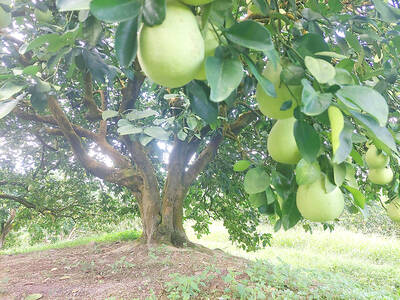
A Hualien pomelo farmer refused to sell to China after the country announced it would permit more Taiwanese pomelo imports, prompting widespread support from Taiwanese consumers, who rallied to buy his fruit. China’s Taiwan Affairs Office last month said that China’s General Administration of Customs registered an additional 79 Taiwanese pomelo orchards and packing facilities in Hualien County, allowing more Taiwanese producers to export pomelos to China. “I am a Hualien fruit farmer and I refuse to sell to China,” Liu Tzu-hao (劉子豪) from Ruisui Township (瑞穗) said in an online post. Liu is a well-known farmer in the community and has served
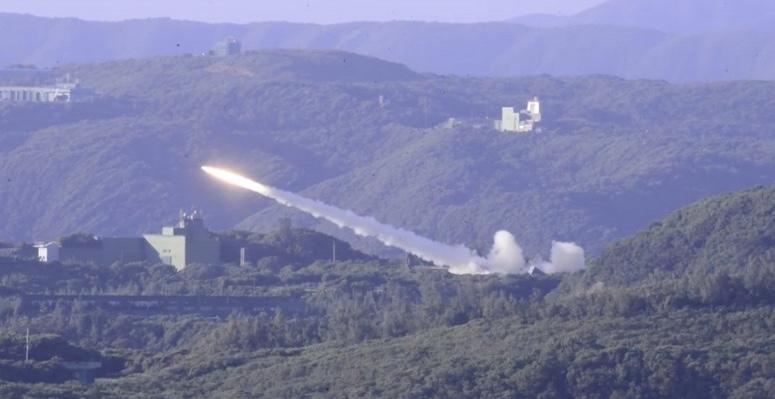
A Chinese military drone was spotted conducting reconnaissance off Taitung County as President William Lai (賴清德) visited Pingtung County this morning to inspect a drill of the armed forces’ precision-strike capabilities, prompting the military to closely monitor its actions. Today was the final day of a three-day military exercise at Jioupeng Base (九鵬基地) to test the joint combat capabilities of the armed forces and coast guard. The exercise began on Wednesday simulating air defense interception and yesterday tested long-range strike capabilities and new air defense weapons. This morning, the military conducted a final exercise involving air defense, anti-ship and drone operations. Military sources said

OCT. 31: The antiviral drugs Tamiflu and Eraflu have been distributed to about 4,000 medical facilities nationwide for people in seven groups who develop flu-like symptoms As the domestic influenza epidemic enters its peak season and continues to escalate, the Centers for Disease Control (CDC) yesterday announced that publicly funded influenza antiviral drugs for seven eligible groups have been extended to Oct. 31, allowing those who develop flu-like symptoms to receive the medication without undergoing a rapid influenza test. The CDC has extended the expanded use of flu antiviral drugs to seven groups: healthcare and influenza-prevention personnel; residents and staff at nursing homes, long-term care facilities and similar institutions; kindergarten and daycare workers and home-based caregivers; students from kindergarten through high school, vocational high school and the
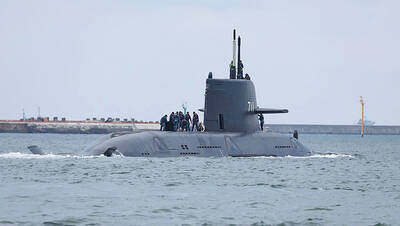
UPDATE: The submarine would need to undergo combined systems testing and crew training for navy personnel before it is ready for mission, an expert said Taiwan’s first domestically built submarine, the Hai Kun (Narwhal, 海鯤), could be delivered to the navy as early as next month, military expert and Taiwan Association for Security and Development chairman Chi Tung-yun (紀東昀) said yesterday. The submarine was yesterday morning observed departing for its 21st sea trial and its 15th submerged test. The vessel missed the initial delivery deadline of November last year due to “testing delays,” its primary contractor, shipbuilder CSBC Corp, Taiwan, said in June. The contractor also cited “political pressure from China” in procuring critical equipment. All testing operations are in the final stages, with the


 RSS
RSS