


Birds, not missiles, should fly in the skies, Chinese Nationalist Party (KMT) Chairwoman Cheng Li-wun (鄭麗文) today said in Shanghai, citing a World War I poem on the need to promote peace, even as China keeps up its daily military activities around Taiwan.
Cheng is in China on what she has called a "peace" mission to lessen tensions at a time when Beijing has stepped up military pressure against Taiwan.
China refuses to talk to President William Lai (賴清德), saying he is a "separatist." Lai's administration has called on Cheng to tell China to stop its threats, and says that Beijing should engage with the democratically elected government in Taipei.
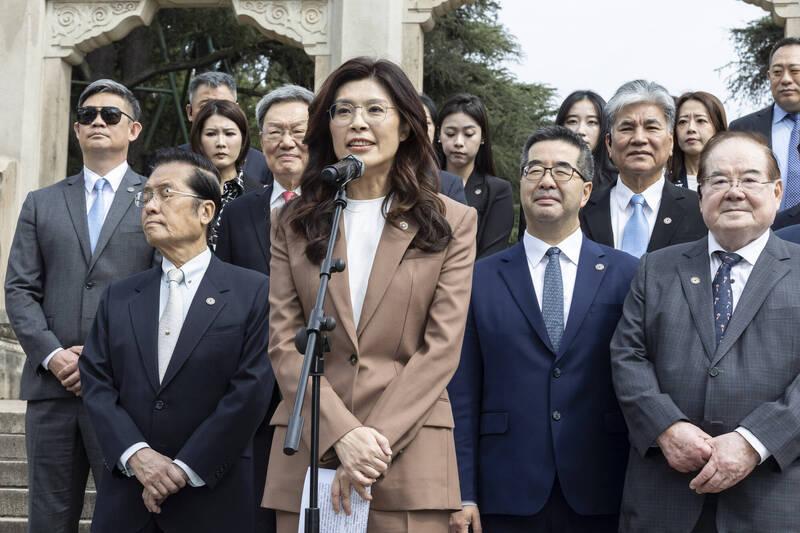
Photo courtesy of the Chinese Nationalist Party (KMT)
Speaking to reporters at Shanghai's Yangshan Port, Cheng said she was fond of how ancient Norse sailors described the sea as the "road of the whale."
"These words are spoken with such humility, and they are entirely right. What should fly in the sky are birds, not missiles. What should swim in the water are fish, not warships," she said in comments carried live on Taiwanese television stations.
Cheng, who flies to Beijing late today for a possible meeting with Chinese President Xi Jinping (習近平), also quoted, in English, part of John McCrae's World War I poem In Flanders Fields: "If ye break faith with us who die, We shall not sleep."
"We may not have been able to give our ancestors peace, but we can certainly still give peace to the people of today and the people of the future," she said.
Beijing has maintained its daily military activities around Taiwan despite Cheng's presence in China.
Six Chinese military aircraft and eight warships were detected around the nation in the 24 hours before 6am today, the Ministry of National Defense said this morning.
"The facts prove that the Chinese communists' military threat against Taiwan is intensifying," Democratic Progressive Party Legislator Michelle Lin (林楚茵) wrote on Facebook.
"Cheng Li-wun has been on her trip for two days, and the Chinese communists still have a knife at Taiwan's throat," Lin said.

In a historic first, Taiwanese officials participated in this year’s Riga Strategic Communications Dialogue in Latvia from Wednesday to Friday last week, which debuted a breakout session focused on Taiwan The event organizer, the NATO Strategic Communications Center of Excellence, displayed Taiwan’s national flag and the officials’ formal titles on their Web site. Taiwanese attendees included National Security Council (NSC) Deputy Secretary-General Lin Fei-fan (林飛帆) and deputy head of the Taipei Representative Office in the UK, Chiang Ya-chi (江雅綺). In addition to the session discussing Taiwan titled “Taiwan: Navigating Strategic Communication in a Tense Environment,” the dialogue also included sessions
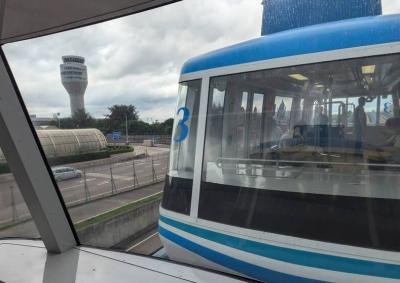
Taiwan Taoyuan International Airport is to suspend its automated Skytrain service connecting Terminal 1 and Terminal 2 starting on July 1 to facilitate connection works for the upcoming Terminal 3, the airport operator said today. Passengers and staff who need to travel between the two terminals after the suspension can instead use the Taoyuan MRT or the airport's 24-hour shuttle bus service, Taoyuan International Airport Corp said. The Taoyuan MRT Airport Line directly links the two terminals, while the shuttle buses are to operate around the clock, the company added. The Skytrain provides free transportation between the airport’s two terminals for travelers and
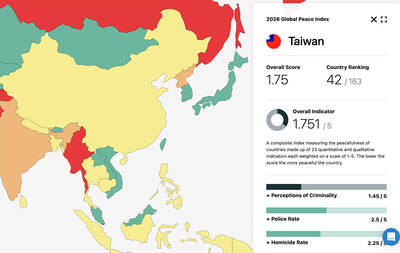
Taiwan ranked 42nd in terms of peacefulness among 163 countries, down five places from last year, according to this year’s Global Peace Index. With an overall score of 1.751, Taiwan dropped from 37th last year, the report published by the global Institute for Economics and Peace showed. The overall score measures a country’s level of peacefulness using 23 quantitative and qualitative indicators across three domains — ongoing domestic and international conflict, societal safety and security, and militarization. While Taiwan ranked 42nd worldwide, it was listed in ninth place among the 19 Asian-Pacific countries in the report, after New Zealand, Singapore, Japan, Malaysia,
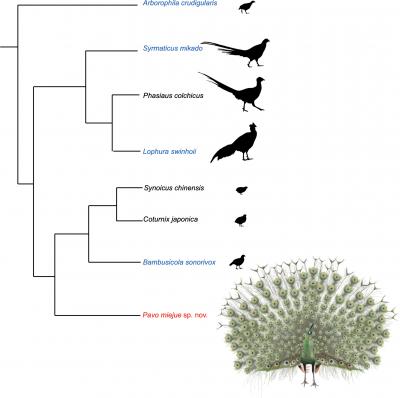
Through analyzing fossil evidence, a research team at National Taiwan University (NTU) discovered the largest endemic bird to have lived in Taiwan, naming it Pavo miejue, or extinct peafowl (滅絕孔雀). The Mikado pheasant, which is printed on the back of the NT$1,000 bank note, was previously believed to be the biggest endemic bird to Taiwan. The research team’s findings suggest that Pavo miejue lived during the Pleistocene epoch tens of thousands of years ago. It is the first endemic extinct bird species discovered and formally named in Taiwan. The study was coauthored by NTU Institute of Ecology and Evolutionary Biology professor Tsai Cheng-hsiu (蔡政修),


 RSS
RSS