


Engagement from microbusiness operators such as night market and street vendors is key in covering the last mile to reduce single-use plastic bags, Minister of Environment Peng Chi-ming said yesterday.
The legislature’s Social Welfare and Environmental Hygiene Committee at a meeting addressed the issue of domestic supply stability amid global supply chain disruptions and soaring oil prices due to conflict in the Middle East, as well as the ministry’s plastic reduction policy.
Many countries have been limiting plastic bag use due to raw material supply shortages with international oil prices soaring to a record US$170 per barrel this year, Peng said.
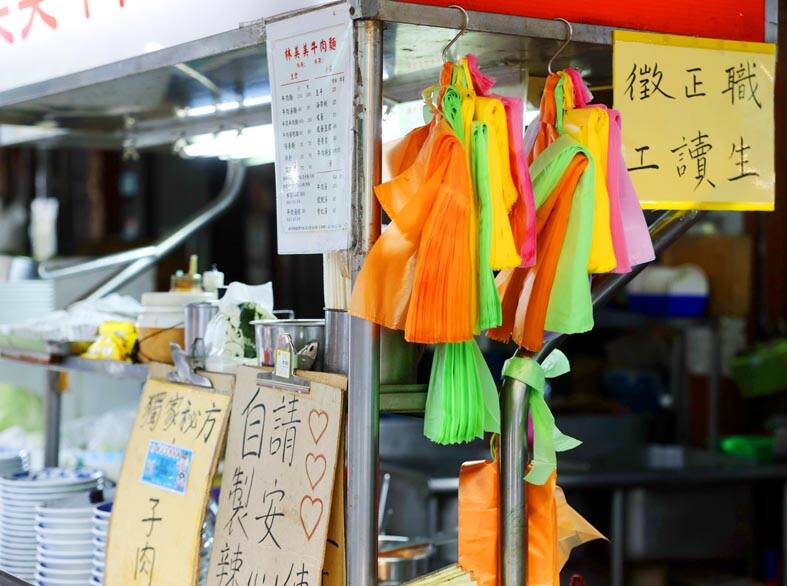
Photo: CNA
Ministry data showed that annual plastic shopping bag use in Taiwan was estimated to be 384 to 427 bags per person in 2023, he said.
Other East Asian countries such as Japan and South Korea had similar rates, while most European countries used much less, he said, adding that the UK used only eight bags per person last year.
The ministry has launched a shopping bag circulation scheme to promote plastic reduction, with Jianguo Flower Market (建國花市), in collaboration with EasyCard Corp, being a demonstration zone that offers monetary incentives, he said.
The scheme encourages use of reusable shopping bags, and assists companies in collecting and providing second-hand bags for reuse in markets and shopping areas, Peng said.
The last mile of reducing plastic shopping bags — which would be the most difficult phase — depends on engagement by microbusinesses, he said, adding that there are five major obstacles:
First, microbusinesses are more sensitive to cost increases, which would lead to higher prices and scare off customers; second, service efficiency is the priority for street vendors and paper containers are not as convenient as plastic bags; third, most street food in Taiwan contains liquids, which requires durable containers like plastic; fourth, plastic bags are commonly used in food delivery services to prevent leaks; and fifth, establishing a rent-and-return container sharing system would incur large costs to which a solution has yet to be found, Peng said.
The ministry has set targets of a 5 percent reduction in single-use plastic products by 2030 and a cumulative 10 percent by 2030 in line with EU standards.
Industrial Development Administration Deputy Director-General Chen Kuo-hsuan (陳國軒) said that the Ministry of Economic Affairs has coordinated industry operators to ensure that manufacturing and supply of plastic raw materials and plastic bags in Taiwan remain stable.
Democratic Progressive Party (DPP) Legislator Huang Hsiung-fang (黃秀芳) and Chinese Nationalist Party (KMT) Legislator Hung Meng-kai (洪孟楷) expressed concern over the conflict between the plastic reduction policy of the environment ministry and the plan to boost plastic manufacturing.
Peng said that the economic ministry focuses on short-term relief amid shortages and preventing anticipatory purchasing by the public, while his ministry promotes source reduction by incentivizing corporate participation in reusable bag circulation and increasing individual retailers’ plastic reduction awareness.
Chen said that the plastic production expansion scheme is temporary and whether it would continue depends on changes in the international situation.
DPP Legislator Chung Chia-pin (鍾佳濱) said the environment ministry should use the analogy of plastic reduction as “losing body fat by working out” rather than relying on “slimming injections.”
The agency should differentiate between agricultural plastics, medical plastics and plastic packaging materials, and prioritize them in its plastic reduction policy, especially during shortages, Chung said, adding that a two-pronged approach could be used to facilitate plastic reduction and supply stability.
Peng said stable supply of medical plastics should be prioritized over the other plastics and his ministry would set reduction targets for plastics through interministerial efforts within the next two months.

NATIONAL SECURITY: Authorities are working to confirm the identities of the military personnel involved and investigating possible illegal conduct and regulatory violations Authorities are probing possible national security implications after Kinmen police and immigration officers on Sunday found a Chinese woman allegedly posing as a tourist while engaging in prostitution involving more than 10 military personnel. The woman, surnamed Chen (陳), has since been deported, authorities said, adding that investigators are still working to confirm the identities of those implicated, as the records only listed code names and aliases. The case stemmed from a report received by the Kinmen District Prosecutors’ Office on Friday last week from the Jinhu Precinct of the Kinmen County Police Bureau. On Sunday, police, along with the National Immigration

GLOBALGIVING: ‘ Caving to external pressure is not acceptable for an organization that has cultivated justice reform and human rights for 30 years,’ one NGO said A slew of non-government organizations (NGOs) have withdrawn from the GlobalGiving fundraising platform after it announced it would use “Chinese Taipei” instead of “Taiwan” from next month. The Taiwan Good Rice Association wrote on Facebook on Friday that it was informed on April 28 via a teleconference call of the change, which was made because the platform wanted to operate in China. Taiwan Good Rice is to terminate all cooperative relationships with GlobalGiving in response to the platform’s “unilateral and non-negotiable” decision to remove references to Taiwan, the NGO said. “Taiwan is in the official name of Taiwan Good Rice Association and the

HEAVY WEATHER: Typhoon Jangmi is due to crash straight into the Ryukyus as airlines look to shift flights to larger aircraft or cancel flights to Okinawa entirely Taiwan’s international air carriers announced flight adjustments over the weekend as Typhoon Jangmi is forecast to hit the Ryukyu Islands today and tomorrow. The Central Weather Administration (CWA) upgraded Jangmi from a tropical storm to a typhoon at 8am yesterday, with the eye located 580km south of Naha city. It was moving north at 19kph. Today, China Airlines’ CI-120, CI-121, CI-122 and CI-123 flights between Taoyuan and Naha, Okinawa, have been canceled as well as CI-132 and CI-133 between Kaohsiung and Naha. EVA Air’s BR-112, BR-113, BR-186 and BR-185 flights between Taoyuan and Naha are also canceled. Low-cost carrier Tigerair Taiwan canceled IT-230,
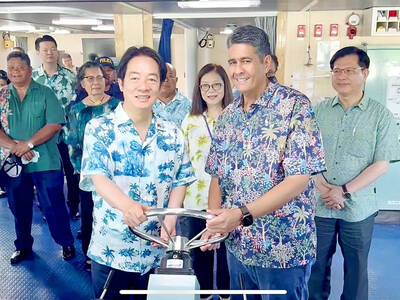
MULTIPRONGED APPROACH: China has sought to pressure Palau across a number of fronts, but the island nation has staunchly resisted overtures to ditch Taiwan Palau has been firm in backing Taiwan despite Chinese pressure that uses tourism economics, cyberattacks and criminal infiltration as tools to threaten the Pacific ally into renouncing its recognition of Taiwan as a sovereign state. The Presidential Office yesterday announced that Vice President Hsiao Bi-khim (蕭美琴) would visit Palau from Saturday to Wednesday next week at the invitation of Palauan President Surangel Whipps Jr. Whipps in April said in an interview that China had outspokenly asked Palau to “denounce Taiwan.” “And we have said: ‘We have no enemies, but nobody tells us who our friends are,’” he said. Whipps has told reporters multiple times


 RSS
RSS