


Chinese Nationalist Party (KMT) Chairwoman Cheng Li-wun (鄭麗文) in an interview with NBC News aired on Saturday said the party would be committed to deepening Taiwan-US ties while promoting peace and stability in the Taiwan Strait.
The Taiwan-US relationship has been invariably important to Taiwan, she said, adding that the KMT used to fight side by side with the US and continues to maintain that bilateral relationship.
The KMT is grateful for the US’ support during critical moments in the past and would be committed to deepening, expanding and cementing Taiwan-US relations, Cheng said.
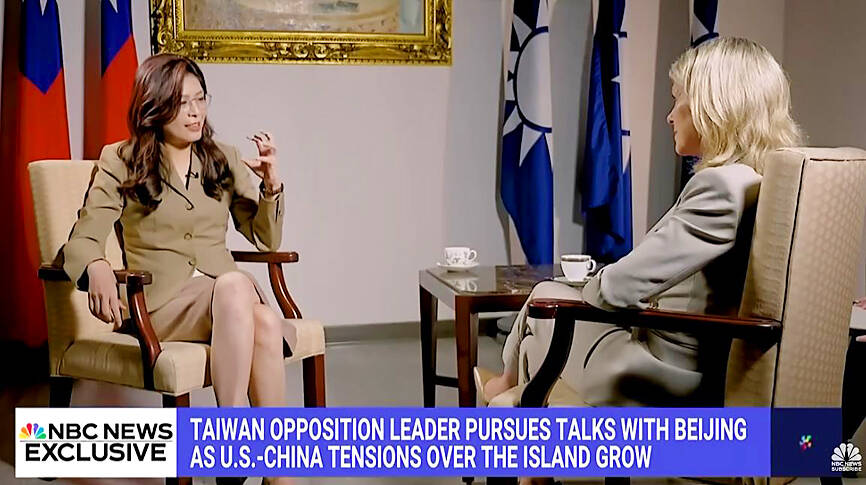
Photo: Screengrab from NBC’s YouTube channel
Taiwan-US relations should not be a one-sided dependency, but be based on reciprocity, cooperation and coprosperity, she said.
Taiwan and the US should continue to deepen cooperation based on common values, such as democracy and freedom, to build a more healthy, stable and sustainable partnership, she added.
Improving cross-strait relations would not compromise Taiwan’s relationship with the US, Cheng said, adding that it was not an “either-or choice.”
Promoting peace across the Strait and reducing the risk of conflicts aligns with the interests of Taiwan, as well as the US and the international community’s expectations of regional stability, Cheng said.
The KMT would strive to resolve differences and build mutual trust between the two sides of the Strait via dialogues, exchanges and benevolent interactions, thereby achieving stable and sustainable cross-strait peace, she said.
The party values national defense and supports Taiwan’s military cooperation with the US in maintaining necessary defense capabilities, Cheng said.
Controversies over defense budgets arose mainly because the governing party failed to fully disclose all necessary information, making it difficult for the legislature to conduct comprehensive oversight and review, she added.
The KMT remains consistent on its position, Cheng said, adding that it would responsibly conduct budget reviews to ensure national security and democratic oversight through information transparency and procedural soundness.
Taiwan should not become a trigger for conflicts, but a key force in maintaining regional peace, she said.
The nation was on the frontline of the first island chain during the Cold War era, but given the current international situation, Taiwan should instead become a critical contributor to the “first peace chain,” facilitating peace, stability and cooperation, Cheng said.
“All are winners in times of peace; all are losers in times of war,” she said.
Cheng said she does not want political competitions in Taiwan, cross-strait interactions or US-China relations to be reduced to zero-sum games.
All parties involved should engage in sincere dialogues and collaborations with goodwill, wisdom and broader perspectives to open a new chapter of world peace, she added.

The Ministry of Finance this afternoon announced the winning numbers for the March-April uniform invoice lottery. The winning number for the NT$10 million (US$318,060) special prize is 19531471, and the winning number for the NT$2 million grand prize is 85941329. Three numbers were drawn for the NT$200,000 first prize: 07225810, 20231230 and 83518781. Those with receipts matching the last seven digits of any of the first-prize numbers will win the NT$40,000 second prize, while those matching the last six digits will win the NT$10,000 third prize. Those whose receipts match the last five digits of the first-prize numbers can claim the NT$4,000 fourth prize,

SIX SUBSIDIES: The monthly allowance for older farmers is to increase to NT$10,000, and NT$5,000 is to be given to homemakers under the national pension system, Lai said The government is to implement major welfare policies for disadvantaged groups, including raising the monthly allowance for older farmers to NT$10,000 and providing homemakers with NT$5,000 per month, President William Lai (賴清德) said yesterday. Lai made the remarks during a visit to Wangling Temple in Chiayi County, saying that the planned increases were being introduced amid economic growth and an increase in tax revenue. Touting a policy, in which the government plans to provide a monthly allowance of NT$5,000 for every child under the age of 18 in a bid to address Taiwan’s low birthrate, Lai said that if received for the
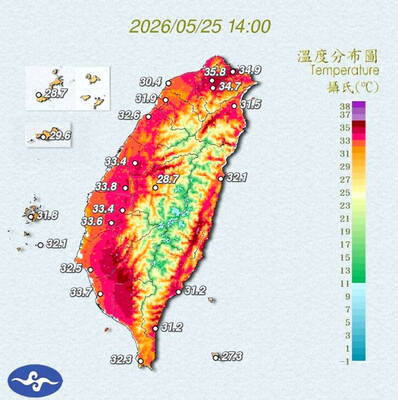
STAY COOL: The HPA recommended that people stay hydrated, use air-conditioning or fans while indoors, wear loose-fitting clothes and walk in the shade while outdoors Employers must implement measures such as installing cooling equipment, and providing drinking water and rest breaks for outdoor workers starting from Monday next week, the Taipei Department of Labor said on Sunday. Employers who fail to comply could face fines of NT$30,000 to NT$300,000 under the Occupational Safety and Health Act (職業安全衛生法), the department said. Businesses in Taipei employing fewer than 100 workers, as well as registered self-employed workers with labor insurance coverage, could receive on-site assessments and guidance from occupational safety consultants to help them apply for central government subsidies to implement or improve heat-protection measures, it said. Under the Ministry of

NATIONAL SECURITY: Authorities are working to confirm the identities of the military personnel involved and investigating possible illegal conduct and regulatory violations Authorities are probing possible national security implications after Kinmen police and immigration officers on Sunday found a Chinese woman allegedly posing as a tourist while engaging in prostitution involving more than 10 military personnel. The woman, surnamed Chen (陳), has since been deported, authorities said, adding that investigators are still working to confirm the identities of those implicated, as the records only listed code names and aliases. The case stemmed from a report received by the Kinmen District Prosecutors’ Office on Friday last week from the Jinhu Precinct of the Kinmen County Police Bureau. On Sunday, police, along with the National Immigration


 RSS
RSS