


True peace is never achieved by bowing to or compromising with authoritarianism, President William Lai (賴清德) said yesterday.
Lai made the remarks during the unveiling ceremony of the Gikong Presbyterian Church in Taipei as a transitional justice site.
The church was the residence of former democracy advocate Lin I-hsiung (林義雄). It was also where, on Feb. 28, 1980, Lin’s mother and twin daughters were murdered, with his other daughter also severely injured, shortly after he was detained over his involvement in the 1979 Kaohsiung Incident.
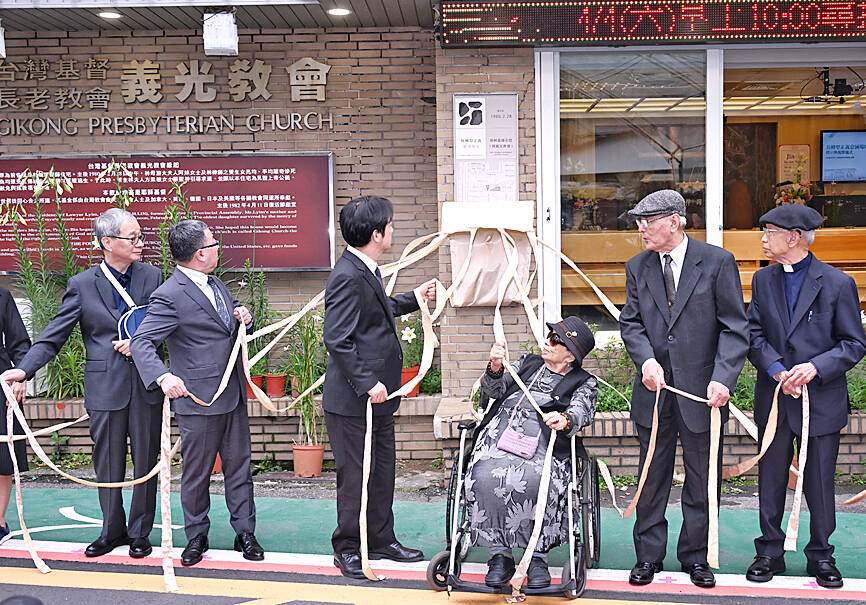
Photo: Fang Pin-chao, Taipei Times
Lai said that during last year’s memorial ceremony for the 228 Incident, he asked the Ministry of Culture to initiate a review to designate the church as a transitional justice site, so that it would be preserved and maintained.
He said that since taking office, he has ordered the expedited release of political archives to uncover historical truth, and that, as of February, the National Security Bureau has declassified and transferred more than 140,000 political records to the National Archives Administration.
All files related to the Lin family murders have now been fully declassified, Lai said.
According to Control Yuan investigative reports, the motive behind the murders was to suppress the Tangwai (黨外, “outside the ruling party” or “pro-democracy”) movement and tighten social control.
Investigations throughout the years consistently point to the involvement of the state apparatus and deliberate concealment of the truth under the then-authoritarian rule, Lai said.
“The story of Taiwanese is a story of courage,” Lai said, adding that even after the Lin family murder case, and in the face of brutal intimidation and a high-pressure political climate, Taiwanese only became more determined to strive toward democracy.
Taiwanese did not back down in 1996 when it was warned that holding the nation’s first direct presidential election might trigger an attack by China, he said.
Every single ballot represented a heart that refuses to bow, even under the shadow of missile threats, he added.
“This is the story of Taiwanese, every choice we make defines our future,” he said, adding that Taiwan would not be the democratic nation it is today if it stalled democratic movements after the Lin family murders or folded under Chinese missile threats.
Today, Taiwan continues to face cognitive warfare and various forms of infiltration by an external hostile force, aimed to exploit internal divisions, sow chaos and erode the public’s faith in democracy, Lai said.
Some people believe that compromising with an authoritarian regime could eliminate the need for a strong defense and that peace could be secured through handshakes,” he said.
“However, history has already proven that true peace is never achieved by bowing to authoritarianism,” Lai said.
“In the face of such challenges, our best defense is a clear understanding of history and shared collective memory,” he said. “The clearer the truth of history, the less likely we are to be manipulated; the clearer our shared memories, the less likely we are to be divided.”

The Ministry of Finance this afternoon announced the winning numbers for the March-April uniform invoice lottery. The winning number for the NT$10 million (US$318,060) special prize is 19531471, and the winning number for the NT$2 million grand prize is 85941329. Three numbers were drawn for the NT$200,000 first prize: 07225810, 20231230 and 83518781. Those with receipts matching the last seven digits of any of the first-prize numbers will win the NT$40,000 second prize, while those matching the last six digits will win the NT$10,000 third prize. Those whose receipts match the last five digits of the first-prize numbers can claim the NT$4,000 fourth prize,

SIX SUBSIDIES: The monthly allowance for older farmers is to increase to NT$10,000, and NT$5,000 is to be given to homemakers under the national pension system, Lai said The government is to implement major welfare policies for disadvantaged groups, including raising the monthly allowance for older farmers to NT$10,000 and providing homemakers with NT$5,000 per month, President William Lai (賴清德) said yesterday. Lai made the remarks during a visit to Wangling Temple in Chiayi County, saying that the planned increases were being introduced amid economic growth and an increase in tax revenue. Touting a policy, in which the government plans to provide a monthly allowance of NT$5,000 for every child under the age of 18 in a bid to address Taiwan’s low birthrate, Lai said that if received for the
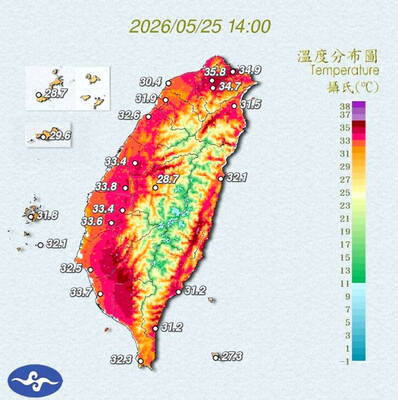
STAY COOL: The HPA recommended that people stay hydrated, use air-conditioning or fans while indoors, wear loose-fitting clothes and walk in the shade while outdoors Employers must implement measures such as installing cooling equipment, and providing drinking water and rest breaks for outdoor workers starting from Monday next week, the Taipei Department of Labor said on Sunday. Employers who fail to comply could face fines of NT$30,000 to NT$300,000 under the Occupational Safety and Health Act (職業安全衛生法), the department said. Businesses in Taipei employing fewer than 100 workers, as well as registered self-employed workers with labor insurance coverage, could receive on-site assessments and guidance from occupational safety consultants to help them apply for central government subsidies to implement or improve heat-protection measures, it said. Under the Ministry of

NATIONAL SECURITY: Authorities are working to confirm the identities of the military personnel involved and investigating possible illegal conduct and regulatory violations Authorities are probing possible national security implications after Kinmen police and immigration officers on Sunday found a Chinese woman allegedly posing as a tourist while engaging in prostitution involving more than 10 military personnel. The woman, surnamed Chen (陳), has since been deported, authorities said, adding that investigators are still working to confirm the identities of those implicated, as the records only listed code names and aliases. The case stemmed from a report received by the Kinmen District Prosecutors’ Office on Friday last week from the Jinhu Precinct of the Kinmen County Police Bureau. On Sunday, police, along with the National Immigration


 RSS
RSS