


The National Health Insurance Administration (NHIA) yesterday announced an expansion of the treatment duration for the Outpatient Parenteral Antimicrobial Therapy (OPAT) program to seven days from five days, effective immediately, allowing people to reduce the frequency of hospital visits.
The decision was made on March 26 at a meeting of the NHI’s Joint Committee for the Fee Schedule of Medical Services, along with a decision to add an “early discharge model” to the Acute Care at Home pilot program, which is scheduled to be implemented in the first half of this year, the agency said.
NHIA Director-General Chen Liang-yu (陳亮妤) said that the OPAT program, which was launched last year, integrates inpatient, emergency and outpatient antibiotic treatment resources to reduce unnecessary hospitalizations, enhancing hospital bed utilization efficiency.

Photo: Chiu Chih-jou, Taipei Times
According to NHIA data, the OPAT program provides an option for some patients who need prolonged courses of intravenous antibiotics to treat infections, allowing them to receive intravenous antibiotics regularly at outpatient clinics instead of being hospitalized.
The enrollment criteria for the OPAT program include people in a stable condition — without the risk of significant complications — who do not require hospitalization, and who have one of the following indications: pneumonia, urinary tract infection, soft tissue infection, osteomyelitis, spinal infection, septic arthritis, endocarditis, postoperative infection or medical device-related infections.
NHIA Medical Affairs Division official Lin You-chun (林右鈞) said that considering outpatient doctors typically assess patients on a weekly basis, and to reduce the need for patients to make frequent hospital visits as well as the administrative burden of re-initiating the program, the decision was made to extend the treatment duration to seven days for each course.
Chuang Yu-chung (莊祐中), director of the OPAT Center at National Taiwan University Hospital, said that delays in treatment would be mitigated.
With the extension to seven days, people can visit the same doctor’s outpatient clinic at the same time on Monday the following week, Chuang said.
Meanwhile, Lin said that an “early discharge model” added to the Acute Care at Home program is suitable for people who have undergone acute care in a hospital and only require daily antibiotic injections.
After a doctor evaluates a patient’s condition and says they are stable, they can return home or to a care facility to continue treatment, while a home medical care team conducts daily visits, he said.
The NHIA plans to allocate about 59 million NHI points (one point usually equals about NT$1) for the new “early discharge model,” which is expected to benefit about 1,200 people, Lin added.

The Ministry of Finance this afternoon announced the winning numbers for the March-April uniform invoice lottery. The winning number for the NT$10 million (US$318,060) special prize is 19531471, and the winning number for the NT$2 million grand prize is 85941329. Three numbers were drawn for the NT$200,000 first prize: 07225810, 20231230 and 83518781. Those with receipts matching the last seven digits of any of the first-prize numbers will win the NT$40,000 second prize, while those matching the last six digits will win the NT$10,000 third prize. Those whose receipts match the last five digits of the first-prize numbers can claim the NT$4,000 fourth prize,

SIX SUBSIDIES: The monthly allowance for older farmers is to increase to NT$10,000, and NT$5,000 is to be given to homemakers under the national pension system, Lai said The government is to implement major welfare policies for disadvantaged groups, including raising the monthly allowance for older farmers to NT$10,000 and providing homemakers with NT$5,000 per month, President William Lai (賴清德) said yesterday. Lai made the remarks during a visit to Wangling Temple in Chiayi County, saying that the planned increases were being introduced amid economic growth and an increase in tax revenue. Touting a policy, in which the government plans to provide a monthly allowance of NT$5,000 for every child under the age of 18 in a bid to address Taiwan’s low birthrate, Lai said that if received for the
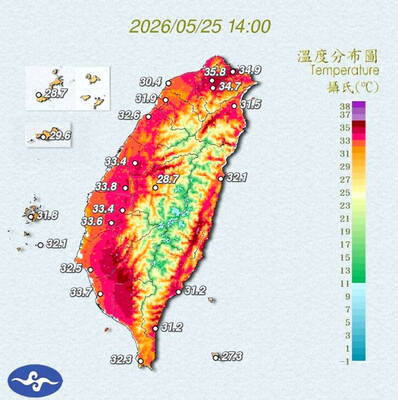
STAY COOL: The HPA recommended that people stay hydrated, use air-conditioning or fans while indoors, wear loose-fitting clothes and walk in the shade while outdoors Employers must implement measures such as installing cooling equipment, and providing drinking water and rest breaks for outdoor workers starting from Monday next week, the Taipei Department of Labor said on Sunday. Employers who fail to comply could face fines of NT$30,000 to NT$300,000 under the Occupational Safety and Health Act (職業安全衛生法), the department said. Businesses in Taipei employing fewer than 100 workers, as well as registered self-employed workers with labor insurance coverage, could receive on-site assessments and guidance from occupational safety consultants to help them apply for central government subsidies to implement or improve heat-protection measures, it said. Under the Ministry of

NATIONAL SECURITY: Authorities are working to confirm the identities of the military personnel involved and investigating possible illegal conduct and regulatory violations Authorities are probing possible national security implications after Kinmen police and immigration officers on Sunday found a Chinese woman allegedly posing as a tourist while engaging in prostitution involving more than 10 military personnel. The woman, surnamed Chen (陳), has since been deported, authorities said, adding that investigators are still working to confirm the identities of those implicated, as the records only listed code names and aliases. The case stemmed from a report received by the Kinmen District Prosecutors’ Office on Friday last week from the Jinhu Precinct of the Kinmen County Police Bureau. On Sunday, police, along with the National Immigration


 RSS
RSS