


A team of Taiwanese and Japanese scientists has identified sea lion fossils in waters around Taiwan proper in a breakthrough discovery that raises new questions.
The team, which includes Tsai Cheng-hsiu (蔡政修), an associate professor of life sciences at National Taiwan University (NTU), and Naoki Kohno, a researcher at the National Museum of Nature and Science in Tokyo, found fossilized remains of Zalophus japonicus, an extinct species of sea lion, the university said in a statement yesterday.
The mammals once lived in the seas surrounding Japan before being hunted into extinction by humans, but their presence near Taiwan proper had not been known until now, it said.
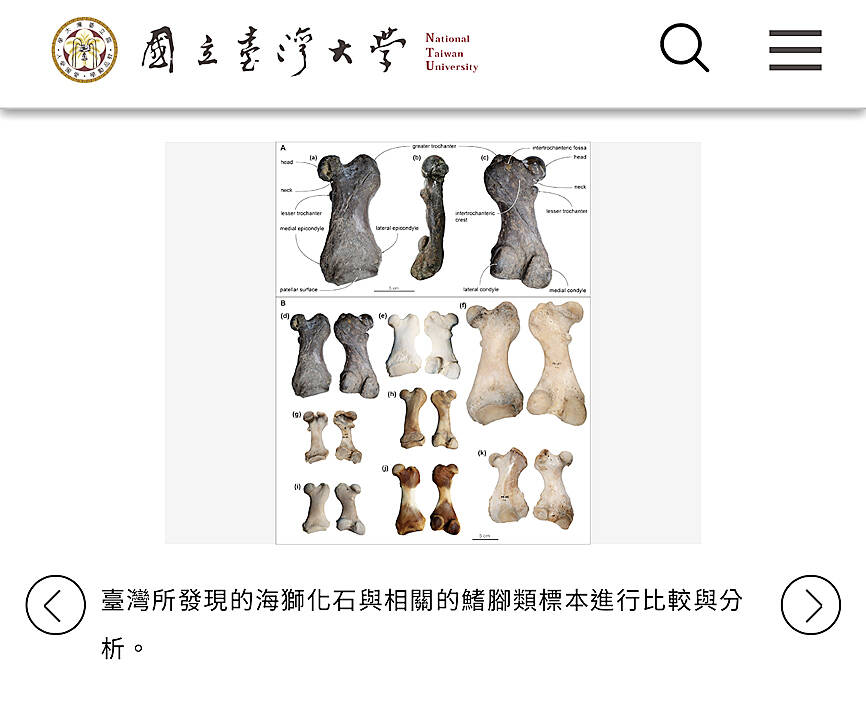
Photo: Screen grab from National Taiwan University’s Web site
The discovery fills a gap in Taiwan’s paleontological record, which already includes rich evidence of massive prehistoric whales that helped the global scientific community track evolutionary changes in whale species size, the university said.
However, fossils of seals and sea lions had not been found before in the region, even though there was no reason they would not have inhabited the west Pacific, the university said.
The Tainan Fossils and Mineral Museum provided the study with the fossil samples, which are now in the NTU collection, the university said.
The research demonstrates that maritime mammals of the pinniped clade existed in the seas surrounding Taiwan proper during the Pleistocene, and that a separate extinction event, distinct from that occurring in the Sea of Japan, had occurred, the university said.
The presence of Zalophus japonicus around Taiwan proper aligns with global fossil evidence pointing to the spread of sea lions to low-latitude regions such as the Galapagos and California, it said.
The find resolves a gap in Taiwan’s research into prehistoric seals and sea lions, and provides potential clues for explaining the Pleistocene mass extinction, Tsai said.
The study — “The Southernmost Zalophus in the Western North Pacific: The First Pinniped (Carnivora, Pinnipedia) fossil from Taiwan” — was published in the Journal of Vertebrate Paleontology on March 16.

Considering that most countries issue more than five denominations of banknotes, the central bank has decided to redesign all five denominations, the bank said as it prepares for the first major overhaul of the banknotes in more than 24 years. Central bank Governor Yang Chin-lung (楊金龍) is expected to report to the Legislative Yuan today on the bank’s operations and the redesign’s progress. The bank in a report sent to the legislature ahead of today’s meeting said it had commissioned a survey on the public’s preferences. Survey results showed that NT$100 and NT$1,000 banknotes are the most commonly used, while NT$200 and NT$2,000

The Centers for Disease Control (CDC) yesterday reported the first case of a new COVID-19 subvariant — BA.3.2 — in a 10-year-old Singaporean girl who had a fever upon arrival in Taiwan and tested positive for the disease. The girl left Taiwan on March 20 and the case did not have a direct impact on the local community, it said. The WHO added the BA.3.2 strain to its list of Variants Under Monitoring in December last year, but this was the first imported case of the COVID-19 variant in Taiwan, CDC Deputy Director-General Lin Ming-cheng (林明誠) said. The girl arrived in Taiwan on

South Korea is planning to revise its controversial electronic arrival card, a step Taiwanese officials said prompted them to hold off on planned retaliatory measures, a South Korean media report said yesterday. A Yonhap News Agency report said that the South Korean Ministry of Foreign Affairs is planning to remove the “previous departure place” and “next destination” fields from its e-arrival card system. The plan, reached after interagency consultations, is under review and aims to simplify entry procedures and align the electronic form with the paper version, a South Korean ministry official said. The fields — which appeared only on the electronic form

The Ministry of Foreign Affairs (MOFA) is suspending retaliation measures against South Korea that were set to take effect tomorrow, after Seoul said it is updating its e-arrival system, MOFA said today. The measures were to be a new round of retaliation after Taiwan on March 1 changed South Korea's designation on government-issued alien resident certificates held by South Korean nationals to "South Korea” from the "Republic of Korea," the country’s official name. The move came after months of protests to Seoul over its listing of Taiwan as "China (Taiwan)" in dropdown menus on its new online immigration entry system. MOFA last week


 RSS
RSS