


The appointments of four Central Election Commission (CEC) nominees hinge on the Legislative Yuan to demonstrate sincerity, the Cabinet said yesterday after the opposition-dominated legislature vetoed its three nominees.
The legislature on March 13 approved the Cabinet’s nomination of Michael You (游盈隆) as CEC chairman and three nominees recommended by opposition parties as commissioners.
However, the Cabinet is yet to initiate the handover and inauguration process after the legislature sent a letter of personnel approval to the Cabinet on March 17.
Photo: Taipei Times
Executive Yuan spokeswoman Michelle Lee (李慧芝) yesterday said Premier Cho Jung-tai (卓榮泰) in September last year reached out to Legislative Speaker Han Kuo-yu (韓國瑜) to facilitate cooperation between the executive and legislative branches.
After Han committed to help, the Executive Yuan, following Han’s advice and at the KMT’s request, issued a formal letter asking the three party caucuses in the Legislative Yuan to recommend CEC nominees, Lee said.
However, the legislature rejected the three other nominees recommended by the Cabinet, she said.
The CEC cannot convene meetings without at least five members in place.
Sources said the Cabinet would recommend a new nominee list and would not initiate the handover process until the list is approved by the legislature.
Saying that executive power should be balanced by legislative power, KMT caucus deputy secretary-general Hsu Yu-chen (許宇甄) said Cho has been passively boycotting bills passed by the legislature by refusing to countersign, execute or plan relevant budgets since he assumed the post.
Such passivity has escalated into a disruption of the constitutional order as the Cabinet refused to appoint the commissioners, she said, adding that it is resistance against the legislative authority rather than administrative inaction.
Acting in accordance with the law would become an empty slogan when the Cabinet is allowed to selectively execute the law, allocate budgets or issue personnel appointments, she said.
The hidden and continued expansion of executive power is paving the way for executive dictatorship and constitutes a severe threat to Taiwan’s democracy, she added.
TPP caucus whip Jacky Chen (陳清龍) said the legislature should ensure the impartiality and professionalism of the commissioners, especially as the CEC is an independent body and must not be used for political bargaining or patronage.
The Executive Yuan has repeatedly called for prompt approval from the legislature of the commission nominees in case election affairs are delayed, but it refused to issue the appointments after the legislature has done its part, he said, adding: “To what extent is Cho Jung-tai going to paralyze the country?”
Additional reporting by Lee Wen-hsin

The Ministry of Finance this afternoon announced the winning numbers for the March-April uniform invoice lottery. The winning number for the NT$10 million (US$318,060) special prize is 19531471, and the winning number for the NT$2 million grand prize is 85941329. Three numbers were drawn for the NT$200,000 first prize: 07225810, 20231230 and 83518781. Those with receipts matching the last seven digits of any of the first-prize numbers will win the NT$40,000 second prize, while those matching the last six digits will win the NT$10,000 third prize. Those whose receipts match the last five digits of the first-prize numbers can claim the NT$4,000 fourth prize,

SIX SUBSIDIES: The monthly allowance for older farmers is to increase to NT$10,000, and NT$5,000 is to be given to homemakers under the national pension system, Lai said The government is to implement major welfare policies for disadvantaged groups, including raising the monthly allowance for older farmers to NT$10,000 and providing homemakers with NT$5,000 per month, President William Lai (賴清德) said yesterday. Lai made the remarks during a visit to Wangling Temple in Chiayi County, saying that the planned increases were being introduced amid economic growth and an increase in tax revenue. Touting a policy, in which the government plans to provide a monthly allowance of NT$5,000 for every child under the age of 18 in a bid to address Taiwan’s low birthrate, Lai said that if received for the
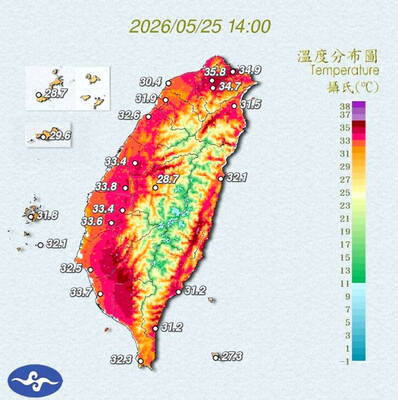
STAY COOL: The HPA recommended that people stay hydrated, use air-conditioning or fans while indoors, wear loose-fitting clothes and walk in the shade while outdoors Employers must implement measures such as installing cooling equipment, and providing drinking water and rest breaks for outdoor workers starting from Monday next week, the Taipei Department of Labor said on Sunday. Employers who fail to comply could face fines of NT$30,000 to NT$300,000 under the Occupational Safety and Health Act (職業安全衛生法), the department said. Businesses in Taipei employing fewer than 100 workers, as well as registered self-employed workers with labor insurance coverage, could receive on-site assessments and guidance from occupational safety consultants to help them apply for central government subsidies to implement or improve heat-protection measures, it said. Under the Ministry of

NATIONAL SECURITY: Authorities are working to confirm the identities of the military personnel involved and investigating possible illegal conduct and regulatory violations Authorities are probing possible national security implications after Kinmen police and immigration officers on Sunday found a Chinese woman allegedly posing as a tourist while engaging in prostitution involving more than 10 military personnel. The woman, surnamed Chen (陳), has since been deported, authorities said, adding that investigators are still working to confirm the identities of those implicated, as the records only listed code names and aliases. The case stemmed from a report received by the Kinmen District Prosecutors’ Office on Friday last week from the Jinhu Precinct of the Kinmen County Police Bureau. On Sunday, police, along with the National Immigration


 RSS
RSS