


An online platform has been set up to provide the latest information on the EU’s carbon border adjustment mechanism (CBAM) for domestic industries, said the Ministry of Environment (MOENV) on Thursday.
The EU launched its CBAM on New Year’s Day this year, placing carbon tariffs on imports, with charges set to take effect by the end of September next year.
MOENV Climate Change Administration official Chen Yi-chia (陳宜佳) said the CBAM covers imports of steel, cement, aluminum, fertilizers, electricity and hydrogen. Among Taiwan’s exports to the EU, steel accounted for the largest share in 2024 at 2.8 million metric tons, she said, adding that an estimated 2,600 Taiwanese businesses — mainly in the steel sector and metal-processing small and medium-sized enterprises (SMEs) — are expected to be affected.
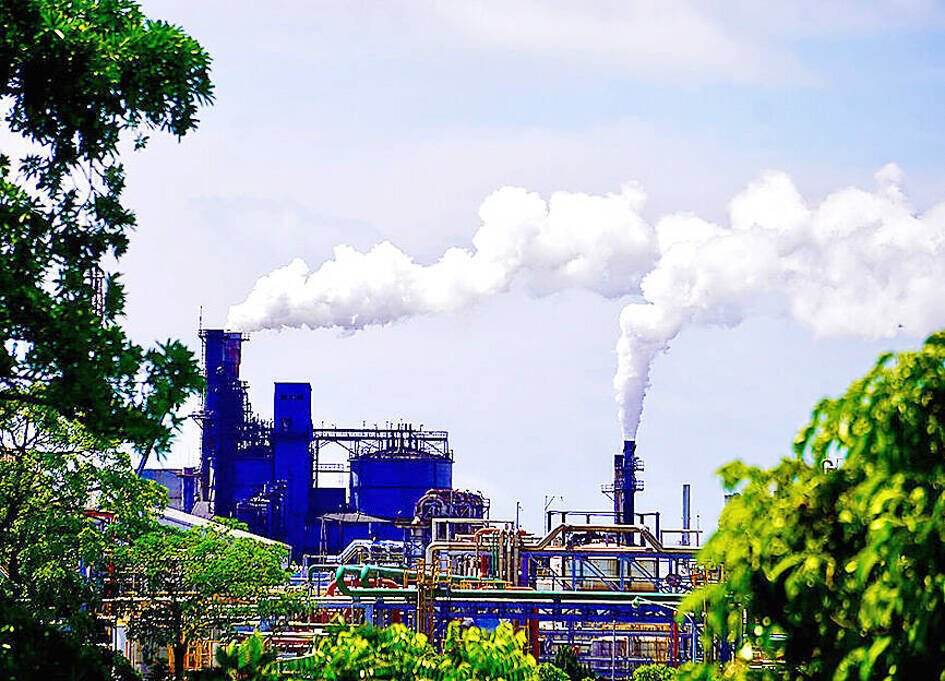
Photo: CNA
Given the complexity of requirements, the MOENV and the Ministry of Economic Affairs have jointly launched the “International CBAM Service Platform” to provide support, including updates on rules, emissions calculations, carbon fee offsets as well as verification and certification services, she said.
Minister of Environment Peng Chi-ming (彭?明) said the EU has yet to finalize its calculation methodology, but it is confirmed that carbon fees Taiwan would begin collecting this year are eligible for offset under the CBAM.
The platform is also intended to serve as a communication channel as EU authorities might not fully grasp the scale of Taiwan’s SMEs, he said.
The CBAM has been put on the Executive Yuan’s trade negotiation agenda, with ensuring the survival of domestic industries being the government’s top priority, he added.
According to Chinese National Federation of Industries deputy secretary-general Chen Hung-wen (陳鴻文), most domestic fastener manufacturers are SMEs, which are expected to be most impacted by increased costs due to the CBAM.
Establishing Taiwan’s own carbon fee system for international carbon price deduction is more favorable than paying fees to other countries, he said, adding that the collected fees can be used to subsidize domestic carbon reduction research and development.
Chen also presented three suggestions for the government’s future efforts in helping the industry to align with the CBAM.
First, more green-collar talent should be trained and industrial carbon emission management should be improved to ensure data credibility and the enrichment of Taiwan’s emission verification capability, given that third-party verified data is mandatory in the CBAM, he said.
Second, as green product design has become a global trend, the government can assist industries in applying more circular materials, helping to reduce emissions in using raw materials, thereby boosting industries’ international competitiveness, Chen said.
Third, the government should accelerate the second energy transition to lower carbon emission factors, given that an increasing number of countries are expected to take part in CBAM, he said.
Taiwan’s emission factors are higher than many countries, he said, adding that lowering the factors can increase export competitiveness.
In other news, the MOENV on Wednesday approved the carbon capture and storage project proposed by CPC Corp, Taiwan.
The project site is located in the Tiezhenshan (鐵砧山) area in Miaoli County, and is expected to store a total of 300,000 tonnes of carbon over a three-year period.
MOENV Climate Change Administration Director-General Tsai Ling-yi (蔡玲儀) yesterday said the site would be used to store the carbon dioxide captured from the flue gases of steel, cement or petrochemical plants.
The government aims to capture and store a cumulative total of 1.76 million tonnes of carbon by 2030, she said.

UPGRADE: The Kang Ding-class frigate is replacing its Chaparall missiles with Tien Chien II and Hua Yang VLS, which would provide it with long-range, 360° air defense Taiwan plans to produce 1,200 to 1,376 Hai Chien II missiles (海劍二, Sea Sword II) — also known as TC-2N — to serve as the standard air defense system of the navy’s surface combatant fleet, a source said yesterday. Last week, the Hai Chien II, the naval version of the Tien Kung II missile (天劍二, Sky Sword II), completed a live-fire test in waters off the National Chungshan Institute of Science and Technology’s Jiupeng facility (九鵬) in Pingtung County’s Manjhou Township (滿州). The MIM72 Chaparral and other dated air defense missiles that currently arm Taiwanese ships have inadequate range to combat Chinese

REASONS FOR TRAVEL: An assistant professor said that proposed amendments to penalize drivers if they used drugs overseas would not deter people from traveling People who operate a motor vehicle under the influence of marijuana would have their driver’s license revoked, even if they used the substance while overseas, the Ministry of Transportation and Communications said yesterday, citing proposed amendments to the Road Traffic Management and Penalty Act (道路交通管理處罰條例). The amendments would also authorize the government to revoke the licenses of people determined to have used Category 1 or Category 2 narcotics, even if they were not operating a vehicle while under the influence of drugs, as well as ban them from taking the license test for three years, the ministry said. People aged 18 or

HEAVY WEATHER: Typhoon Jangmi is due to crash straight into the Ryukyus as airlines look to shift flights to larger aircraft or cancel flights to Okinawa entirely Taiwan’s international air carriers announced flight adjustments over the weekend as Typhoon Jangmi is forecast to hit the Ryukyu Islands today and tomorrow. The Central Weather Administration (CWA) upgraded Jangmi from a tropical storm to a typhoon at 8am yesterday, with the eye located 580km south of Naha city. It was moving north at 19kph. Today, China Airlines’ CI-120, CI-121, CI-122 and CI-123 flights between Taoyuan and Naha, Okinawa, have been canceled as well as CI-132 and CI-133 between Kaohsiung and Naha. EVA Air’s BR-112, BR-113, BR-186 and BR-185 flights between Taoyuan and Naha are also canceled. Low-cost carrier Tigerair Taiwan canceled IT-230,

Johanne Liou (劉喬安), a Taiwanese woman who shot to unwanted fame during the Sunflower movement protests in 2014, returned to Taiwan last night after being deported from the US. She is to stand trial in Taiwan for charges involving embezzlement, fraud and drug crimes. The Criminal Investigation Bureau (CIB) said it took her into custody at Taiwan Taoyuan International Airport and would first question her before transferring her to the New Taipei District Prosecutors’ Office. She was arrested upon disembarking a flight from San Francisco that landed shortly before 7pm. Liou absconded to the US in 2019 after jumping bail


 RSS
RSS