


Presidential Office spokesperson Karen Kuo (郭雅慧) yesterday urged for the swift review of the special defense budget before Chinese Nationalist Party (KMT) Chairwoman Cheng Li-wun’s (鄭麗文) visit to China.
Cheng on Monday said she has accepted Chinese President Xi Jinping’s (習近平) invitation to visit China from Tuesday next week until April 12.
Kuo yesterday said Cheng’s KMT — which together with the Taiwan People’s Party hold a majority in the legislature — should pass the special defense budget needed to counter the continued military threat from China instead of visiting the country.

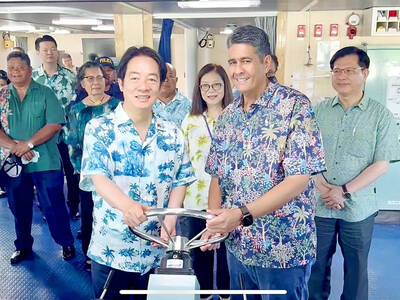
Photo courtesy of the Presidential Office
The failure to pass the general budget is exacerbating the economic risks stemming from energy shortages and soaring cost of living due to the conflict in the Middle East, she added.
The government’s plans to stabilize the economy cannot be enacted without the legislature’s approval, which is yet to happen more than 220 days after the Cabinet introduced this year’s general budget, Kuo said.
The Presidential Office expresses its appreciation for Legislative Speaker Han Kuo-yu’s (韓國瑜) good-faith attempt to push the legislative process along in accordance with the constitutional duty that comes with his position, Kuo said.
Commenting on Cheng’s visit, Kuo said the Presidential Office’s long-standing position is that Taiwan is open to healthy and orderly cross-strait exchanges under the conditions of dignity, equality and no political prerequisites.
However, Beijing has continued to target Taiwan with a campaign of military and diplomatic pressure, she said, adding that cross-strait stability hinges on China’s willingness to respect the right of Taiwanese to decide their destiny.
The KMT should accept that 84 percent of Taiwanese approve of maintaining the “status quo” and 62 percent want the government’s arms procurement budget to be passed, she said.
Separately, Taiwan Economic Democracy Union convener Lai Chung-chiang (賴中強) yesterday called on Cheng to refrain from commenting on Taiwan’s defense procurement or domestic policy in her conversations with Chinese officials.
Citing the Anti-Infiltration Act (反滲透法), he said that engaging in political lobbying in matters touching on domestic policy, national defense and security, or state secrets is punishable by up to three years in prison, in addition to a NT$5 million (US$156,386) fine.
This means Cheng may not relay the opinions of Xi or Chinese officials to KMT politicians for the purpose of directing the party’s policy stance in the legislature or anywhere else in the government, he said.
KMT lawmakers who support policies that originate from Beijing are in the same legal jeopardy as Cheng, Lai said.
Meanwhile, the Legislative Yuan Foreign Affairs and National Defense Committee has completed the initial review of the special national defense budget bill, and all provisions are reserved for cross-party negotiations, with a cross-caucus negotiation originally scheduled for next Thursday.
However, the KMT caucus on Thursday sent a letter requesting that the negotiations be postponed to April 15 or 16, prompting critics to speculate the change in the negotiation date is due to the sensitive timing of a potential Cheng-Xi meeting.
When asked, Cheng yesterday said she fully respects the party caucus’ power to make decisions about the budget and accused the Democratic Progressive Party of smearing her by connecting her visit with the gridlock in the legislature.
“My trip is about bringing peace and stability to the Taiwan Strait and has nothing to do with arms procurement or any other issues,” she said.

NATIONAL SECURITY: Authorities are working to confirm the identities of the military personnel involved and investigating possible illegal conduct and regulatory violations Authorities are probing possible national security implications after Kinmen police and immigration officers on Sunday found a Chinese woman allegedly posing as a tourist while engaging in prostitution involving more than 10 military personnel. The woman, surnamed Chen (陳), has since been deported, authorities said, adding that investigators are still working to confirm the identities of those implicated, as the records only listed code names and aliases. The case stemmed from a report received by the Kinmen District Prosecutors’ Office on Friday last week from the Jinhu Precinct of the Kinmen County Police Bureau. On Sunday, police, along with the National Immigration

GLOBALGIVING: ‘ Caving to external pressure is not acceptable for an organization that has cultivated justice reform and human rights for 30 years,’ one NGO said A slew of non-government organizations (NGOs) have withdrawn from the GlobalGiving fundraising platform after it announced it would use “Chinese Taipei” instead of “Taiwan” from next month. The Taiwan Good Rice Association wrote on Facebook on Friday that it was informed on April 28 via a teleconference call of the change, which was made because the platform wanted to operate in China. Taiwan Good Rice is to terminate all cooperative relationships with GlobalGiving in response to the platform’s “unilateral and non-negotiable” decision to remove references to Taiwan, the NGO said. “Taiwan is in the official name of Taiwan Good Rice Association and the

HEAVY WEATHER: Typhoon Jangmi is due to crash straight into the Ryukyus as airlines look to shift flights to larger aircraft or cancel flights to Okinawa entirely Taiwan’s international air carriers announced flight adjustments over the weekend as Typhoon Jangmi is forecast to hit the Ryukyu Islands today and tomorrow. The Central Weather Administration (CWA) upgraded Jangmi from a tropical storm to a typhoon at 8am yesterday, with the eye located 580km south of Naha city. It was moving north at 19kph. Today, China Airlines’ CI-120, CI-121, CI-122 and CI-123 flights between Taoyuan and Naha, Okinawa, have been canceled as well as CI-132 and CI-133 between Kaohsiung and Naha. EVA Air’s BR-112, BR-113, BR-186 and BR-185 flights between Taoyuan and Naha are also canceled. Low-cost carrier Tigerair Taiwan canceled IT-230,
MULTIPRONGED APPROACH: China has sought to pressure Palau across a number of fronts, but the island nation has staunchly resisted overtures to ditch Taiwan Palau has been firm in backing Taiwan despite Chinese pressure that uses tourism economics, cyberattacks and criminal infiltration as tools to threaten the Pacific ally into renouncing its recognition of Taiwan as a sovereign state. The Presidential Office yesterday announced that Vice President Hsiao Bi-khim (蕭美琴) would visit Palau from Saturday to Wednesday next week at the invitation of Palauan President Surangel Whipps Jr. Whipps in April said in an interview that China had outspokenly asked Palau to “denounce Taiwan.” “And we have said: ‘We have no enemies, but nobody tells us who our friends are,’” he said. Whipps has told reporters multiple times


 RSS
RSS