


Poet Tsai Chi-lan (蔡奇蘭) on Wednesday passed away at the age of 81, the Ministry of Culture said in a statement yesterday.
Expressing his deep sorrow and condolences, Minister of Culture Li Yuan (李遠) said that Tsai was a key representative of Hoklo (commonly known as Taiwanese) literature in southern Taiwan and an important advocate of the Hoklo movement.
Tsai’s work, imbued with a profound sense of place, historical memory and the spirit of Hoklo, would continue to inspire future generations and remain an enduring part of Taiwan’s literary history, Li said.
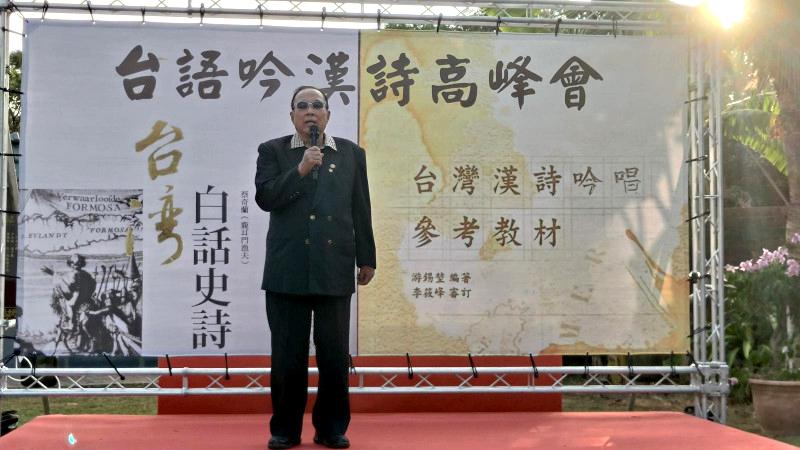
Photo courtesy of professor Chiung Wi-vun
Throughout his life, Tsai wrote about Taiwan’s land, history and people, while nurturing the Hoklo literary community, leaving behind a rich and invaluable cultural legacy, he said.
Tsai was born on Sept. 9, 1944, in Tainan’s Annan District (安南), the ministry said.
Writing under the pen name Luerhmen Fisher (鹿耳門漁夫), he created works in his mother tongue at a time when Hoklo literature faced a generational gap, it said.
He elevated the traditional “seven-character verse” (七字仔), rooted in folk ballads, into an epic form encompassing historical narrative, depictions of the land and a strong sense of national identity, exerting a profound influence, the ministry said.

AGING: While Japan has 22 submarines, Taiwan only operates four, two of which were commissioned by the US in 1945 and 1946, and transferred to Taiwan in 1973 Taiwan would need at least 12 submarines to reach modern fleet capabilities, CSBC Corp, Taiwan chairman Chen Cheng-hung (陳政宏) said in an interview broadcast on Friday, citing a US assessment. CSBC is testing the nation’s first indigenous defense submarine, the Hai Kun (海鯤, Narwhal), which is scheduled to be delivered to the navy next month or in July. The Hai Kun has completed torpedo-firing tests and is scheduled to undergo overnight sea trials, Chen said on an SET TV military affairs program. Taiwan would require at least 12 submarines to establish a modern submarine force after assessing the nation’s operational environment and defense

A white king snake that frightened passengers and caused a stir on a Taipei MRT train on Friday evening has been claimed by its owner, who would be fined, Taipei Rapid Transit Corp (TRTC) said yesterday. A person on Threads posted that he thought he was lucky to find an empty row of seats on Friday after boarding a train on the Bannan (Blue) Line, only to spot a white snake with black stripes after sitting down. Startled, he jumped up, he wrote, describing the encounter as “terrifying.” “Taipei’s rat control plan: Release snakes on the metro,” one person wrote in reply, referring

The coast guard today said that it had disrupted "illegal" operations by a Chinese research ship in waters close to the nation and driven it away, part of what Taipei sees a provocative pattern of China's stepped up maritime activities. The coast guard said that it on Thursday last week detected the Chinese ship Tongji (同濟號), which was commissioned only last year, 29 nautical miles (54km) southeast of the southern tip of Taiwan, although just outside restricted waters. The ship was observed lowering ropes into the water, suspected to be the deployment of scientific instruments for "illegal" survey operations, and the coast
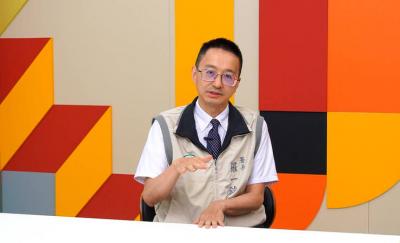
Taiwan’s two cases of hantavirus so far this year are on par with previous years’ case numbers, and the government is coordinating rat extermination work, so there should not be any outbreaks, Centers for Disease Control (CDC) Director-General Philip Lo (羅一鈞) said today in an interview with the Liberty Times (the Taipei Times’ sister newspaper). An increase in rat sightings in Taipei and New Taipei City has raised concerns about the spread of hantavirus, as rats can carry the disease. In January, a man in his 70s who lived in Taipei’s Daan District (大安) tested positive posthumously for hantavirus, Taiwan’s


 RSS
RSS