


Lawmakers from across party lines yesterday questioned the government’s easing of rules on hiring migrant domestic workers, saying that the policy could weaken professional childcare standards and shift the care burden from the state onto families and workers.
Since the Cabinet in the middle of last month approved a plan to ease rules on hiring migrant domestic workers, allowing households with at least one child under the age of 12 to apply, the policy has sparked both support and concern ahead of its implementation on April 13.
At a legislative hearing, Chinese Nationalist Party (KMT) Legislator Chiu Cheng-chun (邱鎮軍) described the government’s move as “abandoning the bottom line of professional care” for children in an estimated 1.44 million eligible households.
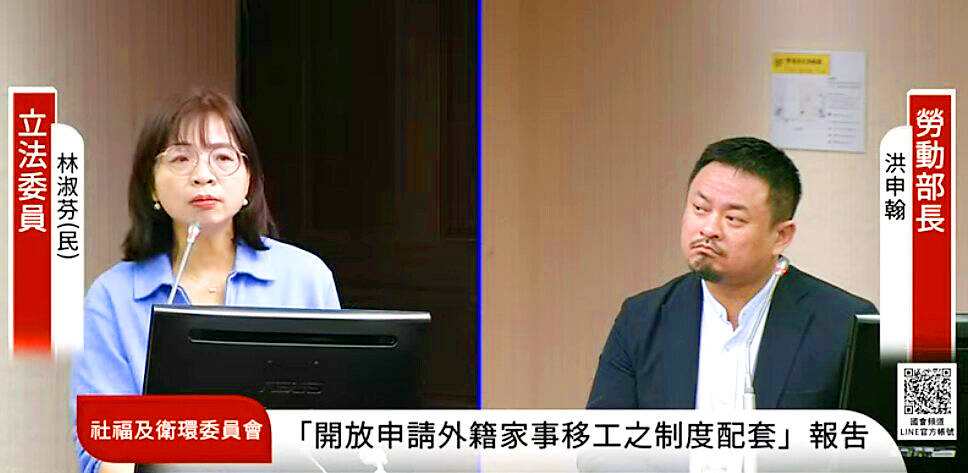
Photo: Li Ching-hui, Taipei Times
“The government’s policy has now been simplified to the idea that as long as someone is watching the children so that adults can go to work in factories or offices, it is a successful policy,” Chiu said.
With public childcare services falling short and local nannies too expensive, he said that by turning to migrant domestic workers, the government no longer seemed concerned about the quality of childcare.
Democratic Progressive Party Legislator Lin Shu-fen (林淑芬) said that the policy amounted to the government shifting care responsibilities and related burdens onto families, which would then pass the pressure on to migrant workers.
Calling it “a typical chain of downward-flowing responsibility,” she said that the policy would widen class disparities.
Middle-class families would struggle to afford it, low-income households would be unable to use it and high-income families would be largely unaffected, Lin said.
Nannies are expected to provide professional services such as healthcare and guidance for children’s early development, Minister of Labor Hung Sun-han (洪申翰)said, adding that “these are, of course, not tasks migrant domestic workers can perform.”
In his presentation to the lawmakers, Hung said that migrant domestic workers under the new policy are positioned as “auxiliary household helpers” to assist with daily housework and living support, and are not meant to replace professional childcare services.
“It is intended to give families with different needs another option, and in practice, families will make different choices based on their own needs, rather than all opting to use domestic workers,” he said.
In an effort to “balance fairness with care needs,” the government would adopt “differentiated measures” for disadvantaged and special-needs households, including priority review and a reduced employment security fee of NT$2,000 per worker per month, instead of the standard NT$5,000, Hung said.
The security fee is a government levy used to support labor welfare and the management of migrant workers.
Meanwhile, foreign employers would be required to pay NT$10,000 per worker per month.

Actor Darren Wang (王大陸) was sentenced to six months in prison, commutable to a fine, by the New Taipei District Court today for contravening the Personal Data Protection Act (個人資料保護法) in a case linked to an alleged draft-dodging scheme. Wang allegedly paid NT$3.6 million (US$114,380) to an illegal group to help him evade mandatory military service through falsified medical documents, prosecutors said. He transferred the funds to Chen Chih-ming (陳志明), the alleged mastermind of a draft-evasion ring, although he lost contact with him as he was already in detention on fraud charges, they said. Chen is accused of helping a

SECURITY: Starlink owner Elon Musk has taken pro-Beijing positions, and allowing pro-China companies to control Taiwan’s critical infrastructure is risky, a legislator said Starlink was reluctant to offer services in Taiwan because of the nation’s extremely high penetration rates in 4G and 5G services, the Ministry of Digital Affairs said yesterday. The ministry made the comments at a meeting of the legislature’s Transportation Committee, which reviewed amendments to Article 36 of the Telecommunications Management Act (電信管理法). Article 36 bans foreigners from holding more than 49 percent of shares in public telecommunications networks, while shares foreigners directly and indirectly hold are also capped at 60 percent of the total, unless specified otherwise by law. The amendments, sponsored by Chinese Nationalist Party (KMT) Legislator Ko

‘SAME OLD TRICK’: Even if Beijing resumes individual travel to Taiwan, it would only benefit Chinese tourism companies, the Economic Democracy Union convener said China’s 10 new “incentives” are “sugar-coated poison,” an official said yesterday, adding that Taiwanese businesses see them clearly for what they are, but that Beijing would inevitably find some local collaborators to try to drums up support. The official, speaking on condition of anonymity, made the remark ahead of a news conference the General Chamber of Commerce is to hold today. The event, titled “Industry Perspectives on China’s Recent Pro-Taiwan Policies,” is expected to include representatives from industry associations — such as those in travel, hotels, food and agriculture — to request the government cooperate with China’s new measures, people familiar with

The eastern extension of the Taipei MRT Red Line could begin operations as early as late June, the Taipei Department of Rapid Transit Systems said yesterday. Taipei Rapid Transit Corp said it is considering offering one month of free rides on the new section to mark its opening. Construction progress on the 1.4km extension, which is to run from the current terminal Xiangshan Station to a new eastern terminal, Guangci/Fengtian Temple Station, was 90.6 percent complete by the end of last month, the department said in a report to the Taipei City Council's Transportation Committee. While construction began in October 2016 with an


 RSS
RSS