

President William Lai (賴清德) yesterday urged the Legislative Yuan to pass the general budget, saying that the ongoing funding freeze has inflicted severe harm to the nation’s development.
Lai, also the Democratic Progressive Party (DPP) chairman, said that the legislature has been deadlocked for 216 days in an unprecedented crisis affecting the constitutional order and the nation’s ability to function.
The budget fight could not come at a worse time, as Taiwan is facing complex challenges posed by a shifting geostrategic landscape, population decline, societal changes and the need to overhaul the economy to address the rise of artificial intelligence (AI) technology, he said.

Photo courtesy of the Democratic Progressive Party
These connected issues require integrated solutions that the government is trying to provide in the budget plan, Lai said.
Taiwan plans to launch its 10 major AI infrastructure projects initiative, aimed at generating more than NT$15 trillion (US$469.5 billion), he said, adding that failure to fund the AI infrastructure projects would severely erode Taiwan’s competitiveness and hinder strategic investments in key technologies.
The AI infrastructure initiative includes funds for a national cloud computing center in Tainan, the sovereign language model Trustworthy AI Dialogue Engine and targeted industry verticals ranging from precision medicine to smart agriculture, and is aimed at making Taiwan one of the world’s top five computing powers by 2040, Lai said.
Delaying the Ministry of Economic Affairs’ proposed investment in emerging technologies and stimulus packages for the upgrade of small and medium-sized businesses would be a heavy blow to scientific research in semiconductors, and discourage foreign companies from investing in Taiwan, he said.
The Ministry of Transportation and Communications’ proposed budgets include the construction of an underground rail in Taoyuan, a double-track electric railway linking Hualien and Taitung, and an elevated railway in Chiayi County, which are key to local economic development, he said.
The gridlock at the legislature also shut down funding for the first and second special reserve funds, and the emergency reserves, which are critical to natural disaster and epidemic response capabilities, he said.
Lawmakers across the political divide should put their country and the well-being of Taiwanese before their party and speedily pass the government general budget, Lai said.
Taiwan’s ability to conduct necessary government activities and deal with crises must be maintained, he added.
Meanwhile, the Chinese Nationalist Party (KMT) caucus yesterday agreed to send the general budget plan for a committee review ahead of a plenary session on Friday next week, following an internal meeting.
During the meeting, several KMT lawmakers reportedly warned that keeping the general budget plan stalled could hurt the party’s prospects in November’s local elections. Some also called on Legislative Speaker Han Kuo-yu (韓國瑜) to mediate a deal, and promote rational and less confrontational budget discussions.
Some KMT lawmakers said that the government should allocate budget for military pay raises and retirement benefits for police and firefighters based on laws the legislature had passed earlier.
Some party members said the party’s proposed NT$380 billion-plus defense package was insufficient. Figures from local officials and lawmakers suggesting increases include Taichung Mayor Lu Shiow-yen (盧秀燕), who supports a special defense budget of NT$800 billion to NT$1 trillion, and Legislator Hsu Chiao-hsin (徐巧芯) favoring an NT$870 billion budget.
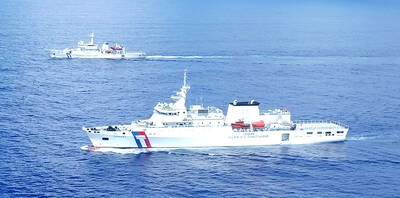
‘FRIENDSHIP FLEET’: A CGA official is scheduled to meet with the president of the Pacific nation, while one of the ships is to host a banquet and National Day event Two Coast Guard Administration (CGA) patrol vessels have docked at Malakal Harbor in Palau as part of an expedition exercise and diplomatic visit, during which a senior official is expected to meet with Palauan President Surangel Whipps Jr, the agency said yesterday. The two vessels, the 4,000-tonne-class Chiayi and the 1,000-tonne-class Penghu, set sail for Palau from Taiwan last week and arrived on Tuesday at Malakal Harbor, the CGA’s Fleet Branch said in a statement. The journey marks the second time the CGA has dispatched a “friendship fleet” to another country, after it sent its first-ever goodwill fleet, comprising the Hualien and
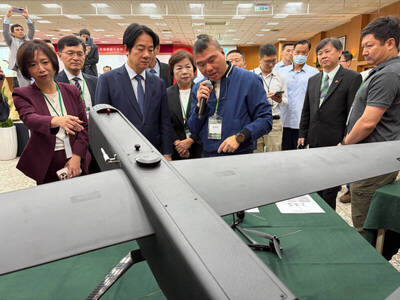
Two executives of drone supplier Jiin Ming Industry Co (錦明實業) have been detained and held incommunicado over the company's alleged use of prohibited China-made chips and camera lenses in drones supplied under recent military contracts, the Taoyuan District Prosecutors' Office said today. In a statement, prosecutors said they raided the offices of Jiin Ming — headquartered in Taoyuan — as well as those of its subsidiaries and its suppliers on Thursday last week. The raids followed a report that the company had breached its procurement contracts by putting the prohibited components into drones delivered to the military. During the raids, prosecutors summoned
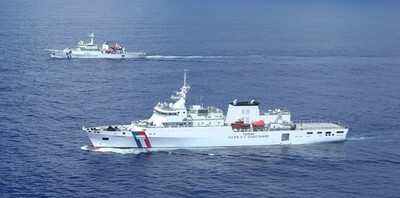
The Coast Guard Administration (CGA) today said that two of its patrol vessels have docked at Palau's Malakal Harbor as part of an expedition exercise and diplomatic visit, during which a senior official is expected to meet with the Palauan president. The two vessels, the 4,000-tonne-class Chiayi (嘉義) and the 1,000-tonne-class Penghu (澎湖), set sail for Palau from Taiwan last week and arrived at Malakal Harbor yesterday, the CGA's Fleet Branch said in a statement. The journey marked the second time the CGA has dispatched a "Friendship Fleet" to another country, after it sent its first-ever goodwill fleet, comprising the Hualien (花蓮)
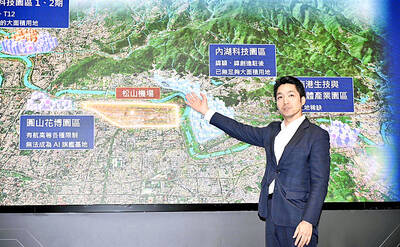
DETAILED PLAN NEEDED: Relocating the airport would affect not just travelers, but also undermine national defense and emergency medical services, a legislator said Taipei Mayor Chiang Wan-an (蔣萬安) yesterday proposed relocating Taipei International Airport (Songshan airport) and turning the site into an artificial intelligence (AI) park, drawing opposition from politicians across party lines. Chiang’s plan would turn the 300 hectares into an AI park featuring tech clusters, residential communities and green space. The industrial cluster would host 200 domestic enterprises, generate NT$12 trillion (US$376.47 billion) in output, and accommodate 65,000 jobs and 35,000 residents, he said. Cabinet spokeswoman Michelle Lee (李慧芝) said the Executive Yuan was surprised by the announcement, as the Taipei City Government did not discuss the proposal with the central government before making


 RSS
RSS