


The Forestry and Nature Conservation Agency’s Pingtung Branch has initiated a public-private collaboration on Taipei frog conservation, with the goal of restoring the species by 2030.
The branch on Thursday signed a memorandum of understanding for the collaboration with seven organizations across industry, government and academia, including the National Science and Technology Council’s Southern Taiwan Science Park Bureau, the Kaohsiung Agriculture Bureau and Synbio Tech Inc (生合生技).
Branch director Lee Cheng-hsien (李政賢) said the Taipei frog, or Hylarana taipehensis, is listed as a rare and valuable species in Taiwan and is facing threats from habitat fragmentation and population decline.
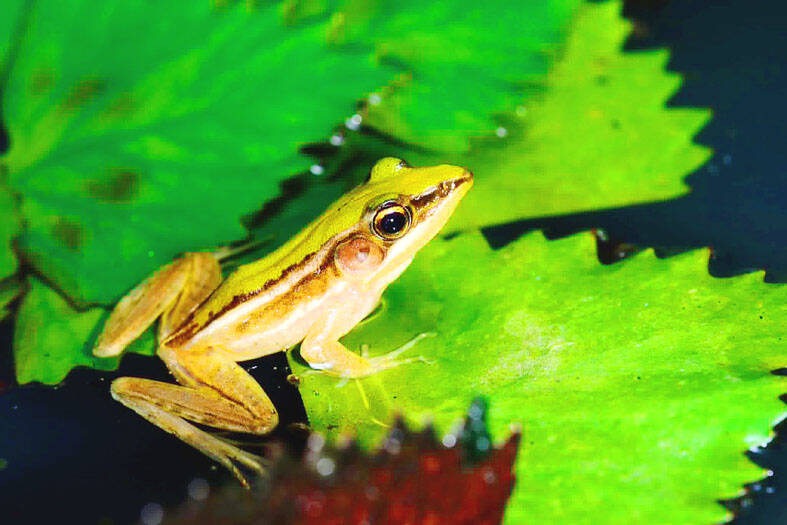
Photo: Screen grab from the Web site of the Forestry and Nature Conservation Agency’s Pingtung Branch
Nearly 60 percent of Taiwan’s threatened species, including the Taipei frog, inhabit areas outside natural reserves, making the Taiwan Ecological Network program indispensable for restoring their fragmented habitats, he said.
Synbio Tech has adopted about three hectares of green space within the Kaohsiung Science Park as part of the collaboration and would use nature-based carbon reduction techniques to restore these areas into Taipei frog habitats.
Agency official Wang Chao-hua (汪昭華) said the Taipei frog was once widely distributed nationwide, from Taipei to Pingtung County, but it has become rare due to land development and pesticide use.
The agency would not only promote frog breeding initiatives, but would also support habitat restoration projects through its certification mechanism for other effective area-based conservation measures (OECM), she said.
In related news, the agency on Wednesday last week issued OECM certificates of support to 62 sites and recognized three additional sites as OECM candidates.
The total area of sites with OECM certification is 2,916 hectares, with property owners ranging from government agencies and businesses to schools, civic groups, and private landowners, the agency said.
That reflects broad participation across multiple sectors of society in promoting terrestrial OECM in Taiwan in line with the Convention on Biological Diversity, it said.
Most sites are located within the national ecological network, covering forests, farmlands, rivers, wetlands, as well as streams and green spaces in urban areas, it said.
Agency Director-General Lin Hwa-ching (林華慶) said many of the sites have long been part of the government’s biodiversity conservation or environmentally friendly policies, such as the program for adopting marginal state-owned land not open to the public, the ecosystem services payment program and the Satoyama Initiative.
The OECM certification helps publicize the environmental contributions made by these sites and reflects the economic, social, and cultural benefits derived from their ecological conservation efforts, he said.


UPGRADE: The Kang Ding-class frigate is replacing its Chaparall missiles with Tien Chien II and Hua Yang VLS, which would provide it with long-range, 360° air defense Taiwan plans to produce 1,200 to 1,376 Hai Chien II missiles (海劍二, Sea Sword II) — also known as TC-2N — to serve as the standard air defense system of the navy’s surface combatant fleet, a source said yesterday. Last week, the Hai Chien II, the naval version of the Tien Kung II missile (天劍二, Sky Sword II), completed a live-fire test in waters off the National Chungshan Institute of Science and Technology’s Jiupeng facility (九鵬) in Pingtung County’s Manjhou Township (滿州). The MIM72 Chaparral and other dated air defense missiles that currently arm Taiwanese ships have inadequate range to combat Chinese

REASONS FOR TRAVEL: An assistant professor said that proposed amendments to penalize drivers if they used drugs overseas would not deter people from traveling People who operate a motor vehicle under the influence of marijuana would have their driver’s license revoked, even if they used the substance while overseas, the Ministry of Transportation and Communications said yesterday, citing proposed amendments to the Road Traffic Management and Penalty Act (道路交通管理處罰條例). The amendments would also authorize the government to revoke the licenses of people determined to have used Category 1 or Category 2 narcotics, even if they were not operating a vehicle while under the influence of drugs, as well as ban them from taking the license test for three years, the ministry said. People aged 18 or
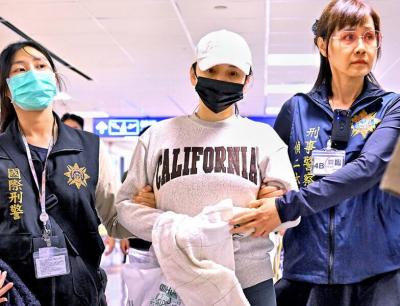
Johanne Liou (劉喬安), a Taiwanese woman who shot to unwanted fame during the Sunflower movement protests in 2014, returned to Taiwan last night after being deported from the US. She is to stand trial in Taiwan for charges involving embezzlement, fraud and drug crimes. The Criminal Investigation Bureau (CIB) said it took her into custody at Taiwan Taoyuan International Airport and would first question her before transferring her to the New Taipei District Prosecutors’ Office. She was arrested upon disembarking a flight from San Francisco that landed shortly before 7pm. Liou absconded to the US in 2019 after jumping bail

Shih Hsin University President Chen Ching-he (陳清河) yesterday issued a public apology for comments made in his commencement speech last week, stating that he has asked the school to suspend his duties and halt his wages for two months as a show of contrition. At the commencement ceremony on May 30, Chen said, “If you don’t manage your time well, or your own emotions, or your health, then I am telling every one of you — put a quick end to ‘you,’ because the world has no need for ‘you.’” The comments have sparked significant controversy online, and Chen through an open


 RSS
RSS