


The National Palace Museum on Monday opened a special exhibition exploring fantastical creatures using artifacts from its collection, alongside other objects illustrating the role of mythical beasts in folk culture.
At the opening ceremony for “The Return of Mythical Creatures in Artifacts,” museum director Hsiao Tsung-huang (蕭宗煌) said that humans have long held a sense of wonder toward the unknown universe and nature.
Mythical beasts emerged from different interpretations and imaginations of animals, and through stories passed down by word of mouth, totemic depictions, morphological transformations and the influence of religious beliefs, the creatures gradually evolved into many forms, each carrying special significance, he said.
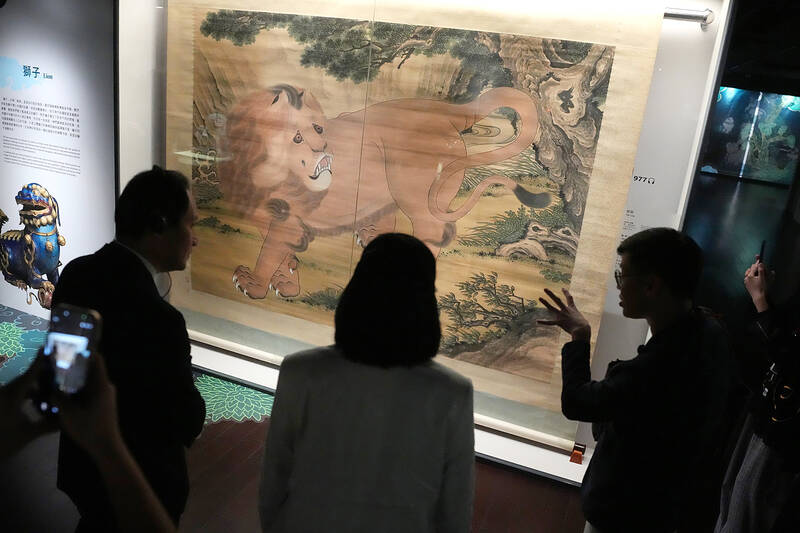
Photo: CNA
Unlike Western mythical creatures, which often embody both good and evil, those in East Asia are largely seen as benevolent, symbolizing protection and blessings, Hsiao said.
The exhibition features selected artifacts themed around mythical beasts, including the qilin (麒麟), an auspicious creature in Chinese mythology that symbolizes peace and is said to appear when a sage is present in the world, the museum said.
Also on display is a wooden sculpture of a Matsu (媽祖) palanquin, borrowed from Beigang Chaotian Temple in Yunlin County. Completed in 1912, the centennial piece features four dragons at its entrance and along its pillars, symbolizing the submission of all sea creatures to Matsu and prayers for calm seas.
Meanwhile, the Tiger God (虎爺) sculpture, borrowed from the National Museum of Taiwan History, features a simple and charming design.
In folk belief, the tiger god is often placed beneath altars, serving as a deity’s mount or helping convey messages and carry objects.
Chaotian Temple Museum director Lin Heng-yi (林恒毅) said the temple has preserved nearly 20,000 artifacts related to the worship of the sea goddess Matsu over the past 300 years.
Three pieces from the temple’s collection are featured in the exhibition, he said.
Although relatively recent, the items showcase exquisite craftsmanship, are difficult to preserve and are considered highly valuable, reflecting the temple’s long-standing efforts in cultural preservation and promotion, Lin said.
The exhibition is being held at Exhibition Hall 1 of the museum’s Northern Branch through Aug. 30.
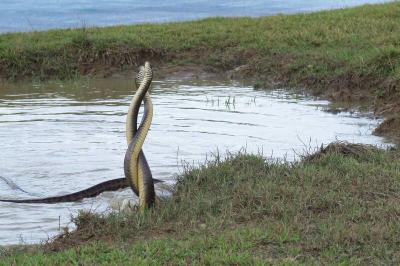
Kenting National Park service technician Yang Jien-fon (楊政峰) won a silver award in World Grand Prix Photography Awards Spring Season for his photograph of two male rat snakes intertwined in combat. Yang’s colleagues at Kenting National Park said he is a master of nature photography who has been held back by his job in civil service. The awards accept entries in all four seasons across six categories: architectural and urban photography, black-and-white and fine art photography, commercial and fashion photography, documentary and people photography, nature and experimental photography, and mobile photography. Awards are ranked according to scores and divided into platinum, gold and
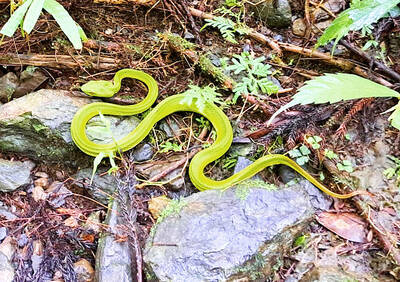
More than half of the bamboo vipers captured in Tainan in the past few years were found in the city’s Sinhua District (新化), while other districts had smaller catches or none at all. Every year, Tainan captures about 6,000 snakes which have made their way into people’s homes. Of the six major venomous snakes in Taiwan, the cobra, the many-banded krait, the brown-spotted pit viper and the bamboo viper are the most frequently captured. The high concentration of bamboo vipers captured in Sinhua District is puzzling. Tainan Agriculture Bureau Forestry and Nature Conservation Division head Chu Chien-ming (朱健明) earlier this week said that the
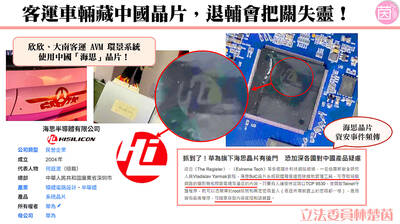
BREACH OF CONTRACT: The bus operators would seek compensation and have demanded that the manufacturer replace the chips with ones that meet regulations Two bus operators found to be using buses with China-made chips are to demand that the original manufacturers replace the systems and provide compensation for breach of contract, the Veterans Affairs Council said yesterday. Democratic Progressive Party Legislator Michelle Lin (林楚茵) yesterday said that Da Nan Bus Co and Shin-Shin Bus Co Ltd have fielded a total of 82 buses that are using Chinese chips. The bus models were made by Tron-E, while the systems provider was CYE Electronics, Lin said. Lin alleged that the buses were using chips manufactured by Huawei subsidiary HiSilicon Co, which presents a national security risk if the

The National Immigration Agency has banned two Chinese from returning to Taiwan, after they published social media content it described as disrespectful to national sovereignty. The agency imposed a two-month ban on a Chinese man surnamed Liang (梁) and a permanent ban on a woman surnamed Yang (楊), an influencer with 23 million followers, in October last year and last week respectively. Minister of the Interior Liu Shyh-fang (劉世芳) yesterday said on the sidelines of a legislative meeting that Chinese visitors to Taiwan are required to comply with the rules and regulations governing their entry permits. The government has handled the ban and


 RSS
RSS