


Mainland Affairs Council (MAC) Minister Chiu Chui-cheng (邱垂正) yesterday refused to answer questions from China-born Taiwan People’s Party (TPP) Legislator Li Chen-hsiu (李貞秀) during a legislative committee session, saying it would be "illegal" to answer someone not qualified to hold office.
"If an administrative official responds to questions from someone who is not qualified to serve as a legislator, that would be unconstitutional and illegal," Chiu told a meeting of the legislature’s Internal Administration Committee.
Under the Nationality Act (國籍法), the power to remove a legislator from office rests with the Legislative Yuan.
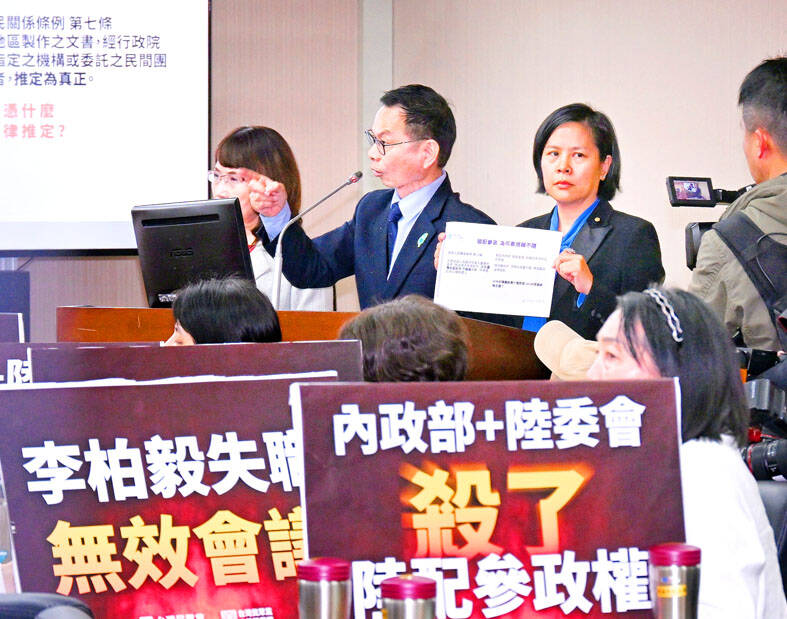
Photo: Fang Pin-chao, Taipei Times
Legislative Speaker Han Kuo-yu (韓國瑜) of the Chinese Nationalist Party (KMT) has said that Li’s legislative status and powers should be respected until the "relevant facts are established" and a "final judicial ruling is made," with no indication that the legislature plans to remove her from office.
Li is not facing legal action for what the government has described as illegally sitting in the legislature and has already taken an oath of office.
Chiu was responding to a joint interpellation by TPP caucus whip Jacky Chen (陳清龍), TPP Legislator Chen Gau-tzu (陳昭姿) and Li.
Li did not renounce her Chinese household registration "in a timely manner as required by law," and therefore does not meet the eligibility requirements to run for office under the Act Governing Relations Between the People of the Taiwan Area and the Mainland Area (臺灣地區與大陸地區人民關係條例), Chiu said.
Li also failed to fulfill her obligation under the Nationality Act to demonstrate "sole allegiance to the Republic of China” (ROC, Taiwan’s official name), he said, referring to Article 20 of the act, which stipulates that ROC nationals who also hold citizenship in another country "shall have no right to hold government offices of the ROC."
Chiu’s response came after Li’s opening remarks during the joint interpellation in which she said that neither the MAC, the Ministry of the Interior nor the Executive Yuan had the authority to determine the status of a legislator.
"If the executive branch overrides the legislative branch, the democratic system will cease to exist," she said.
Li also criticized the Executive Yuan for deciding whether the legislature could exercise oversight, describing the move as "unprecedented" and a "trampling" of the powers granted to the legislature by the Constitution.
Following her opening remarks, Li asked Chiu to answer a series of questions, including a request that he read aloud specific articles from the Constitution and its Additional Articles.
However, Chiu did not respond to Li directly, speaking only after KMT Legislator Liao Hsien-hsiang (廖先翔), the committee convener, asked him to do so.
Chiu then said he would respond to Liao — rather than Li — on questions surrounding her legitimacy as a lawmaker.
A similar pattern continued for the remainder of the joint interpellation; whenever Li asked a question, Liao would repeat it and ask Chiu to respond, and the MAC head would say he was answering Liao.
Yesterday’s exchange was not the first time government officials had refused to answer questions from Li.
At a meeting of the same committee on Monday last week, Minister of the Interior Liu Shyh-fang (劉世芳) and other interior ministry officials did not take the podium, despite Li asking Liu at least three times to do so for questioning.
The Constitution gives legislators the power to question top government officials. A separate law governing the Legislative Yuan’s power also states that officials who are being questioned cannot refuse to answer, withhold information, give false answers or show contempt toward the legislature.
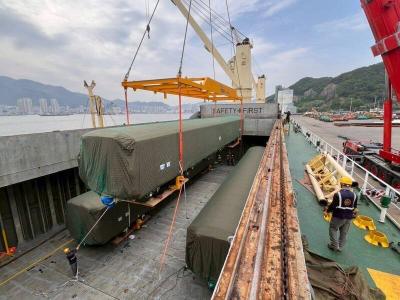
The first of 10 new high-capacity trains purchased from South Korea’s Hyundai Rotem arrived at the Port of Taipei yesterday to meet the demands of an expanding metro network, Taipei Rapid Transit Corp (TRTC) said yesterday. The train completed a three-day, 1,200km voyage from the Port of Masan in South Korea, the company said. Costing NT$590 million (US$18.79 million) each, the new six-carriage trains feature a redesigned interior based on "human-centric" transportation concepts, TRTC said. The design utilizes continuous longitudinal seating to widen the aisles and optimize passenger flow, while also upgrading passenger information displays and driving control systems for a more comfortable
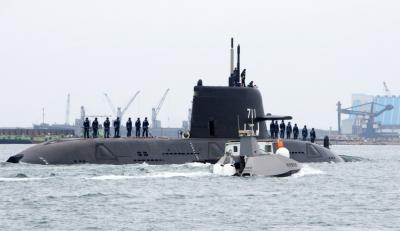
Taiwan's first indigenous defense submarine, the SS-711 Hai Kun (海鯤, or Narwhal), departed for its 13th sea trial at 7am today, marking its seventh submerged test, with delivery to the navy scheduled for July. The outing also marked its first sea deployment since President William Lai (賴清德) boarded the submarine for an inspection on March 19, drawing a crowd of military enthusiasts who gathered to show support. The submarine this morning departed port accompanied by CSBC Corp’s Endeavor Manta (奮進魔鬼魚號) uncrewed surface vessel and a navy M109 assault boat. Amid public interest in key milestones such as torpedo-launching operations and overnight submerged trials,
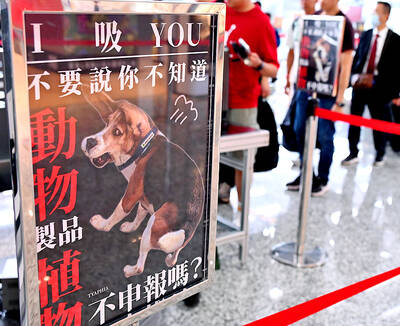
Quarantine awareness posters at Taiwan Taoyuan International Airport have gone viral for their use of wordplay. Issued by the airport branch of the Animal and Plant Health Inspection Agency, the posters feature sniffer dogs making a range of facial expressions, paired with advisory messages built around homophones. “We update the messages for holidays and campaign needs, periodically refreshing materials to attract people’s attention,” quarantine officials said. “The aim is to use the dogs’ appeal to draw focus to quarantine regulations.” A Japanese traveler visiting Taiwan has posted a photo on X of a poster showing a quarantine dog with a

Taiwan’s coffee community has launched a “one-person-one-e-mail” campaign, calling for people to send a protest-e-mail to the World Coffee Championships (WCC) urging it to redesignate Taiwanese competitors as from “Taiwan,” rather than “Chinese Taipei.” The call followed sudden action last week after the WCC changed all references to Taiwanese competitors from “Taiwan” to “Chinese Taipei,” including recent World Latte Art champion Bala (林紹興), who won the World Latte Art Championship in San Diego earlier this month. When Bala received the trophy, he was referred to as representing Taiwan, as well as in the announcement on the WCC’s Web site, until it


 RSS
RSS