


Members of the Taiwan Go Go Front alliance yesterday called for suspension of plan to restart the Guosheng Nuclear Power Plant in New Taipei City’s Wanli District (萬里) and the Ma-anshan Nuclear Power Plant in Pingtung County’s Hengchun Township (恆春).
The alliance, including the Green Party Taiwan (GPT), the Taiwan Statebuilding Party (TSP), the New Power Party and the Taiwan Obasang Political Equality Party, issued the call after President William Lai (賴清德) on Saturday signaled he was open to restarting two decommissioned nuclear plants to meet an expected increase in energy demand driven by the artificial intelligence sector, as well as to comply with changes to the Nuclear Reactor Facilities Regulation Act (核子反應器設施管制法) last year, which provided a legislative basis for the continuation of nuclear power plant operations even after entering the decommissioning stage.
GPT convener and New Taipei City councilor candidate Kan Chung-wei (甘崇緯) yesterday said the amendment to the law simply establishes a legal basis for potentially restarting decommissioned nuclear power plants, it does not automatically allow their return to operation.
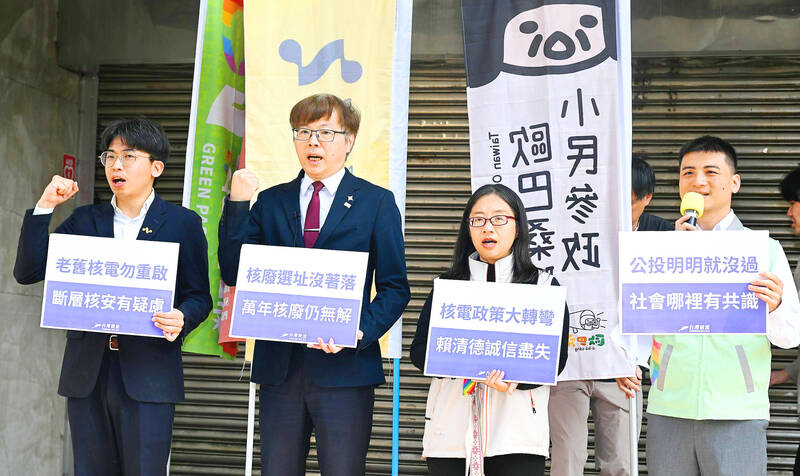
Photo: Liao Chen-huei, Taipei Times
The move to initiate the process has come from the Executive Yuan under Lai’s direction, he said, urging the government to stop blurring the issue and misleading the public.
The two nuclear power plants are in geologically active areas and there are as many as 5 million people living within 30km of the Guosheng power plant, he said.
There has yet to be a regional evacuation plan and the final disposal sites for low-level and high-level nuclear waste remain unknown, he added.
“[We] strongly urge the president to instruct the Ministry of Economic Affairs and Taiwan Power Co to withdraw the restart plan and to revisit the issue only after the three principles have genuinely been met,” he said.
TSP Chairman Wang Hsing-huan (王興煥) said energy policy shapes a society’s broader vision for environmental, social and economic sustainability and should be guided by science — not ideology.
Policies therefore can evolve as conditions change, he said.
However, the risks posed by aging reactors, seismic fault lines and unresolved nuclear waste disposal plans persist, he said.
The government’s assertions that “nuclear safety is assured, waste disposal is resolved and a social consensus exists” lack supporting evidence, he said.

NATIONAL SECURITY: Authorities are working to confirm the identities of the military personnel involved and investigating possible illegal conduct and regulatory violations Authorities are probing possible national security implications after Kinmen police and immigration officers on Sunday found a Chinese woman allegedly posing as a tourist while engaging in prostitution involving more than 10 military personnel. The woman, surnamed Chen (陳), has since been deported, authorities said, adding that investigators are still working to confirm the identities of those implicated, as the records only listed code names and aliases. The case stemmed from a report received by the Kinmen District Prosecutors’ Office on Friday last week from the Jinhu Precinct of the Kinmen County Police Bureau. On Sunday, police, along with the National Immigration

GLOBALGIVING: ‘ Caving to external pressure is not acceptable for an organization that has cultivated justice reform and human rights for 30 years,’ one NGO said A slew of non-government organizations (NGOs) have withdrawn from the GlobalGiving fundraising platform after it announced it would use “Chinese Taipei” instead of “Taiwan” from next month. The Taiwan Good Rice Association wrote on Facebook on Friday that it was informed on April 28 via a teleconference call of the change, which was made because the platform wanted to operate in China. Taiwan Good Rice is to terminate all cooperative relationships with GlobalGiving in response to the platform’s “unilateral and non-negotiable” decision to remove references to Taiwan, the NGO said. “Taiwan is in the official name of Taiwan Good Rice Association and the

HEAVY WEATHER: Typhoon Jangmi is due to crash straight into the Ryukyus as airlines look to shift flights to larger aircraft or cancel flights to Okinawa entirely Taiwan’s international air carriers announced flight adjustments over the weekend as Typhoon Jangmi is forecast to hit the Ryukyu Islands today and tomorrow. The Central Weather Administration (CWA) upgraded Jangmi from a tropical storm to a typhoon at 8am yesterday, with the eye located 580km south of Naha city. It was moving north at 19kph. Today, China Airlines’ CI-120, CI-121, CI-122 and CI-123 flights between Taoyuan and Naha, Okinawa, have been canceled as well as CI-132 and CI-133 between Kaohsiung and Naha. EVA Air’s BR-112, BR-113, BR-186 and BR-185 flights between Taoyuan and Naha are also canceled. Low-cost carrier Tigerair Taiwan canceled IT-230,

REASONS FOR TRAVEL: An assistant professor said that proposed amendments to penalize drivers if they used drugs overseas would not deter people from traveling People who operate a motor vehicle under the influence of marijuana would have their driver’s license revoked, even if they used the substance while overseas, the Ministry of Transportation and Communications said yesterday, citing proposed amendments to the Road Traffic Management and Penalty Act (道路交通管理處罰條例). The amendments would also authorize the government to revoke the licenses of people determined to have used Category 1 or Category 2 narcotics, even if they were not operating a vehicle while under the influence of drugs, as well as ban them from taking the license test for three years, the ministry said. People aged 18 or


 RSS
RSS