


The Chinese Nationalist Party (KMT) caucus yesterday made six demands regarding the Democratic Progressive Party’s (DPP) energy policy after President William Lai (賴清德) on Saturday confirmed that work has begun to secure approvals for restarting the decommissioned Guosheng Nuclear Power Plant in New Taipei City’s Wanli District (萬里) and the Ma-anshan Nuclear Power Plant in Pingtung County’s Hengchun Township (恆春).
During a news conference at the Legislative Yuan yesterday, the KMT caucus demanded that Lai and the DPP apologize for former president Tsai Ing-wen’s (蔡英文) “nuclear-free homeland” policy, which it called a “flawed energy policy.”
It called on the government to immediately amend laws related to the policy, conduct a thorough investigation into its shortcomings, establish a transparent decisionmaking process for energy policy, eliminate “black-box decisionmaking and political interference,” and ensure that the Executive Yuan “acts in accordance with the law.”
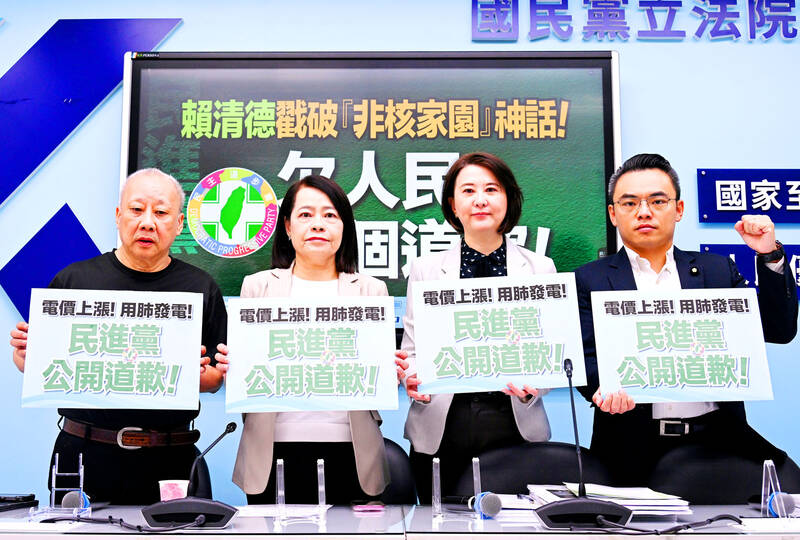
Photo: Fang Pin-chao, Taipei Times
KMT Legislator Hung Meng-kai (洪孟楷) said that for at least the past five years, opposition parties had repeatedly advocated for using nuclear power to support the transition to green energy, describing energy as a matter of national security.
Hung said artificial intelligence (AI) computing centers require large amounts of power and questioned why Premier Cho Jung-tai’s (卓榮泰) Cabinet — which came into office branding itself as the “AI Cabinet” — did not recognize the importance of abundant and stable electricity for AI infrastructure.
Hung criticized the DPP for persisting with the nuclear-free homeland policy over the past two years, only to suddenly reconsider this year, saying the party owes an apology to civic groups and the public who support nuclear power as part of the transition to green energy.
Hung also called for public disclosure of the nuclear power restart costs.
Former National Tsing Hua University nuclear engineering professor Lee Min (李敏) said the main advantage of nuclear power is stable electricity pricing, which is not affected by fluctuations in international fossil fuel prices.
Lee pointed to the Russian invasion of Ukraine as an example, saying that electricity generated by Taiwan Power Co (Taipower) from nuclear sources remained stable while gas prices surged.
About 33.6 percent of Taiwan’s gas-fired electricity output relies on natural gas from Qatar, and prices soared after the outbreak of the US-Israel war with Iran last month, making gas difficult to acquire even with sufficient funds, he said.
Lee urged the DPP government to develop a comprehensive long-term nuclear plan, saying nuclear energy should be incorporated into long-term energy planning.
Separately yesterday, KMT Chairwoman Cheng Li-wun (鄭麗文) said Taiwan has paid a price for its anti-nuclear policy, blaming ideology, populism and shortsightedness.
She criticized the DPP for saying Taiwan would never face power shortages despite repeated warnings, asking why the party had not apologized to the public.
Additional reporting by CNA
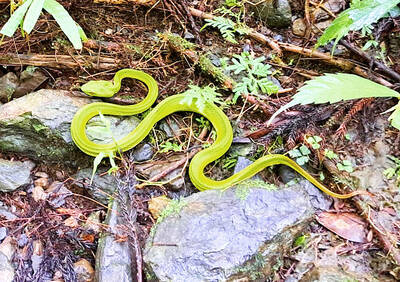
More than half of the bamboo vipers captured in Tainan in the past few years were found in the city’s Sinhua District (新化), while other districts had smaller catches or none at all. Every year, Tainan captures about 6,000 snakes which have made their way into people’s homes. Of the six major venomous snakes in Taiwan, the cobra, the many-banded krait, the brown-spotted pit viper and the bamboo viper are the most frequently captured. The high concentration of bamboo vipers captured in Sinhua District is puzzling. Tainan Agriculture Bureau Forestry and Nature Conservation Division head Chu Chien-ming (朱健明) earlier this week said that the
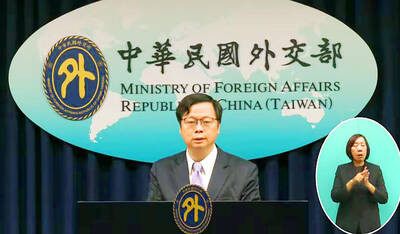
NAMING SPAT: The foreign ministry called on Denmark to propose an acceptable solution to the erroneous nationality used for Taiwanese on residence permits Taiwan has revoked some privileges for Danish diplomatic staff over a Danish permit that lists “Taiwan” as “China,” Eric Huang (黃鈞耀), head of the Ministry of Foreign Affairs’ Department of European Affairs, told a news conference in Taipei yesterday. Reporters asked Huang whether the Danish government had responded to the ministry’s request that it correct the nationality on Danish residence permits of Taiwanese, which has been listed as “China” since 2024. Taiwan’s representative office in Denmark continues to communicate with the Danish government, and the ministry has revoked some privileges previously granted to Danish representatives in Taiwan and would continue to review
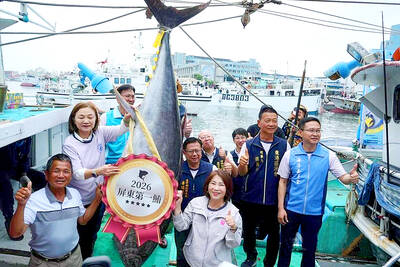
The first bluefin tuna of the season, brought to shore in Pingtung County and weighing 190kg, was yesterday auctioned for NT$10,600 (US$333.5) per kilogram, setting a record high for the local market. The auction was held at the fish market in Donggang Fishing Harbor, where the Siaoliouciou Island-registered fishing vessel Fu Yu Ching No. 2 delivered the “Pingtung First Tuna” it had caught for bidding. Bidding was intense, and the tuna was ultimately jointly purchased by a local restaurant and a local company for NT$10,600 per kilogram — NT$300 ,more than last year — for a total of NT$2.014 million. The 67-year-old skipper
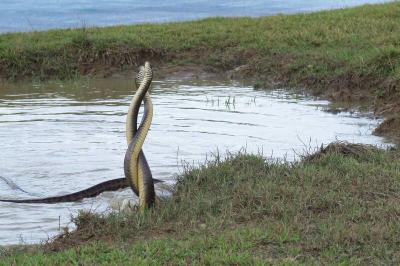
Kenting National Park service technician Yang Jien-fon (楊政峰) won a silver award in World Grand Prix Photography Awards Spring Season for his photograph of two male rat snakes intertwined in combat. Yang’s colleagues at Kenting National Park said he is a master of nature photography who has been held back by his job in civil service. The awards accept entries in all four seasons across six categories: architectural and urban photography, black-and-white and fine art photography, commercial and fashion photography, documentary and people photography, nature and experimental photography, and mobile photography. Awards are ranked according to scores and divided into platinum, gold and


 RSS
RSS