


It is a misinterpretation to say that the Democratic Progressive Party (DPP) government has a definite intention to restart nuclear plants, DPP caucus chief executive Chuang Jui-hsiung (莊瑞雄) said yesterday.
President William Lai (賴清德) on Saturday said the government has begun the approval process for restarting the decommissioned Guosheng Nuclear Power Plant in New Taipei City’s Wanli District (萬里) and the Ma-anshan Nuclear Power Plant in Pingtung County’s Hengchun Township (恆春).
The remarks drew criticism from opposition parties, who said Lai “busted the myth of a nuclear-free homeland and took a U-turn in his policy.”
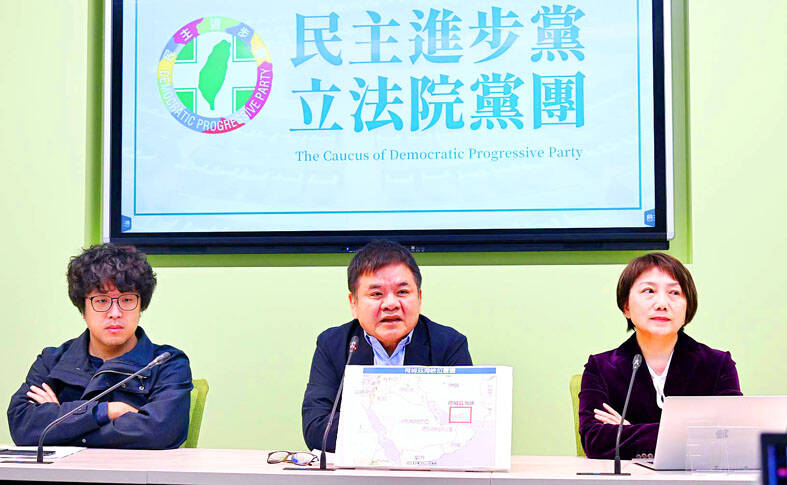
Photo: Fang Pin-chao, Taipei Times
Chuang yesterday said that what Lai is doing is taking precautions, given the gravity of restarting nuclear plants.
Taiwan reached nuclear-free status after the No. 2 reactor of the Ma-anshan nuclear power plant was decommissioned on May 17 last year, he said.
The DPP is known for its vision of a “nuclear-free homeland” while the Chinese Nationalist Party (KMT) embraces nuclear power, he said.
The DPP’s position on nuclear power has been clear and consistent from former president Tsai Ing-wen’s (蔡英文) two terms to Lai’s administration, he said.
Nuclear plants would not be operated without nuclear safety and nuclear energy would not exist without public consensus, Chuang said.
“Lai’s remarks are meant as a contingency response,” Chuang said.
“It’s understandable that the administrative branch, in response to amendments to the Nuclear Reactor Facilities Regulation Act (核子反應器設施管制法), has initiated procedures and is conducting evaluations in accordance with the law,” he said, referring to the Legislative Yuan’s amendments to the Nuclear Reactor Facilities Regulation Act (核子反應器設施管制法) last year that provide a legislative basis for the continuation of nuclear power plant operations even after entering the decommissioning stage.
“However, rashly claiming that ‘the DPP government will restart nuclear power plants’ is a misinterpretation,” he added.
Chuang said industry requires a stable power supply, in response to opposition criticism, particularly as Taiwan is seeing rapid economic development and demands from artificial intelligence and semiconductor industries are spiking.
While Taiwan’s electrical capacity should be sufficient until 2032, the government must plan ahead to ensure a stable power supply thereafter, he said.
DPP caucus secretary-general Fan Yun (范雲) cited Premier Cho Jung-tai (卓榮泰) as saying that the government would neither change its energy transition roadmap nor change its requirement for nuclear safety.
It would stick to the “three principles” — that safety is assured, nuclear waste is manageable and there is social consensus — Fan quoted Cho as saying.
That is the DPP caucus’ position on nuclear energy, she said, adding it would strictly supervise the Nuclear Safety Commission and the Ministry of Economic Affairs, which is responsible for handling nuclear waste.

The military has spotted two Chinese warships operating in waters near Penghu County in the Taiwan Strait and sent its own naval and air forces to monitor the vessels, the Ministry of National Defense (MND) said. Beijing sends warships and warplanes into the waters and skies around Taiwan on an almost daily basis, drawing condemnation from Taipei. While the ministry offers daily updates on the locations of Chinese military aircraft, it only rarely gives details of where Chinese warships are operating, generally only when it detects aircraft carriers, as happened last week. A Chinese destroyer and a frigate entered waters to the southwest
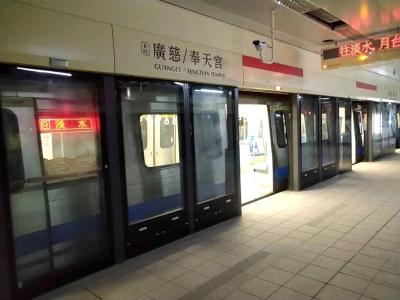
The eastern extension of the Taipei MRT Red Line could begin operations as early as late June, the Taipei Department of Rapid Transit Systems said yesterday. Taipei Rapid Transit Corp said it is considering offering one month of free rides on the new section to mark its opening. Construction progress on the 1.4km extension, which is to run from the current terminal Xiangshan Station to a new eastern terminal, Guangci/Fengtian Temple Station, was 90.6 percent complete by the end of last month, the department said in a report to the Taipei City Council's Transportation Committee. While construction began in October 2016 with an
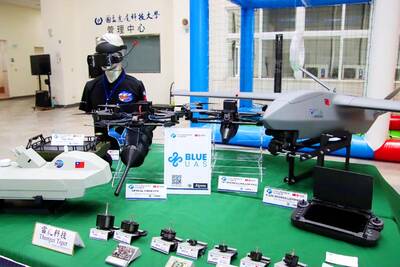
NON-RED SUPPLY: Boosting the nation’s drone industry is becoming increasingly urgent as China’s UAV dominance could become an issue in a crisis, an analyst said Taiwan’s drone exports to Europe grew 41.7-fold from 2024 to last year, with demand from Ukraine’s fight against Russian aggression the most likely driver of growth, a study showed. The Institute for Democracy, Society and Emerging Technology (DSET) in a statement on Wednesday said it found that many of Taiwan’s uncrewed aerial vehicle (UAV) sales were from Poland and the Czech Republic. These countries likely transferred the drones to Ukraine to aid it in its fight against the Russian invasion that started in 2022, it said. Despite the gains, Taiwan is not the dominant drone exporter to these markets, ranking second and fourth

Japanese Prime Minister Sanae Takaichi’s comment last year on Tokyo’s potential reaction to a Taiwan-China conflict has forced Beijing to rewrite its invasion plans, a retired Japanese general said. Takaichi told the Diet on Nov. 7 last year that a Chinese naval blockade or military attack on Taiwan could constitute a “survival-threatening situation” for Japan, potentially allowing Tokyo to exercise its right to collective self-defense. Former Japan Ground Self-Defense Force general Kiyofumi Ogawa said in a recent speech that the remark has been interpreted as meaning Japan could intervene in the early stages of a Taiwan Strait conflict, undermining China’s previous assumptions


 RSS
RSS