


Mainland Affairs Council (MAC) Minister Chiu Chui-cheng (邱垂正) today remained silent when questioned at the Legislative Yuan regarding China-born Taiwan People's Party (TPP) Legislator Li Zhenxiu’s (李貞秀) eligibility to hold office.
Chiu appeared before the legislature’s Internal Administration Committee alongside Straits Exchange Foundation chairman Su Jia-chyuan (蘇嘉全).
He refused to answer any direct questions posed by Li, although he responded to Chinese Nationalist Party (KMT) Legislator Liao Hsien-hsiang (廖先翔) when she repeated Li’s questions.
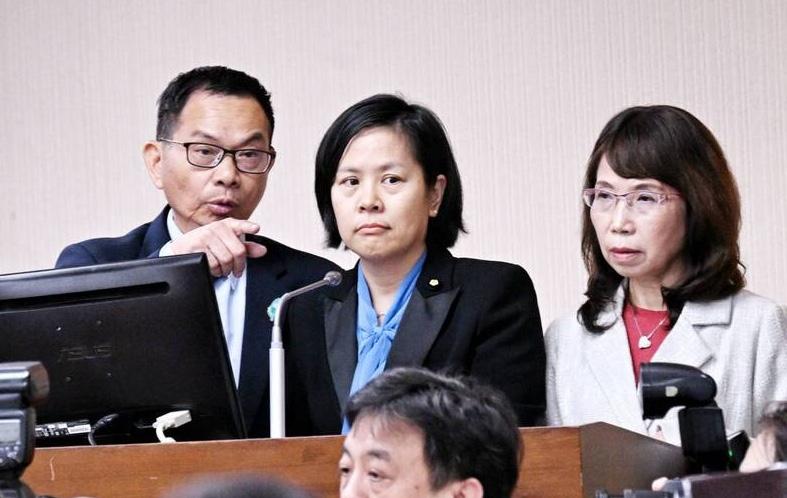
Photo: Fang Pin-chao, Taipei Times
Li, who was born in China and married a Taiwanese man, was sworn in as a legislator-at-large for the TPP on Feb. 3.
The government contends that she failed to fulfill several qualifying conditions to take office — including formally renouncing her Chinese citizenship — leading to cross-party infighting as to her eligibility to serve as a legislator.
Legislative Speaker Han Kuo-yu (韓國瑜) of the KMT earlier this month said that he would allow Li to assume her seat until the courts reach a final verdict.
Li, alongside fellow TPP legislators Chen Chao-chi (陳昭姿) and caucus whip Jacky Chen (陳清龍), today requested to give joint questioning.
The Democratic Progressive Party (DPP) caucus said that there was no precedent for joint questioning and argued against the request.
The meeting’s convenor, Liao, called for a recess and TPP legislators began holding up signs accusing the Ministry of the Interior and the council of “killing the political rights of Chinese spouses.”
After the recess, Liao granted the three legislators the right to joint questioning.
As Chiu approached the podium, Li said that the MAC, interior ministry and Executive Yuan do not have the authority to determine the status of Legislative Yuan members, and if the executive branch overrides the legislature, “democracy will be destroyed.”
She then requested that Chiu read aloud Article 4 of the Constitution and Article 11 of the Additional Articles of the Constitution (中華民國憲法增修條文).
Chiu refused to respond to Li’s line of questioning, responding only to Liao’s reiterations.
He reiterated the council’s stance that Li had not renounced her household registration and nationality in China with sufficient time prior to taking office and in accordance with the law, and therefore did not meet eligibility requirements under cross-strait regulations.
He said it would be “unconstitutional and illegal” for an official to respond to someone without legislative qualification, adding that the government cannot knowingly break the law.
Similarly, Minister of the Interior Liu Shyh-fang (劉世芳) on Monday last week refused to answer to Li’s line of questioning at a meeting of the Internal Administration Committee.
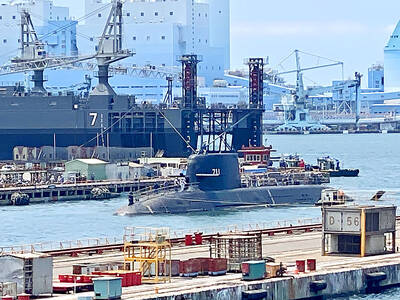
AGING: While Japan has 22 submarines, Taiwan only operates four, two of which were commissioned by the US in 1945 and 1946, and transferred to Taiwan in 1973 Taiwan would need at least 12 submarines to reach modern fleet capabilities, CSBC Corp, Taiwan chairman Chen Cheng-hung (陳政宏) said in an interview broadcast on Friday, citing a US assessment. CSBC is testing the nation’s first indigenous defense submarine, the Hai Kun (海鯤, Narwhal), which is scheduled to be delivered to the navy next month or in July. The Hai Kun has completed torpedo-firing tests and is scheduled to undergo overnight sea trials, Chen said on an SET TV military affairs program. Taiwan would require at least 12 submarines to establish a modern submarine force after assessing the nation’s operational environment and defense

A white king snake that frightened passengers and caused a stir on a Taipei MRT train on Friday evening has been claimed by its owner, who would be fined, Taipei Rapid Transit Corp (TRTC) said yesterday. A person on Threads posted that he thought he was lucky to find an empty row of seats on Friday after boarding a train on the Bannan (Blue) Line, only to spot a white snake with black stripes after sitting down. Startled, he jumped up, he wrote, describing the encounter as “terrifying.” “Taipei’s rat control plan: Release snakes on the metro,” one person wrote in reply, referring
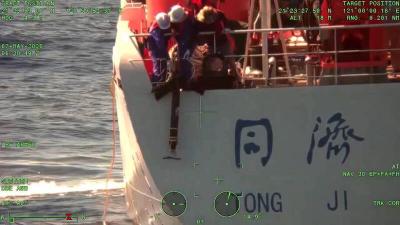
The coast guard today said that it had disrupted "illegal" operations by a Chinese research ship in waters close to the nation and driven it away, part of what Taipei sees a provocative pattern of China's stepped up maritime activities. The coast guard said that it on Thursday last week detected the Chinese ship Tongji (同濟號), which was commissioned only last year, 29 nautical miles (54km) southeast of the southern tip of Taiwan, although just outside restricted waters. The ship was observed lowering ropes into the water, suspected to be the deployment of scientific instruments for "illegal" survey operations, and the coast
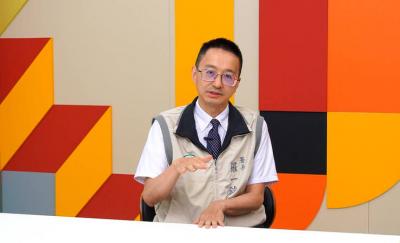
Taiwan’s two cases of hantavirus so far this year are on par with previous years’ case numbers, and the government is coordinating rat extermination work, so there should not be any outbreaks, Centers for Disease Control (CDC) Director-General Philip Lo (羅一鈞) said today in an interview with the Liberty Times (the Taipei Times’ sister newspaper). An increase in rat sightings in Taipei and New Taipei City has raised concerns about the spread of hantavirus, as rats can carry the disease. In January, a man in his 70s who lived in Taipei’s Daan District (大安) tested positive posthumously for hantavirus, Taiwan’s


 RSS
RSS