


The Mainland Affairs Council (MAC) has warned that Beijing might target Taiwanese who explicitly do not support Taiwan’s unification with China.
China could invoke its newly passed Law on Promoting Ethnic Unity and Progress to carry out transnational repression against Taiwanese, the MAC said in a report to the legislature. The law, adopted on March 12 and set to take effect on July 1, promotes the use of Mandarin, accelerates economic integration, and requires loyalty to Beijing. Critics have warned that it advances forced assimilation and restricts minority cultures.
Beijing’s transnational repression tramples international norms, undermine healthy cross-strait interaction and have heightened international awareness of Beijing’s ambitions, the report said.
Photo: Chung Li-hua, Taipei Times
The MAC said it would coordinate integrated efforts to counter such actions and safeguard the rights and interests of Taiwanese.
China continues to pursue a “dual-track strategy” of integration and pressure toward Taiwan, the MAC said. Beijing’s latest five-year plan emphasizes “deepening cross-strait integrated development” and institutionalizes policies designed to encourage Taiwanese in China to integrate, it added.
China’s plan highlights priorities of “stabilizing growth, promoting transformation and preventing risks,” with a stronger focus on domestic circulation.
“Chinese economic policy is increasingly state-led, and technological self-reliance has become a core industrial strategy,” the MAC said, adding “This reflects mounting structural pressures in China’s economy, financial system and social development, which increase the operational risks for Taiwanese businesses operating in China.”
The MAC criticized Beijing for using subsidies and other incentives to lure Taiwanese businesses, talent and capital into China’s industrial supply chains while creating the impression of flourishing cross-strait exchanges to advance its goal of promoting integration and eventual unification.
“China is currently grappling with numerous internal problems, compounded by economic weakness,” the MAC said, adding that rising social pressures and accumulated public grievances challenge governance and social stability.
Authorities would help Taiwanese businesses diversify their global presence while strengthening competitiveness, risk awareness and Taiwan’s economic resilience and autonomy, the council said.
The approach aligns with the government’s economic strategy of encouraging businesses to be “rooted in Taiwan while deploying globally,” it added.
“The government will closely monitor China’s internal and external developments and Beijing’s Taiwan policies, assess their potential impact on cross-strait relations, and respond prudently to safeguard peace and stability in the Taiwan Strait,” it added.

NATIONAL SECURITY: Authorities are working to confirm the identities of the military personnel involved and investigating possible illegal conduct and regulatory violations Authorities are probing possible national security implications after Kinmen police and immigration officers on Sunday found a Chinese woman allegedly posing as a tourist while engaging in prostitution involving more than 10 military personnel. The woman, surnamed Chen (陳), has since been deported, authorities said, adding that investigators are still working to confirm the identities of those implicated, as the records only listed code names and aliases. The case stemmed from a report received by the Kinmen District Prosecutors’ Office on Friday last week from the Jinhu Precinct of the Kinmen County Police Bureau. On Sunday, police, along with the National Immigration
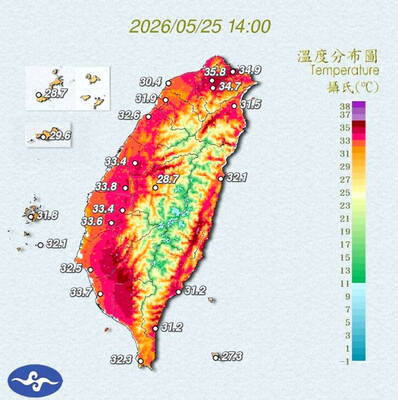
STAY COOL: The HPA recommended that people stay hydrated, use air-conditioning or fans while indoors, wear loose-fitting clothes and walk in the shade while outdoors Employers must implement measures such as installing cooling equipment, and providing drinking water and rest breaks for outdoor workers starting from Monday next week, the Taipei Department of Labor said on Sunday. Employers who fail to comply could face fines of NT$30,000 to NT$300,000 under the Occupational Safety and Health Act (職業安全衛生法), the department said. Businesses in Taipei employing fewer than 100 workers, as well as registered self-employed workers with labor insurance coverage, could receive on-site assessments and guidance from occupational safety consultants to help them apply for central government subsidies to implement or improve heat-protection measures, it said. Under the Ministry of

GLOBALGIVING: ‘ Caving to external pressure is not acceptable for an organization that has cultivated justice reform and human rights for 30 years,’ one NGO said A slew of non-government organizations (NGOs) have withdrawn from the GlobalGiving fundraising platform after it announced it would use “Chinese Taipei” instead of “Taiwan” from next month. The Taiwan Good Rice Association wrote on Facebook on Friday that it was informed on April 28 via a teleconference call of the change, which was made because the platform wanted to operate in China. Taiwan Good Rice is to terminate all cooperative relationships with GlobalGiving in response to the platform’s “unilateral and non-negotiable” decision to remove references to Taiwan, the NGO said. “Taiwan is in the official name of Taiwan Good Rice Association and the

Chinese Nationalist Party (KMT) Chairwoman Cheng Li-wun (鄭麗文) yesterday briefed her party’s Central Standing Committee regarding her scheduled visit to the US between Monday next week and June 16, saying that her purpose would be to persuade the US that the Republic of China (ROC) Constitution was a “one China” constitution that would foster stable and peaceful cross-strait relations. The ROC Constitution is the most important defense for all Taiwanese citizens, as it upholds our democracy and has contributed to our robust economy, which aligns with international and US interests, she said. “We would not be troublemakers and drag the US under,”


 RSS
RSS