


The Ministry of National Defense (MND) has proposed amendments to the Criminal Code of the Armed Forces (陸海空軍刑法) to stiffen punishment for active-duty service members who swear allegiance to China.
The move came after a high-profile espionage case, in which former army colonel Hsiang Te-en (向德恩) was accused of signing a document of surrender with the Chinese Communist Party (CCP), posing with the document in uniform and pledging assistance to the best of his abilities in the event of an invasion.
Hsiang, who was found guilty of accepting money in return for declaring his allegiance to China, was sentenced to seven years and ssix months in prison. His appeal was rejected by the Supreme Court in 2023.
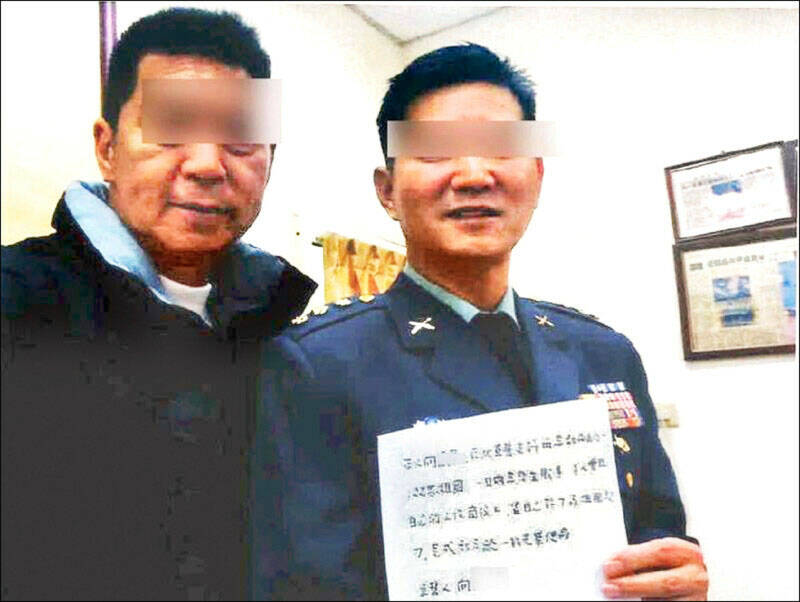
Photo: Copied by Huang Chia-lin, Taipei Times
In a report submitted to a legislative hearing, the MND said that the proposed amendments to Article 24 of the Criminal Code of the Armed Forces are intended to deter and punish such behavior, safeguarding national security and military interests.
The proposed amendments stipulate that active-duty military personnel who swear allegiance to an enemy, whether verbally or through other means, would face imprisonment of one to seven years.
Penalties for those who fail in their duties and defect to the enemy would be increased to three to 10 years, according to the draft.
The draft also introduces punishments for preparatory acts and conspiracy — aiming to strengthen legal provisions governing breaches of military loyalty and enhance deterrence against infiltration by hostile forces.
Under Article 138 of the Constitution and Article 5 of the National Defense Act (國防法), active-duty military personnel are obligated to fulfill their duties and ensure national security, the MND said.
The MND said that individuals recruited into hostile organizations might engage in espionage, leaks of classified information or other coordinated activities to achieve specific objectives, posing significant threats to national security and social stability.
The MND expressed support for proposed amendments to the National Security Act (國家安全法) to criminalize participation in organizations linked to foreign or external hostile forces.
The draft amendments say that military officers and non-commissioned officers convicted of offenses listed under Article 13-1 of the National Security Act during active service or reserve service would be ineligible for retirement benefits.
Those convicted after discharge would lose their entitlement and any benefits already received would be subject to recovery, the draft says.
The Ministry of Civil Service, in its report, said that for civil servants who violate their duties or loyalty obligations — such as by committing offenses listed under Article 13 of the act — it is reasonable to deprive them of their pension.
The Ministry of Justice, in its report, said that recent national security cases have involved active-duty personnel swearing allegiance to enemy forces, forswearing their duty to uphold national security and loyalty to the state.
There is a need for a more comprehensive legal framework and stricter regulations to address such conduct, as acts such as pledging allegiance to hostile forces via video recordings or signing non-resistance pledges could expose loopholes in the legal code, the MND said, adding the Executive Yuan has proposed amendments to the Criminal Code of the Armed Forces.

The Ministry of Finance this afternoon announced the winning numbers for the March-April uniform invoice lottery. The winning number for the NT$10 million (US$318,060) special prize is 19531471, and the winning number for the NT$2 million grand prize is 85941329. Three numbers were drawn for the NT$200,000 first prize: 07225810, 20231230 and 83518781. Those with receipts matching the last seven digits of any of the first-prize numbers will win the NT$40,000 second prize, while those matching the last six digits will win the NT$10,000 third prize. Those whose receipts match the last five digits of the first-prize numbers can claim the NT$4,000 fourth prize,

SIX SUBSIDIES: The monthly allowance for older farmers is to increase to NT$10,000, and NT$5,000 is to be given to homemakers under the national pension system, Lai said The government is to implement major welfare policies for disadvantaged groups, including raising the monthly allowance for older farmers to NT$10,000 and providing homemakers with NT$5,000 per month, President William Lai (賴清德) said yesterday. Lai made the remarks during a visit to Wangling Temple in Chiayi County, saying that the planned increases were being introduced amid economic growth and an increase in tax revenue. Touting a policy, in which the government plans to provide a monthly allowance of NT$5,000 for every child under the age of 18 in a bid to address Taiwan’s low birthrate, Lai said that if received for the
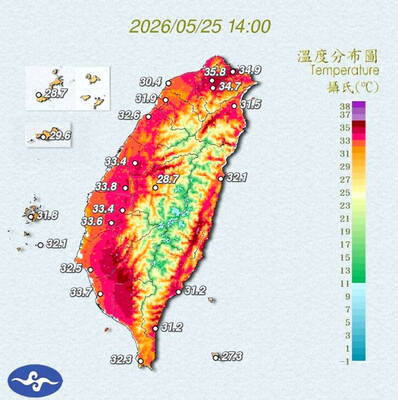
STAY COOL: The HPA recommended that people stay hydrated, use air-conditioning or fans while indoors, wear loose-fitting clothes and walk in the shade while outdoors Employers must implement measures such as installing cooling equipment, and providing drinking water and rest breaks for outdoor workers starting from Monday next week, the Taipei Department of Labor said on Sunday. Employers who fail to comply could face fines of NT$30,000 to NT$300,000 under the Occupational Safety and Health Act (職業安全衛生法), the department said. Businesses in Taipei employing fewer than 100 workers, as well as registered self-employed workers with labor insurance coverage, could receive on-site assessments and guidance from occupational safety consultants to help them apply for central government subsidies to implement or improve heat-protection measures, it said. Under the Ministry of

NATIONAL SECURITY: Authorities are working to confirm the identities of the military personnel involved and investigating possible illegal conduct and regulatory violations Authorities are probing possible national security implications after Kinmen police and immigration officers on Sunday found a Chinese woman allegedly posing as a tourist while engaging in prostitution involving more than 10 military personnel. The woman, surnamed Chen (陳), has since been deported, authorities said, adding that investigators are still working to confirm the identities of those implicated, as the records only listed code names and aliases. The case stemmed from a report received by the Kinmen District Prosecutors’ Office on Friday last week from the Jinhu Precinct of the Kinmen County Police Bureau. On Sunday, police, along with the National Immigration


 RSS
RSS