


Fall injuries have become the second-biggest cause of accidental deaths in Taiwan and about one in six people people aged 65 years or older has reported accidental falls, the Health Promotion Administration (HPA) said last week, as it offered tips to help elderly people prevent fall injuries.
According to the Ministry of Health and Welfare’s 2024 deaths statistics, fall injuries ranked second among the leading causes of accidental deaths.
The HPA added that its 2021 National Health Interview Survey found that on average one in six older people have reported accidental falls, with one in 12 seeking treatment for fall injuries.
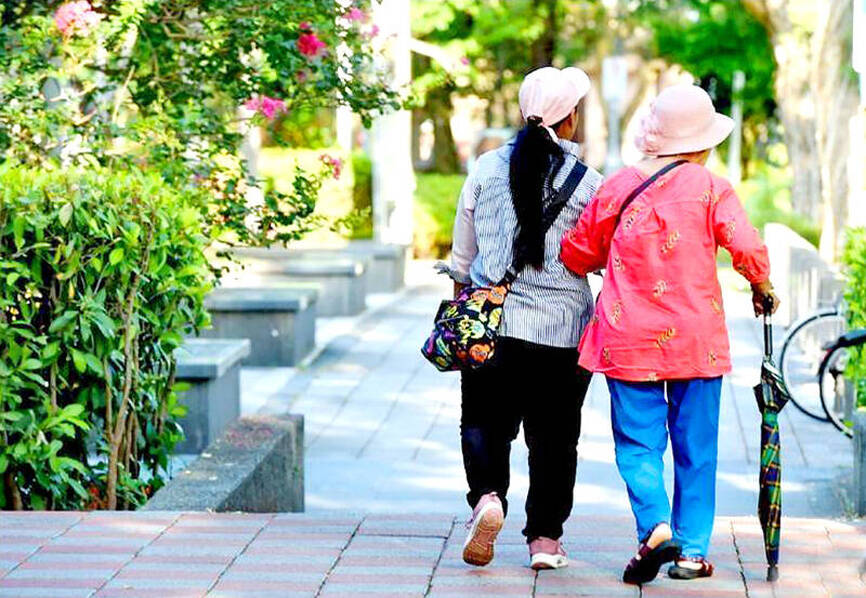
Photo: Taipei Times
Chou Yen-yu (周燕玉), an official at the HPA’s Aging and Chronic Disease Control Division, said the causes of falls in older people can be categorized into internal factors and external environmental factors.
The internal factors include mainly age-related muscle loss, which can cause decreased walking pace, difficulty rising from a seated position or going up and down stairs, she said.
It can be further complicated by vision and hearing impairment, ill-fitting glasses, or dizziness and blood pressure fluctuations due to taking multiple medications for chronic conditions, Chou said.
External environmental factors could be things such as suddenly waking up at night and going to the restroom in insufficient lighting, slippery bathroom floors or a lack of bedside railings, she said.
Chou said people might become depressed after a fall injury or reduce their physical activity due to pain or fear of falling again, which could accelerate muscle loss as well as cause more burden on family members or caregivers as they grow more dependent on them for daily tasks.
The HPA offered five tips to help elderly people prevent fall injuries.
First, family members should “proactively ask and assess risks” — asking older family members if they have fallen or have difficulty walking lately.
Second, integrate exercises into daily routine to help maintain physical stability. Showing older family members simple and safe fall prevention exercises they can do at home, such as seated leg lifts on a sturdy chair, or heel raises or alternating one-leg balance while standing and holding a table or the wall, could enhance lower body strength and overall stability.
Third, check medications and physical health regularly. Taking several medications, such as sleeping pills, painkillers or psychotropic drugs at the same time could cause drowsiness or dizziness. People can consult with a doctor to recalibrate their medications.
Fourth, create a safe home environment. Keep hallways well-lit and clear of obstacles, install anti-slip tape and grab bars in the bathroom and properly organize clutter and electrical cords to reduce the risk of falls from slipping or tripping.
Finally, the HPA suggested “choosing proper footwear and mobility aids” — wear well-fitting, slip-resistant shoes with full coverage and if necessary, use mobility aids such as canes or walkers to improve walking safety.
HPA Director-General Shen Ching-fen (沈靜芬) recommended older people and their families visit the HPA official website’s fall prevention Web site.
They are encouraged to follow the HPA’s Line account (https://lin.ee/mYuv4LE) where they can assess six key domains of intrinsic capacity — cognitive, mobility, nutrition, visual, hearing and psychological capacities — and learn more fall prevention tips, she said.
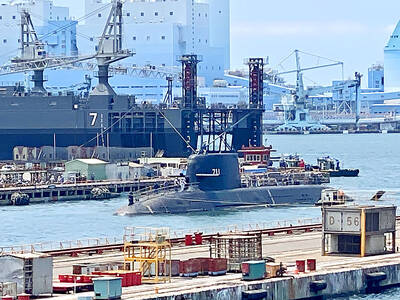
AGING: While Japan has 22 submarines, Taiwan only operates four, two of which were commissioned by the US in 1945 and 1946, and transferred to Taiwan in 1973 Taiwan would need at least 12 submarines to reach modern fleet capabilities, CSBC Corp, Taiwan chairman Chen Cheng-hung (陳政宏) said in an interview broadcast on Friday, citing a US assessment. CSBC is testing the nation’s first indigenous defense submarine, the Hai Kun (海鯤, Narwhal), which is scheduled to be delivered to the navy next month or in July. The Hai Kun has completed torpedo-firing tests and is scheduled to undergo overnight sea trials, Chen said on an SET TV military affairs program. Taiwan would require at least 12 submarines to establish a modern submarine force after assessing the nation’s operational environment and defense
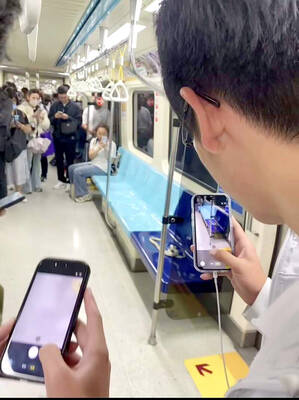
A white king snake that frightened passengers and caused a stir on a Taipei MRT train on Friday evening has been claimed by its owner, who would be fined, Taipei Rapid Transit Corp (TRTC) said yesterday. A person on Threads posted that he thought he was lucky to find an empty row of seats on Friday after boarding a train on the Bannan (Blue) Line, only to spot a white snake with black stripes after sitting down. Startled, he jumped up, he wrote, describing the encounter as “terrifying.” “Taipei’s rat control plan: Release snakes on the metro,” one person wrote in reply, referring
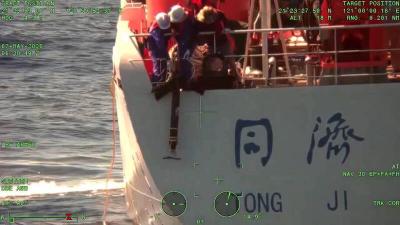
The coast guard today said that it had disrupted "illegal" operations by a Chinese research ship in waters close to the nation and driven it away, part of what Taipei sees a provocative pattern of China's stepped up maritime activities. The coast guard said that it on Thursday last week detected the Chinese ship Tongji (同濟號), which was commissioned only last year, 29 nautical miles (54km) southeast of the southern tip of Taiwan, although just outside restricted waters. The ship was observed lowering ropes into the water, suspected to be the deployment of scientific instruments for "illegal" survey operations, and the coast
Taiwan’s two cases of hantavirus so far this year are on par with previous years’ case numbers, and the government is coordinating rat extermination work, so there should not be any outbreaks, Centers for Disease Control (CDC) Director-General Philip Lo (羅一鈞) said today in an interview with the Liberty Times (the Taipei Times’ sister newspaper). An increase in rat sightings in Taipei and New Taipei City has raised concerns about the spread of hantavirus, as rats can carry the disease. In January, a man in his 70s who lived in Taipei’s Daan District (大安) tested positive posthumously for hantavirus, Taiwan’s


 RSS
RSS