


CSBC Corp, Taiwan, the main contractor for Taiwan’s first indigenous submarine, has pledged to promptly address issues in the vessel’s interior raised by an opposition lawmaker on Friday, but said that it did not expect ongoing tests to be affected.
In a statement later on Friday, CSBC categorized the issues raised by Chinese Nationalist Party (KMT) Legislator Ma Wen-chun (馬文君) as “cosmetic issues” and said they could be immediately rectified.
Ma raised questions on social media about the submarine, the Hai Kun (海鯤), or Narwhal, citing photos and footage of President William Lai’s (賴清德) visit onboard the docked vessel on Thursday released by the Presidential Office.
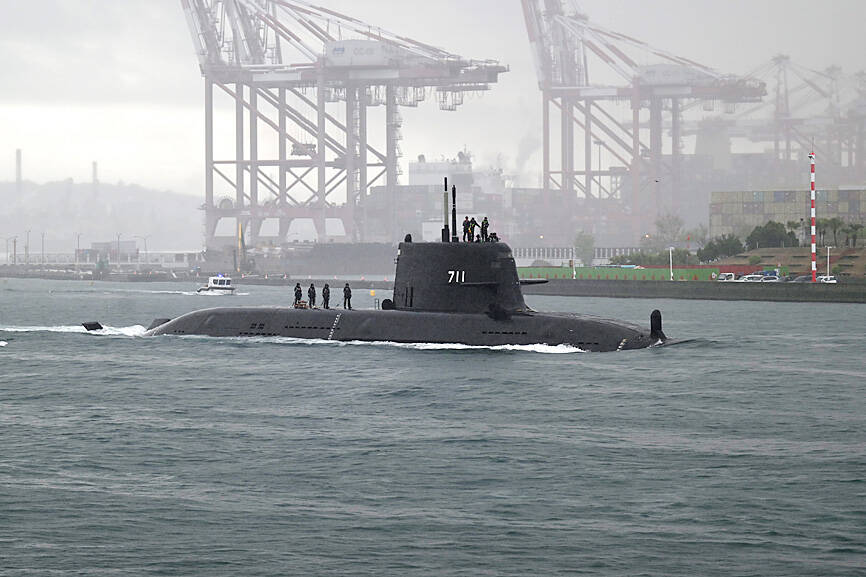
Photo: Lee Hui-chou, Taipei Times
Among the issues Ma pointed out were three missing rivets in a visibly uneven steel panel behind a meeting table and water stains on an exhaust duct casing.
Ma questioned whether the water stains had resulted from a leak.
She also cited a video showing that a bunk bed curtain appeared stuck when the president tried to open it, but said that was likely a minor issue.
In its statement, CSBC said the flaws stemmed from “incomplete restoration following work done,” likely meaning that the areas affected had work done, but were not restored to their previous condition.
Any repairs would not affect ongoing tests of the submarine, the shipbuilder said.
The company said it is contractually obligated to ensure the ship’s appearance and finish prior to delivery, and would recheck and correct any issues related to the vessel’s overall exterior and interior before delivery, after which the navy would conduct a final inspection.
The Narwhal has so far passed six shallow-water submersion tests, and further sea trials were proceeding step by step under the principles of safety and quality assurance, CSBC said.
Any indication of flaws in the submarine raises concerns given the delays the prototype vessel has faced.
Former indigenous submarine program convener Huang Shu-kuang (黃曙光) said in September 2023, when the submarine prototype was unveiled, that the submarine could be delivered to the navy before the end of 2024, but that did not happen.
A contractual deadline of November last year was also unmet, amid reports of technical issues, including components and parts failing due to voltage surges from an onshore power supply to which the ship was connected during testing last month.
CSBC last month said that it was working to deliver the submarine in June, but Minister of National Defense Wellington Koo (顧立雄) on Friday said his ministry would no longer set a timeline and would instead focus on ensuring that safety requirements are met.
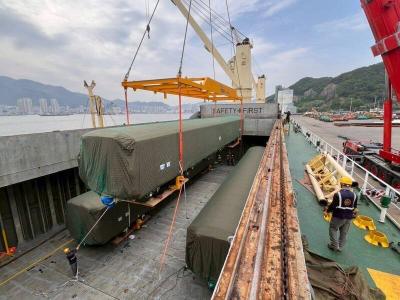
The first of 10 new high-capacity trains purchased from South Korea’s Hyundai Rotem arrived at the Port of Taipei yesterday to meet the demands of an expanding metro network, Taipei Rapid Transit Corp (TRTC) said yesterday. The train completed a three-day, 1,200km voyage from the Port of Masan in South Korea, the company said. Costing NT$590 million (US$18.79 million) each, the new six-carriage trains feature a redesigned interior based on "human-centric" transportation concepts, TRTC said. The design utilizes continuous longitudinal seating to widen the aisles and optimize passenger flow, while also upgrading passenger information displays and driving control systems for a more comfortable
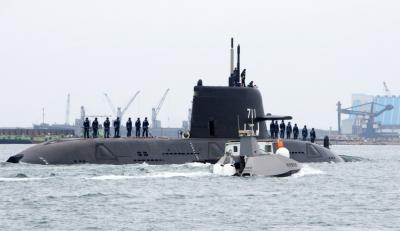
Taiwan's first indigenous defense submarine, the SS-711 Hai Kun (海鯤, or Narwhal), departed for its 13th sea trial at 7am today, marking its seventh submerged test, with delivery to the navy scheduled for July. The outing also marked its first sea deployment since President William Lai (賴清德) boarded the submarine for an inspection on March 19, drawing a crowd of military enthusiasts who gathered to show support. The submarine this morning departed port accompanied by CSBC Corp’s Endeavor Manta (奮進魔鬼魚號) uncrewed surface vessel and a navy M109 assault boat. Amid public interest in key milestones such as torpedo-launching operations and overnight submerged trials,
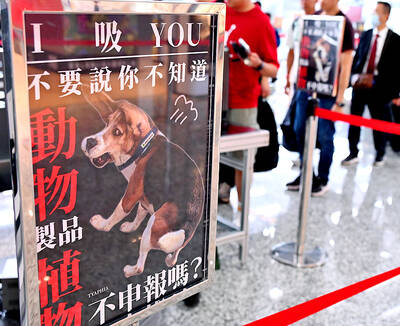
Quarantine awareness posters at Taiwan Taoyuan International Airport have gone viral for their use of wordplay. Issued by the airport branch of the Animal and Plant Health Inspection Agency, the posters feature sniffer dogs making a range of facial expressions, paired with advisory messages built around homophones. “We update the messages for holidays and campaign needs, periodically refreshing materials to attract people’s attention,” quarantine officials said. “The aim is to use the dogs’ appeal to draw focus to quarantine regulations.” A Japanese traveler visiting Taiwan has posted a photo on X of a poster showing a quarantine dog with a

Taiwan’s coffee community has launched a “one-person-one-e-mail” campaign, calling for people to send a protest-e-mail to the World Coffee Championships (WCC) urging it to redesignate Taiwanese competitors as from “Taiwan,” rather than “Chinese Taipei.” The call followed sudden action last week after the WCC changed all references to Taiwanese competitors from “Taiwan” to “Chinese Taipei,” including recent World Latte Art champion Bala (林紹興), who won the World Latte Art Championship in San Diego earlier this month. When Bala received the trophy, he was referred to as representing Taiwan, as well as in the announcement on the WCC’s Web site, until it


 RSS
RSS