

Canada aims to diversify its partnerships as the global landscape shifts rapidly and does not intend to choose sides between China and Taiwan, Vina Nadjibulla, vice president of research and strategy at the Asia Pacific Foundation of Canada, said yesterday.
Despite stalled progress on a proposed Taiwan-Canada trade cooperation deal, both sides should continue deepening ties in practical areas, Nadjibulla said in an interview in Taipei.
"I think whether that happens or not, that's a political decision and we'll wait to see what happens between the two governments," she said.
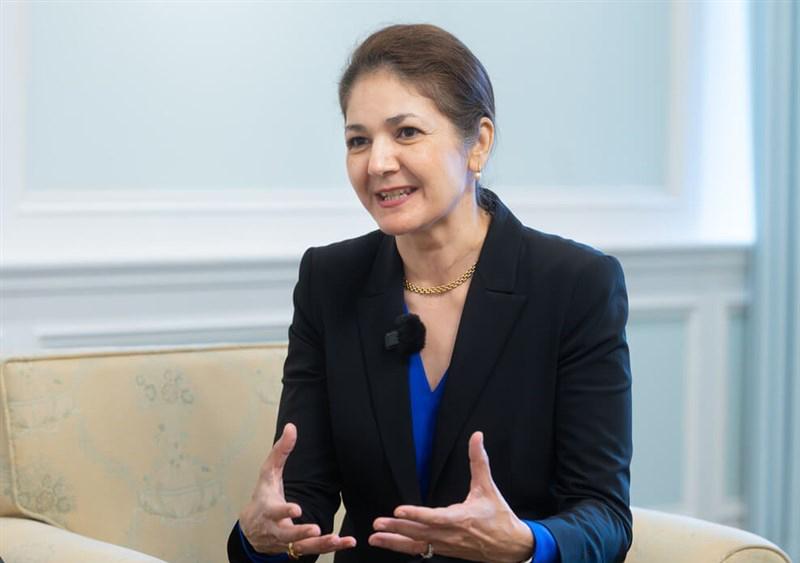
Photo: CNA
Taiwan and Canada concluded talks on a trade cooperation framework agreement in the first half of last year, but Ottawa has reportedly delayed its signing over concerns about its ties with Beijing.
Commenting on the matter, Nadjibulla said that cooperation could still be expanded in areas such as energy security, critical minerals and emerging technologies.
"There's already so much that can be happening," even without a formal deal, she added.
Businesses and civil society groups "can continue to do more together and that will actually create the enabling environment for that political decision to be made," Nadjibulla said.
On broader strategic positioning, she said that Canada is seeking to bolster its autonomy by diversifying partnerships rather than aligning with any single power.
"I think that is exactly what [Canadian] Prime Minister [Mark] Carney was saying, that countries that are not hegemonic, that are not [the US] or China, need to work together to be able to have as much agency, as much choice, as much autonomy as possible," she said.
Asked about ties with the US, Nadjibulla said that Canada is seeking to maintain constructive ties while reinforcing its own capabilities and partnerships with other countries.
The strategy includes investing in domestic strength and expanding global partnerships, rather than reacting to every policy shift in Washington, she said.
"So it's staying calm. It's focusing on what we can control, on deepening relationships and friendships around the world," Nadjibulla said.
At the same time, Canada remains "clear-eyed" in its approach to China, having experienced economic coercion and diplomatic tensions over the past few years, she said.
Only 5 percent of Canadian exports go to China, which is much lower than the share for Australia or Japan, she added.
Ottawa is seeking to stabilize ties with Beijing while maintaining "clear guardrails," including avoiding cooperation in sensitive areas such as artificial intelligence and defense, she said.
Nadjibulla highlighted the economic complementarity between Taiwan and Canada, saying that Taiwan can benefit from Canada's strengths in energy, resources and research, while Canada can tap Taiwan's manufacturing capabilities.
Diversifying energy supply sources could help Taiwan boost its resilience, particularly given geopolitical uncertainties, she said.
"With everything that's happening in the Middle East right now, you're also vulnerable because you're getting so much of your energy from a part of the world that's actually much more volatile," she added.
A total of 400 foreign “high- level” professionals have been naturalized as Republic of China (Taiwan) citizens over the past decade as the government has eased nationality rules to attract talent from a wider range of fields, the Ministry of the Interior said yesterday. The 400th high-level professional, who works in the electronics industry, was approved for ROC citizenship on Aug. 26, the MOI said. The MOI quoted the newly naturalized citizen as saying that Taiwan is a leader in fields such as semiconductors, electronics manufacturing, artificial intelligence development and energy technology. He also said
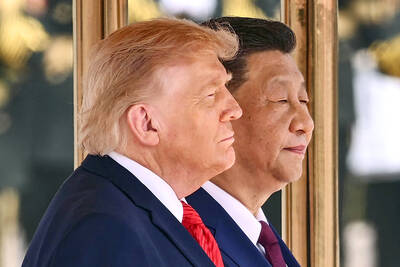
China has warned that it could cancel a planned US-China leaders’ summit if Washington approves new arms sales to Taiwan, a Japanese media outlet quoted sources as saying yesterday. US President Donald Trump, “apparently eager to showcase some diplomatic achievements ahead of November’s midterm congressional elections, places great importance on holding the summit with Chinese President Xi Jinping (習近平),” Japan’s Kyodo News reported. “While preparing for Xi’s upcoming trip, China has restated its position that the Taiwan issue is a ‘red line’ in bilateral relations,” the report said. The report said that when Xi met with Trump in Beijing in May, Xi said
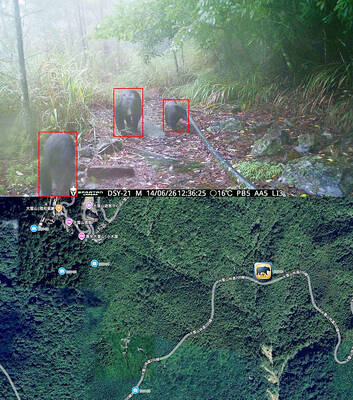
RARE PEEK: The footage released showed one of the bears staying in a cave for as long as 70 days, providing the first record of Formosan black bear’s overwintering The Forestry and Nature Conservation Agency yesterday released tracking records of released Formosan black bears for the first time, showing that they get much closer to human settlements than previously thought. The agency said it had captured two bears, Da Qu-ali (達古阿里) and Aziman (阿里曼), in indigenous villages in Hualien County and began to track them with a camera-mounted satellite collar after releasing them back into the wild. The results confirmed that the bears have moved from deep mountain areas into lowland hills closer to human communities, leading to an increase in human-bear conflicts, it said. The agency has introduced artificial intelligence-assisted early
DIPLOMATIC TOUR: Chinese President Xi Jinping began a series of overseas visits last month to Kyrgyzstan, Egypt and India, aimed at securing leverage, an official said Recent Chinese diplomatic and military moves are aimed at creating pressure ahead of a planned meeting between Chinese President Xi Jinping (習近平) and US President Donald Trump, National Security Council adviser Huang Chung-yen (黃重諺) said. Trump when visiting China in May extended an invitation to Xi to visit Washington on Sept. 24. China is yet to officially announce plans for Xi’s visit to the US. In an interview with the Liberty Times (sister paper of the Taipei Times) on Thursday, Huang said Xi’s overseas visits, China’s “gray zone” activities along the First Island Chain and efforts to expand its trade surplus with the


 RSS
RSS