


Kaohsiung Mayor Chen Chi-mai (陳其邁) yesterday promoted Kaohsiung's Smart Lighthouse Project on the sidelines of the Nvidia GTC conference in San Jose, California, highlighting its potential for partnerships with international tech firms.
As demand for computing power surges amid a shift toward generative artificial intelligence (AI) inference and "AI factory" development, the project is aimed at applying a "sovereign AI" approach to city governance, Chen told reporters at Nvidia GTC.
Sovereign AI refers to a country or region's ability to develop AI using its own infrastructure, data, workforce and industry networks.
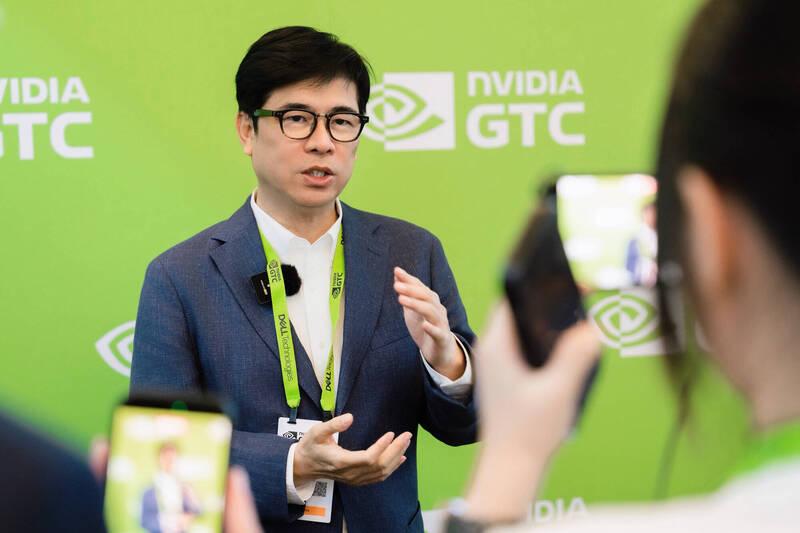
Photo courtesy of the Kaohsiung City Government
Under the initiative, Kaohsiung plans to work with Nvidia and Foxconn, also known as Hon Hai Precision Industry Co, to establish centers using Nvidia’s compute unified device architecture to support demand for computing power and for software development, Chen said.
The city has met with foreign entities such as Amazon Web Services and AT&T to explore ways to integrate telecom services with Nvidia's vision-language model training results to address urban challenges such as traffic, flood prevention and environmental monitoring, Chen said.
He said that Kaohsiung also hopes to work with Nvidia to develop what he described as the world's largest city-scale large language model with local features.
Chen also spoke with Foxconn chairman Young Liu (劉揚偉) during a keynote speech delivered by Nvidia CEO Jensen Huang (黃仁勳) and met with representatives from Taiwanese and US companies attending the event.
Chen is scheduled to meet academics at Stanford University to expand academic and technological exchanges after completing his visit to Nvidia GTC.
The event began yesterday and ends on Thursday.
Chen, who departed for the US on Wednesday last week, is scheduled to return to Taiwan on Friday.
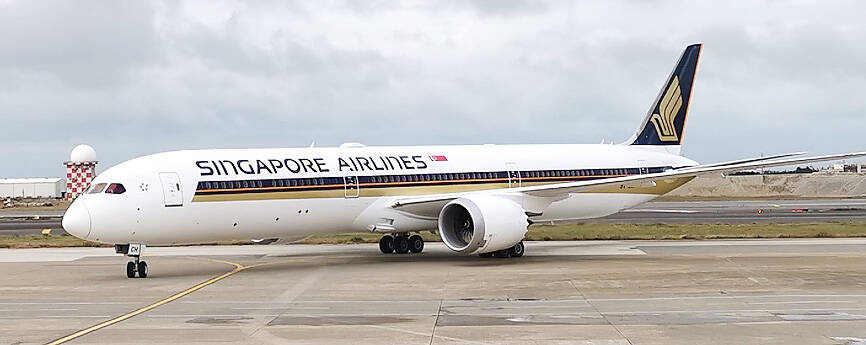
INCREASED CAPACITY: The flights on Mondays, Wednesdays, Fridays and Sundays would leave Singapore in the morning and Taipei in the afternoon Singapore Airlines is adding four supplementary flights to Taipei per week until May to meet increased tourist and business travel demand, the carrier said on Friday. The addition would raise the number of weekly flights it operates to Taipei to 18, Singapore Airlines Taiwan general manager Timothy Ouyang (歐陽漢源) said. The airline has recorded a steady rise in tourist and business travel to and from Taipei, and aims to provide more flexible travel arrangements for passengers, said Ouyang, who assumed the post in July last year. From now until Saturday next week, four additional flights would depart from Singapore on Monday, Wednesday, Friday

Taiwan’s three major international carriers are increasing booking fees, with EVA Airways having already increased the charge to US$28 per flight segment from US$25, while China Airlines (CAL) and Starlux Airlines are set to follow suit. Booking fees are charged by airlines through a global distribution system (GDS) and passed on to passengers. Carriers that apply the fees include CAL, EVA, Starlux and Tigerair Taiwan. A GDS is a computerized network operated by a company that connects airlines with travel agents and ticketing platforms, allowing reservations to be made and processed in real time. Major players include Amadeus, Sabre and Travelport. EVA Air began
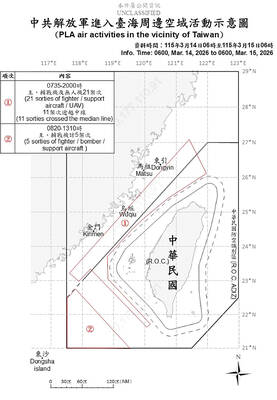
The Ministry of National Defense yesterday reported the return of large-scale Chinese air force activities after their unexplained absence for more than two weeks, which had prompted speculation regarding Beijing’s motives. China usually sends fighter jets, drones and other military aircraft around the nation on a daily basis. Interruptions to such routine are generally caused by bad weather. The Ministry of National Defense said it had detected 26 Chinese military aircraft in the Taiwan Strait over the previous 24 hours. It last reported that many aircraft on Feb. 25, when it spotted 30 aircraft, saying Beijing was carrying out another “joint combat
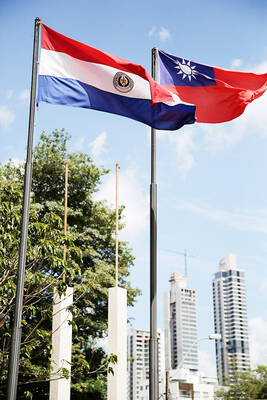
When Paraguayan opposition lawmaker Leidy Galeano returned from an all-expenses-paid tour of six Chinese cities late last year, she was convinced Paraguay risked missing out on major economic gains by sticking with longtime ally Taipei over Beijing — a message that participants on the trip heard repeatedly from Chinese officials. “Everything I saw there, I wanted for my country,” said Galeano, a member of the newly-formed Yo Creo party whose senior figures have spoken favorably about China. This trip and others like it — which people familiar with the visits said were at the invitation of the Chinese consulate in Sao Paulo


 RSS
RSS