


Minister of the Interior Liu Shyh-fang (劉世芳) was granted permission not to respond to questions from Taiwan People’s Party (TPP) Legislator Li Zhenxiu (李貞秀) during Li’s first legislative inquiry yesterday, as questions over her eligibility to serve continued to loom.
Although Li has held a Taiwanese ID card for more than 10 years and registered as a candidate for TPP’s legislators-at-large in 2023, the ministry’s records showed she did not complete the renunciation of Chinese citizenship until March last year and that she had dual citizenship when she registered as a candidate.
The rules of the Public Officials Election and Recall Act (公職人員選舉罷免法施行細則) require candidates to sign a declaration stating that they do not possess household registration in China, Chinese passport or nationality of any other country.
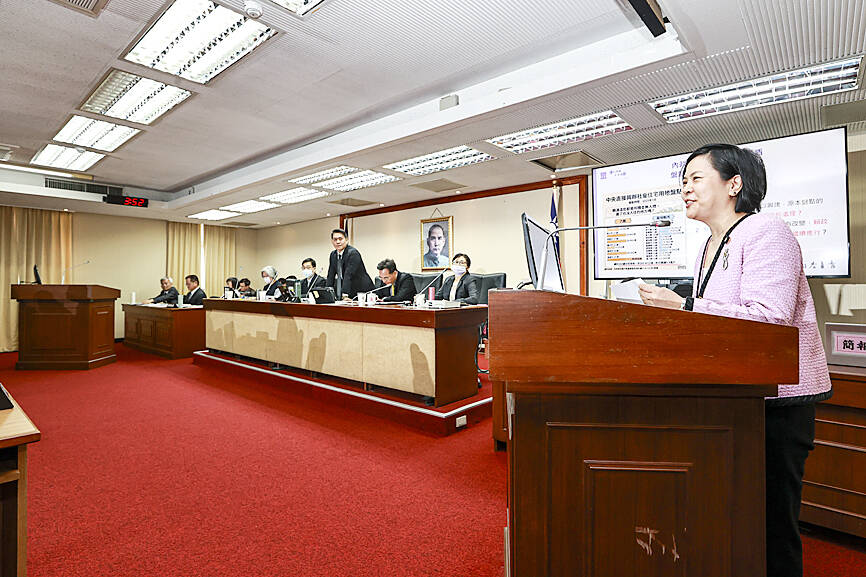
Photo: Wang Yi-sung, Taipei Times
Li was reported to have falsely claimed having only Taiwanese citizenship when she was sworn into office last month.
Legislative Speaker Han Kuo-yu (韓國瑜) ruled following a cross-caucus negotiation last week that Li’s status and authority as legislator should be respected until the issues have been settled through judicial proceedings.
Li repeatedly attempted to put Liu on the stand during the Legislature’s Internal Administration Committee meeting yesterday, her first inquiry after becoming a Taiwanese legislator.
However, Democratic Progressive Party (DPP) Legislator Lee Po-yi (李柏毅), who presided over the meeting, said Li’s right to speak at the committee would be respected, but Executive Yuan officials were entitled to not respond to her questions or provide information she requested.
After the meeting, Li accused Liu of humiliating her and Taiwan’s democracy for addressing her as “Mrs.” rather than a legislator. She said the meeting’s conveners should be neutral in the matter regarding her qualifications.
“The legislature is the highest institution that represents the people and the Executive Yuan cannot unilaterally decide, without any legal basis, to deprive a legislator of the right to question government officials simply because of their political affiliation,” Li told reporters.
Liu said during the meeting that Li should say if she is still Chinese, as the ministry has yet to receive documents proving that she had filed an application to renounce her citizenship before she was sworn into office.
“The agencies overseen by the Ministry of the Interior, including the National Police Agency, National Land Management Agency, National Fire Agency have classified documents. As civil servants must be loyal to the country and abide by national security laws, I am afraid we cannot do as she requests,” Liu said, adding that Li might even face criminal charges if she falsely claimed not to possess Chinese citizenship.
The Mainland Affairs Council said Article 21 of the Act Governing Relations Between the People of the Taiwan Area and the Mainland Area (臺灣地區與大陸地區人民關係條例) allows Chinese nationals to run for and hold public office in Taiwan after having a registered household in Taiwan for 10 years, with the 10-year period beginning after they complete naturalization procedures, including obtaining Taiwanese citizenship and submitting proof of renunciation of Chinese citizenship within the time period.
The National Immigration Agency (NIA) has only received a document issued by the public security bureau in China’s Hunan Province in March last year, saying Li had canceled her household registration in China following her marriage in Taiwan in 1993.
The cross-strait laws back then required Chinese nationals to cancel Chinese household registration after obtaining Taiwanese citizenship, which Li did in 1999.
Li was unlikely to have canceled her Chinese household registration before securing Taiwanese citizenship in 1999, the council said.
Following an amendment to Article 9 of the cross-strait act in 2004, Chinese nationals were given six months to submit proof of canceling their Chinese household registration after the amendment was implemented. The time period was later shortened to three months.
The NIA has never received such proof, the council said.
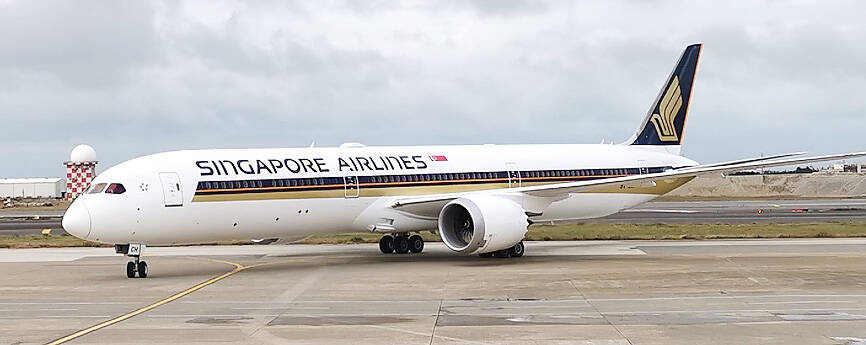
INCREASED CAPACITY: The flights on Mondays, Wednesdays, Fridays and Sundays would leave Singapore in the morning and Taipei in the afternoon Singapore Airlines is adding four supplementary flights to Taipei per week until May to meet increased tourist and business travel demand, the carrier said on Friday. The addition would raise the number of weekly flights it operates to Taipei to 18, Singapore Airlines Taiwan general manager Timothy Ouyang (歐陽漢源) said. The airline has recorded a steady rise in tourist and business travel to and from Taipei, and aims to provide more flexible travel arrangements for passengers, said Ouyang, who assumed the post in July last year. From now until Saturday next week, four additional flights would depart from Singapore on Monday, Wednesday, Friday

Taiwan’s three major international carriers are increasing booking fees, with EVA Airways having already increased the charge to US$28 per flight segment from US$25, while China Airlines (CAL) and Starlux Airlines are set to follow suit. Booking fees are charged by airlines through a global distribution system (GDS) and passed on to passengers. Carriers that apply the fees include CAL, EVA, Starlux and Tigerair Taiwan. A GDS is a computerized network operated by a company that connects airlines with travel agents and ticketing platforms, allowing reservations to be made and processed in real time. Major players include Amadeus, Sabre and Travelport. EVA Air began
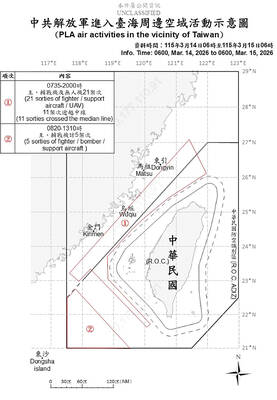
The Ministry of National Defense yesterday reported the return of large-scale Chinese air force activities after their unexplained absence for more than two weeks, which had prompted speculation regarding Beijing’s motives. China usually sends fighter jets, drones and other military aircraft around the nation on a daily basis. Interruptions to such routine are generally caused by bad weather. The Ministry of National Defense said it had detected 26 Chinese military aircraft in the Taiwan Strait over the previous 24 hours. It last reported that many aircraft on Feb. 25, when it spotted 30 aircraft, saying Beijing was carrying out another “joint combat

WATCH FOR HITCHHIKERS: The CDC warned those returning home from Japan to be alert for any contagious diseases that might have come back with them People who have returned from Japan following the World Baseball Classic (WBC) games during the weekend are recommended to watch for symptoms of infectious gastroenteritis, flu and measles for two weeks, the Centers for Disease Control (CDC) said. Flu viruses remain the most common respiratory pathogen in Taiwan in the past four weeks and the influenza B virus accounted for 55.7 percent of the tested cases, exceeding the percentage of influenza A (H3N2) infections and becoming the local dominant strain, CDC Epidemic Intelligence Center Deputy Director Lee Chia-lin (李佳琳) said at a news conference on Tuesday. There were 82,187 hospital visits for


 RSS
RSS