


Businesses across Lienchiang County (Matsu), which has one of Taiwan’s lowest unemployment rates, are struggling to recruit workers as a shrinking labor pool and aging workforce leave key industries short of staff.
The shortage has hit sectors ranging from hospitality and retail to construction and childcare, raising concerns that it could affect residents’ daily lives and the tourism-driven economy of the outlying islands.
A 2024 human resources survey by the Lienchiang County Government showed that the unemployment rate was just 0.1 percent, much lower than the 3.38 percent rate for all of Taiwan.
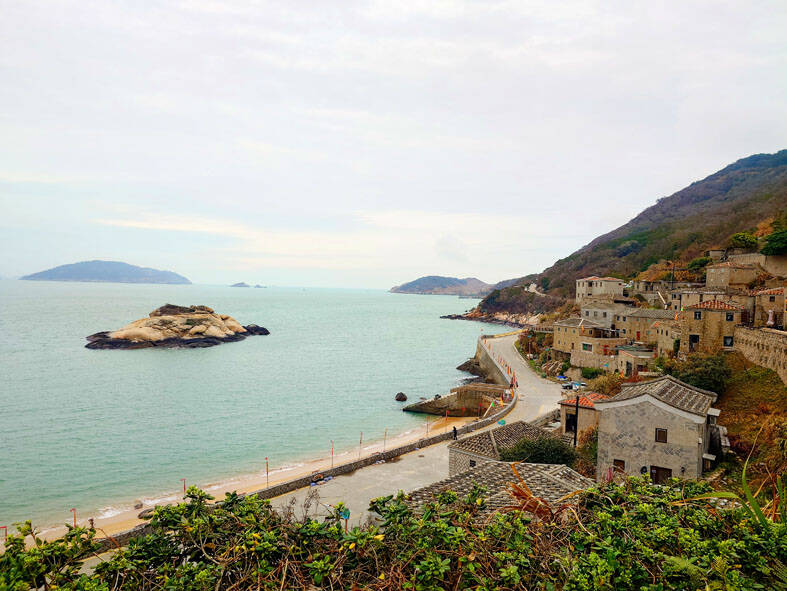
Photo: CNA
Meanwhile, 56.94 percent of Matsu’s workforce is employed by government agencies, while only 22.09 percent work in the private sector, further limiting the labor pool available to businesses.
A guesthouse owner in Nangan Township (南竿), surnamed Chang (張), said she has offered a starting monthly salary of NT$38,000 for full-time staff, but still cannot find suitable employees.
“People online often joke that if employers offer ‘bananas,’ they can only hire ‘monkeys,’” Chang said. “However, in Matsu, even when wages are 1.2 to 1.5 times higher than in Taiwan proper, it is still hard to find the right person.”
Labor shortages have also slowed construction, a contractor overseeing public works projects in Juguang Township (莒光) said.
The company offers wages starting at NT$3,000 per day, with meals and accommodation for workers relocating from Taiwan proper, but few applicants are interested due to the limited transportation and resources on the islands of Matsu, he said.
Demographic trends have further tightened the labor supply.
Workers aged 45 to 64 made up 51.43 percent of the workforce, while those aged 25 to 44 accounted for 37.19 percent, the report said.
Young workers are particularly scarce, with people aged 15 to 24 making up just 2.96 percent of the labor force, the data showed.
Liu Yu-ting (劉羽庭), a director at a Matsu youth development association, said that many young people from the islands move to Taiwan proper for better opportunities.
Those who return often prefer starting their own business or entering public-sector jobs rather than frontline roles in retail or food service, Liu said.
Some employers have begun experimenting with new ways to recruit and retain workers.
Another guesthouse owner in Nangan, surnamed Chung (鍾), said she recruits short-term helpers through social media, offering accommodation and encouraging them to explore the islands during their stay.
She also shares meals with helpers and reduces working hours so they have time to experience life in Matsu, which she said improves job satisfaction and sometimes encourages them to stay longer.
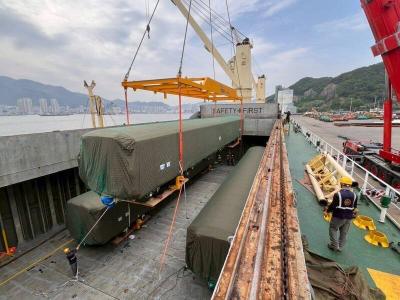
The first of 10 new high-capacity trains purchased from South Korea’s Hyundai Rotem arrived at the Port of Taipei yesterday to meet the demands of an expanding metro network, Taipei Rapid Transit Corp (TRTC) said yesterday. The train completed a three-day, 1,200km voyage from the Port of Masan in South Korea, the company said. Costing NT$590 million (US$18.79 million) each, the new six-carriage trains feature a redesigned interior based on "human-centric" transportation concepts, TRTC said. The design utilizes continuous longitudinal seating to widen the aisles and optimize passenger flow, while also upgrading passenger information displays and driving control systems for a more comfortable
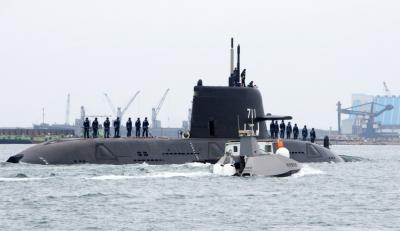
Taiwan's first indigenous defense submarine, the SS-711 Hai Kun (海鯤, or Narwhal), departed for its 13th sea trial at 7am today, marking its seventh submerged test, with delivery to the navy scheduled for July. The outing also marked its first sea deployment since President William Lai (賴清德) boarded the submarine for an inspection on March 19, drawing a crowd of military enthusiasts who gathered to show support. The submarine this morning departed port accompanied by CSBC Corp’s Endeavor Manta (奮進魔鬼魚號) uncrewed surface vessel and a navy M109 assault boat. Amid public interest in key milestones such as torpedo-launching operations and overnight submerged trials,
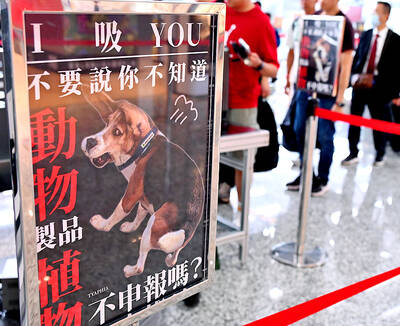
Quarantine awareness posters at Taiwan Taoyuan International Airport have gone viral for their use of wordplay. Issued by the airport branch of the Animal and Plant Health Inspection Agency, the posters feature sniffer dogs making a range of facial expressions, paired with advisory messages built around homophones. “We update the messages for holidays and campaign needs, periodically refreshing materials to attract people’s attention,” quarantine officials said. “The aim is to use the dogs’ appeal to draw focus to quarantine regulations.” A Japanese traveler visiting Taiwan has posted a photo on X of a poster showing a quarantine dog with a

Taiwan’s coffee community has launched a “one-person-one-e-mail” campaign, calling for people to send a protest-e-mail to the World Coffee Championships (WCC) urging it to redesignate Taiwanese competitors as from “Taiwan,” rather than “Chinese Taipei.” The call followed sudden action last week after the WCC changed all references to Taiwanese competitors from “Taiwan” to “Chinese Taipei,” including recent World Latte Art champion Bala (林紹興), who won the World Latte Art Championship in San Diego earlier this month. When Bala received the trophy, he was referred to as representing Taiwan, as well as in the announcement on the WCC’s Web site, until it


 RSS
RSS